The Iron Skeleton of Heat Transfer: Why Mechanical Design Matters More Than You Think
11 min
- TEMA: The Specialist
- ASME: The Law
- FAQ
When we talk about heat exchangers—those massive industrial organs responsible for transferring energy in power plants, refineries, and chemical facilities—the conversation almost always gravitates toward thermal performance. Engineers ask: "How fast can this cool down?" or "How many megajoules can we recover per hour?" Efficiency charts get drawn, heat transfer coefficients get debated, and everyone goes home feeling productive.
But there is a darker, more critical side to engineering these machines. While thermal design determines how well a unit works, mechanical design determines whether it survives.
A heat exchanger is, at its core, a pressurized vessel waiting for a weakness to exploit. It contains volatile fluids at extreme temperatures and crushing pressures, operating not for hours, but for decades. Mechanical design is the discipline that transforms thermal requirements into physical reality—ensuring that these industrial giants don't just perform, but endure.
The Core Mission: Safety in a Pressure Cooker
Imagine a pressure cooker the size of a school bus, operating continuously for 20 years, enduring earthquakes, hurricane-force winds, and internal fluids that might be corrosive, flammable, or outright explosive. That is the challenge of mechanical design.
The objectives form a "Holy Trinity" of engineering:
Safety & Compliance is the absolute priority. A leak or explosion isn't just an operational hiccup; it's a threat to human life, and potentially a mile-wide exclusion zone. Every decision flows from this foundation.
Durability means surviving the invisible enemies: corrosion quietly eating the metal from within, erosion wearing it down where fluid velocity is highest, and thermal cycling—the relentless expansion and contraction that works like bending a paperclip back and forth until it snaps.
Maintainability is the design consideration most often neglected—and most bitterly regretted. If you can't open a unit to clean it, inspect it, or replace a gasket, it becomes a liability rather than an asset. Good mechanical design accounts for the humans who will wrestle with the machine years down the line, often at 2 a.m. during an unplanned shutdown.
The Rulebook: Design Isn't a Free-for-All
You cannot sketch a heat exchanger on a napkin and build it. The industry is governed by rigorous international codes—the unwritten constitution of mechanical engineering, made very much written.
TEMA: The Specialist
The Tubular Exchanger Manufacturers Association (TEMA) sets the specific rules for shell-and-tube exchangers. They classify equipment based on the severity of the service:
Class R (Refinery): The heavyweights. Built for the harsh, punishing environments of oil processing, where a failure can cascade into catastrophe.
Class C (Commercial): The reliable workhorses of general industry—cost-effective and proven.
Class B (Chemical): Specialized units, often requiring exotic materials like Hastelloy or titanium for specific chemical duties.
ASME: The Law
The ASME Boiler and Pressure Vessel Code (Section VIII) is the global heavyweight champion of safety standards. It dictates the mathematics behind wall thickness and weld quality.
Division 1 uses "Design-by-Rule"—conservative, time-tested formulas that result in thicker, inherently safer walls. Division 2 allows "Design-by-Analysis"—using advanced computer simulations to optimize every gram of material, yielding lighter, more precise designs for engineers willing to prove their case with numbers. Think of Division 1 as the cautious general and Division 2 as the brilliant tactician who needs to justify every move.
The Workflow: From Concept to Steel
How does an engineer move from a spreadsheet full of process data to a fabrication drawing? It is a sequential logic gate, where each step informs the next and a mistake early on compounds painfully later.
Define the Inputs. We don't design for the normal operating pressure alone—we design for Design Pressure, typically set 10–15% higher than the maximum operating condition, plus a buffer for upset scenarios. We also add a Corrosion Allowance: literally specifying extra millimeters of steel whose sole purpose is to be sacrificed to rust over the vessel's 20-year life.
Identify All Loads. Internal pressure is only the beginning. What if an earthquake strikes? What about the weight of massive connecting pipework bearing down on the nozzles? What about wind loads on a tall vertical vessel, or the thermal shock of a cold fluid charge into a hot shell? Each load must be identified, quantified, and designed against.
Select Materials. The metal must match the fluid. Carbon steel is cheap and abundant, but seawater demands titanium. Hydrogen service requires steels with tightly controlled chemistry to prevent embrittlement. Getting this wrong doesn't cause immediate failure—it causes slow, invisible degradation that manifests years later, at the worst possible moment.
Calculate Thickness. Using code formulas, engineers determine exactly how thick the shell, heads, and nozzles must be to keep stress below the material's Allowable Limit—the ceiling beyond which permanent deformation begins.
Verify the Welds. Welds are assigned a Joint Efficiency factor. If every inch of a weld is X-rayed (full radiography), the code trusts it more, allowing slightly thinner walls. Skip the X-ray, and the code penalizes you with a heavier vessel. It's a direct, elegant trade-off between inspection cost and material cost.
Stress: The Invisible Enemy
Not all stress is created equal, and the distinction is what separates a competent mechanical engineer from a dangerous one.
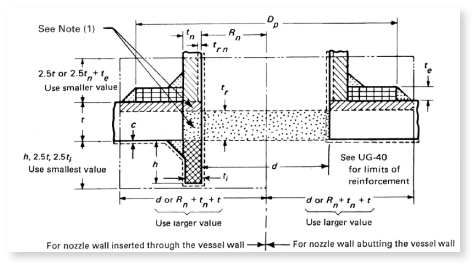
Primary Membrane Stress is the average stretching of metal due to pressure—the "balloon effect." It is dangerous and non-self-limiting. If it exceeds the material's yield strength, the vessel doesn't spring back; it bulges and eventually ruptures. We guard against it with safety factors of 3.5 or higher.
Primary Bending Stress acts like bending a ruler. It causes distortion and is allowed slightly higher limits than membrane stress, but it remains strictly controlled, particularly at nozzle connections and support saddles.
Secondary Stress arises when metal wants to expand due to heat but is physically restrained by the surrounding structure. Crucially, this type is self-limiting: once the metal yields slightly and redistributes the load, the stress is relieved. The code is correspondingly more generous here, recognizing that a little local yielding is not a catastrophe.
Peak Stress is the most insidious category. It lives at sharp corners, weld toes, and abrupt geometric changes—invisible on a drawing, but intensely real in the metal. It won't cause immediate failure, but under thousands of pressure cycles and temperature swings, it seeds microscopic cracks that grow, millimeter by millimeter, until one day the vessel fails long before its design life expires. This is fatigue, and designing against it requires thinking about not just today's load, but every load the vessel will ever see.
The Tubesheet: The Swiss Cheese Paradox
The tubesheet is perhaps the most fascinating single component in a shell-and-tube exchanger. It is a thick metal plate drilled with hundreds—sometimes thousands—of holes to accept the tube ends. And therein lies its fundamental paradox.
To resist the pressure differential between the shell side and tube side, you need a massive, rigid plate. But to hold the tubes, you must drill away a substantial fraction of that material. This is the Ligament Efficiency problem: the more holes you drill, the weaker the plate becomes. Engineers must thread a needle between a plate stiff enough to resist bending and light enough to not be prohibitively expensive.
The problem deepens with thermal behavior. In a U-tube design, the tubes are bent into a hairpin shape and free to expand independently of the shell—an elegant mechanical solution that dramatically reduces thermal stress. In a fixed tubesheet design, the tubesheets are welded directly to the shell, creating a rigid assembly. When the shell and tubes experience different temperatures and try to expand at different rates, they fight each other like two stubborn people pulling on opposite ends of a rope, generating enormous structural loads that must be accounted for in every calculation.
Geometry Matters: Heads and Shells
The shell is a simple cylinder, but you need to cap the ends. The shape you choose is a battle between physics, economics, and the laws of geometry.
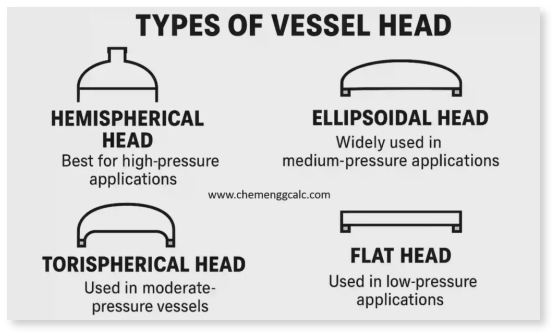
Hemispherical heads are the theoretical ideal. A sphere distributes pressure perfectly evenly across its surface, requiring walls only half as thick as a cylinder of the same diameter. The catch: forming a perfectly curved steel hemisphere is expensive and time-consuming, reserved for the most extreme pressures.
Ellipsoidal (2:1) heads are the industry's everyday workhorse—a smoothly curved shape that strikes an excellent balance between strength, internal volume, and fabrication cost. If you've seen the domed ends of a propane tank, you've seen this geometry.
Torispherical heads are cheaper still, but carry a hidden cost: a sharp "knuckle" radius where the dished portion meets the cylindrical flange. Stress concentrates at this knuckle, making torispherical heads unsuitable for high-pressure service. The savings at the fabrication shop can be paid back with interest in maintenance costs.
Flat covers are geometrically the weakest option—a flat plate resists pressure purely by bending, like a trapdoor holding back a flood. It must be made extraordinarily thick to survive any meaningful pressure. But their saving grace is access: unbolt a flat cover and the entire interior of the vessel is immediately accessible. For heat exchangers that require frequent cleaning or inspection, that convenience can be worth the weight penalty.
The Final Exam: Reality Checks
Before any design is released for fabrication, it must pass a series of unglamorous but essential "sanity checks" that no simulation can fully replicate.
Can it actually be built? Are the tolerances realistic, or will the assembly require millimeter-perfect alignment across a six-meter shell? Can the lifting lugs handle the full weight of the bundle during a maintenance pull? A beautiful design that cannot be manufactured or maintained is not a good design—it is an expensive problem deferred to someone else.
And finally, the Hydrotest. Before a heat exchanger ever sees a drop of process fluid, it is filled with water—a deliberately incompressible fluid that won't explosively release energy if something fails—and pressurized to 1.3 or 1.5 times its design limit. Every weld, flange, and fitting is observed under this elevated load. Water weeps from a pinhole. A flange face shows damp staining at a gasket improperly seated. The hydrotest catches what calculations might miss, and it has been the final guardian of mechanical integrity for well over a century.
Only when the metal holds, the flanges seal, and the welds remain bone dry does the mechanical designer's job truly end.
Mechanical design is ultimately the art of predicting the future—of foreseeing 20 years of pressure cycles, thermal shocks, corrosion, and seismic events, and building a vessel that greets those extremes as simply another day at the office. It is less glamorous than thermal optimization, rarely discussed at conferences, and almost never mentioned when a plant runs smoothly. It only enters the conversation when something goes wrong. Which is precisely why it must be done right the first time.

FAQ
Q1: What's the main difference between a regenerator and a recuperator?
A recuperator continuously transfers heat through a metal wall (like a car radiator), while a regenerator works in cycles—it stores heat in a solid matrix during one phase, then releases it during another. Think of it as a "thermal battery" that catches, holds, and releases heat precisely when needed, achieving 85-95% efficiency in extreme conditions.
Q2: Why can't regenerators be used in clean rooms or food processing?
Regenerators have an inherent contamination issue: the same matrix contacts both dirty exhaust and fresh intake air. This causes 1-5% carryover—residual gas from one stream mixing into the other. While acceptable for steel mills and glass furnaces, this cross-contamination is a dealbreaker for applications requiring strict purity, like hospitals or semiconductor fabrication.
Q3: Why is mechanical design as critical as thermal performance in heat exchangers?
A heat exchanger is essentially a pressurized vessel operating under extreme conditions for decades. While thermal design determines efficiency, mechanical design ensures survival. Engineers must account for internal pressure, corrosion, thermal expansion, earthquakes, and fatigue. Poor mechanical design doesn't just reduce performance—it can lead to catastrophic failure. That's why strict codes like ASME and TEMA govern every calculation, from wall thickness to weld quality.
Keep Learning
Induction Billet Heating: How to Achieve Uniform Heating
Induction billet heating prepares metal for forging, extrusion, or rolling by generating heat inside the workpiece. For steel billets, reaching the required exit temperature is only part of the task: the temperature distribution from surface to core and along the billet must also suit the forming process. Uniformity depends on how frequency, coil geometry, heat transfer, power distribution, and billet movement work together. This guide focuses on through-heating steel billets, particularly in progress......
How to Upgrade a 3D Printer Heated Bed with a Silicone Heater
If your 3D printer heated bed takes too long to reach temperature, develops uneven heating, or struggles to maintain a stable surface temperature, a silicone heater can be a practical upgrade. Faster warm-up and more uniform heat can improve first-layer consistency and reduce temperature-related printing issues. This guide explains how to identify when a heated-bed upgrade is needed, choose a suitable silicone heater, install it safely, and verify the results. Quick Answer A silicone heater can be a s......
How Graphene and MXene Flake Sensors Detect Force
Key Takeaways Flake networks sense force through microstructural change: Graphene and MXene coatings distribute conduction across overlapping platelets whose contacts shift under stretch or pressure, producing measurable resistance changes. Three mechanisms compete: Crack propagation, flake slippage, and quantum tunnelling each dominate at different deformation levels, giving many sensors multiple sensitivity regions rather than one uniform response. The substrate is an active partner: Elastomers, tex......
Conductive 2D Coatings Are a Matching Problem, Not a Miracle Ink
Key Takeaways Ink is a system, not a material: Conductivity depends on the combined effect of flake chemistry, solvent, additives, substrate, coating method, and post-processing—not on the 2D filler alone. Three carbon routes carry different trade-offs: GNPs demand dispersion engineering, GO shifts effort to a reduction step, and MXenes move the bottleneck to synthesis, storage, and oxidation control. Substrate geometry drives method selection: Spray and blade coating suit flat sheets; dip coating nat......
Graphene Heat Spreader Design: Layers and Interfaces
Key Takeaways Conductivity alone is not enough: A record thermal-conductivity value does not guarantee a cooler chip. Effective thickness, interface resistance, hot-spot geometry, and heat-sink connections all belong to the same thermal path. Few-layer graphene can outperform a single layer in practice: A few-layer sheet provides a larger heat-flow cross section and better tolerates transfer, embedding, and defects, even though its intrinsic conductivity is lower. Interface resistance is the bottlenec......
How Graphene Heat Spreaders Cool SOI Chip Hot Spots
Key Takeaways Buried oxide is a thermal bottleneck: SOI's insulating layer improves electrical isolation but traps heat near transistor channels, creating dangerous hot spots that package-level cooling alone cannot fix. Graphene enables lateral heat routing: Placing graphene or few-layer graphene beneath the buried oxide adds a high-conductivity sideways path, redistributing hot-spot energy toward dedicated sinks without removing any heat itself. Multi-source chips benefit most: Finite-element modelin......