The $10 Billion Blanket: Understanding the Silent Crisis in Industrial Heat Exchangers
13 min
- What is Fouling?
- The Physics of the Problem: A Double Blow
- The Economic Toll
- The Five Modes of Fouling
- The Lifecycle of a Deposit
- The Tug-of-War: How Engineers Model Fouling
- Engineering Solutions: Fighting the Buildup
- Conclusion
- FAQ
In the vast, complex machinery of modern industry—from power plants generating electricity to refineries processing fuel—there is a critical component that often goes unnoticed: the Heat Exchanger. These devices are the thermal lungs of the industrial world, transferring heat from one fluid to another to manage energy efficiency. Walk through any chemical plant or refinery, and you’ll find them everywhere: towering shell-and-tube units the size of school buses, compact plate exchangers stacked like metallic accordions, and spiral designs that look like industrial DNA helixes.
However, these massive machines face a persistent, microscopic enemy. It isn’t a mechanical breakdown or a software glitch, but a phenomenon known as Fouling.
What is Fouling?
In simple terms, fouling is the accumulation of unwanted material on heat transfer surfaces. Imagine boiling water in a kettle every day for a year; eventually, a crusty white layer of scale forms on the heating element. Now, scale that problem up to an industrial plant processing millions of gallons of river water or crude oil daily.
Unless the fluid involved is a pristine, laboratory-grade gas or liquid, some degree of fouling is inevitable. Even “clean” cooling water from rivers carries microscopic suspended clay particles, traces of dissolved minerals, and floating organic matter. In refineries, crude oil contains sulfur compounds, asphaltenes (heavy tar-like molecules), and metal contaminants that have been locked in underground reservoirs for millions of years. When these fluids rush through the intricate passages of a heat exchanger at temperatures ranging from near-freezing to several hundred degrees Celsius, chemistry happens—and not the kind engineers want.
Over time, these deposits act as an “insulating blanket” on the metal surfaces. While it might seem like a mere cleaning nuisance, fouling is a critical factor in plant safety, reliability, and economics. A fouled heat exchanger is like an athlete trying to compete while breathing through a straw—everything becomes harder, less efficient, and eventually unsustainable.
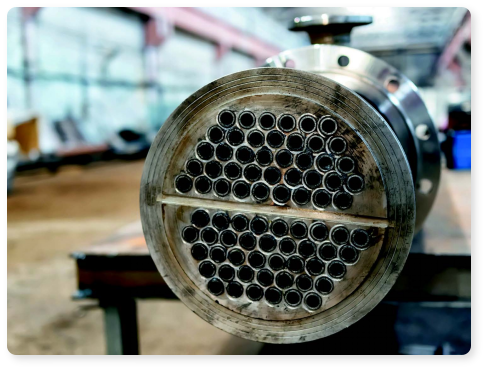
The Physics of the Problem: A Double Blow
Fouling degrades the “thermohydraulic” performance of a system, a technical way of saying it hurts the equipment in two distinct ways:
1. The Thermal Barrier (The Blanket)
The primary job of a heat exchanger is to move energy efficiently from one place to another. A thin stainless steel tube wall, perhaps just 2 millimeters thick, can transfer enormous amounts of heat because metal is an excellent conductor. However, fouling deposits—whether they are mud, rust, or biological slime—generally have thermal conductivities 100 to 1,000 times lower than the metal tubes they sit on.
This adds Thermal Resistance (R) to the system, like wrapping a radiator in bubble wrap.
Consequently, the Overall Heat Transfer Coefficient (U) drops. In severe cases, U can fall by 50% or more compared to a clean unit.
The Result: To achieve the same temperature goals, the system must burn more fuel or use more steam, directly increasing the carbon footprint and operational costs. For a large power plant, this can mean consuming an extra train car of coal per day—just to overcome dirt. Multiply that across thousands of industrial facilities worldwide, and the climate impact becomes staggering.
2. The Hydraulic Blockage (The Clog)
As deposits thicken, they constrict the physical space inside the tubes. This is analogous to plaque building up in human arteries—and the consequences can be just as dire.
The free cross-sectional area for fluid flow decreases, sometimes by 30% or more.
The surface becomes rougher, transforming from mirror-smooth metal to a landscape resembling sandpaper, creating tremendous friction.
The Result: The pressure drop (△P) across the unit skyrockets. Pumps and fans must work much harder to push fluids through the narrowed channels, consuming vast amounts of electrical power. A fouled cooling water system can force pumps to consume 200% of their design power, draining megawatts that could have powered entire neighborhoods. In severe cases, flow can become so restricted that it causes dangerous vibrations, leading to mechanical failure of the tubes—and in worst-case scenarios, catastrophic leaks of hazardous materials.
The Economic Toll
Fouling is not just an engineering headache; it is a massive financial drain. Estimates suggest that in the United States alone, fouling-related costs range between $4.2 billion and $10 billion annually. Globally, the number likely exceeds $20 billion. To put this in perspective, that’s roughly equivalent to building a new international space station every single year—except instead of exploring the cosmos, we’re just scrubbing crud off pipes.
The Hidden Costs of Dirt:
Capital Oversizing: Engineers often design heat exchangers 20% to 50% larger than theoretically necessary just to account for future dirt accumulation. This is like buying a mansion when you only need a cottage, simply because you know the basement will eventually flood. These oversized units cost more to manufacture, require more land area, need larger support structures, and consume more steel and exotic alloys.
Downtime: When a unit plugs up beyond operational limits, production must stop for cleaning. In high-value industries like petrochemicals, one day of downtime can represent millions of dollars in lost production—often far exceeding the cost of the repair itself. A major oil refinery losing just 24 hours of operation might sacrifice enough gasoline to fill 2,000 tanker trucks.
Energy Penalty: The extra fuel required to overcome the “insulating blanket” represents a significant waste of global energy resources. If we could eliminate just half of all heat exchanger fouling worldwide, the energy savings would rival the output of several large nuclear power plants—energy that could instead power cities or be left in the ground entirely.
The Five Modes of Fouling
Fouling is not a single phenomenon; it is a collection of mechanisms, each with its own personality and preferred hunting grounds. Understanding which “mode” is attacking the system is the first step toward prevention.
Particulate Fouling: The accumulation of suspended solids like silt, mud, or soot. This is common in systems using untreated river water, especially after storms upstream stir up sediment. Picture a filter screen that gets clogged with coffee grounds—except the “grounds” are clay particles finer than talcum powder, settling molecule by molecule onto every available surface.
Chemical Reaction Fouling: When the fluid itself chemically reacts near the hot surface to form a solid deposit. A classic example is “coking” in oil refining, where hydrocarbon molecules “bake” onto the tube walls at high temperatures, transforming from liquid petroleum into hard, carbon-rich crust resembling charcoal. This is essentially the industrial equivalent of burning food onto a pan—except the “pan” is a million-dollar heat exchanger.
Corrosion Fouling: The heat exchanger surface reacts with the fluid, creating corrosion products (like rust or iron oxide) that build up as a crust. Ironically, the corroded material doesn’t just disappear into the fluid—it often stays right where it formed, creating a porous, insulating layer that accelerates further degradation.
Crystallization (Scaling): Dissolved salts precipitate out of the liquid to form hard mineral deposits. The most famous culprit is Calcium Carbonate (CaCO), the same mineral that forms stalactites in caves. Interestingly, this often happens due to “inverse solubility”—some salts become less soluble as water gets hotter, causing them to crust rapidly onto the hottest surfaces. This counterintuitive behavior means that the places you most need heat transfer are exactly where scale loves to form. The result can be deposits as hard as concrete, requiring jackhammers or acid baths to remove.
Biological Fouling: The growth of living organisms. This ranges from microscopic bacterial slime (biofilm) to macroscopic invaders like barnacles, mussels, and algae, which can completely block flow passages. Coastal power plants that draw seawater for cooling wage constant warfare against marine life that views their heat exchangers as prime real estate. A single season without proper treatment can result in shellfish colonies inches thick, transforming sleek metal tubes into underwater reefs.
The Lifecycle of a Deposit
A fouling layer does not appear instantly; it evolves through a five-stage lifecycle, much like a slow-motion geological process happening in fast-forward:
Initiation: The “incubation” period. The surface is clean, and performance is stable. This grace period can last anywhere from hours to months, depending on fluid quality. During this phase, surface imperfections, microscopic scratches, and temperature gradients create nucleation sites—the equivalent of beachheads for the coming invasion.
Transport: Impurities are carried from the bulk fluid to the tube wall. This occurs through multiple mechanisms: turbulent eddies tumble particles toward the surface, thermal gradients create convection currents that drag dissolved species along invisible highways, and diffusion slowly shuffles molecules from high-concentration regions to low-concentration ones.
Attachment: The material sticks. Strong adhesion forces—van der Waals attractions, electrostatic charges, chemical bonds—overcome the sweeping force of the fluid flow. Once a few particles stick, they create rough patches that trap even more material, like seeds growing into a forest.
Removal: A competing process where the fluid shears off parts of the deposit. High-velocity flow can erode soft deposits, thermal cycling causes flaking, and occasionally large chunks break free in dramatic avalanches. This is the system’s natural self-cleaning mechanism—but it’s often too weak to prevent net accumulation.
Aging: The deposit hardens and matures. Soft slime may calcify into rock-hard scale through a process called “sintering,” where high temperatures fuse particles together. Fresh deposits that could be wiped away with a sponge transform into armor-like crusts requiring chemical dissolution or mechanical removal, making them incredibly difficult to remove later.
The Tug-of-War: How Engineers Model Fouling
To predict how a heat exchanger will behave over months or years of operation, engineers use mathematical models like the Kern-Seaton approach. They view fouling as a dynamic battle between two opposing forces: Deposition vs. Removal.
Ideally: As the fouling layer thickens, the flow channel narrows, causing the fluid velocity to speed up (conservation of mass requires the same flow rate to squeeze through a smaller area). This increased speed creates higher shear stress at the wall, which scrubs harder and removes more material—like water flowing faster over a riverbed washing away more sediment.
Asymptotic Behavior: Eventually, if the system is well-designed, the rate of removal catches up to the rate of deposition. The fouling level flattens out to a constant plateau (asymptote), reaching a steady-state “equilibrium dirt level.”
Designers aim for this plateau to occur at an acceptable thickness—say, 1-2 millimeters—where the unit can still meet performance requirements. If designed correctly, the heat exchanger can operate indefinitely at this “fouled but stable” state, requiring only periodic scheduled maintenance. However, if the fluid velocity is too low, or if the chemistry is particularly aggressive, deposition wins the war, and the unit plugs completely—a condition engineers call “runaway fouling.”
Engineering Solutions: Fighting the Buildup
We cannot eliminate fouling entirely—thermodynamics and chemistry won’t allow it—but we can mitigate it through smart design and vigilant operation. The best defense is a multi-layered strategy:
Keep it Moving: High fluid velocity is the best defense against fouling. Keeping liquids moving at over 2 meters per second (about walking speed) helps “scrub” the tubes and prevents particles from settling. Some advanced designs use velocities up to 3-4 m/s, though this increases pumping costs. It’s a delicate balance: too slow and deposits accumulate; too fast and you waste energy fighting friction.
Eliminate Dead Spots: Advanced baffle designs and flow distributors ensure there are no stagnant corners or recirculation zones where debris can hide and colonies can establish. Computational fluid dynamics (CFD) simulations now allow engineers to visualize flow patterns and eliminate these “dead zones” before the first weld is made.
Material Science: Using smooth, corrosion-resistant alloys (like Titanium, Duplex Stainless Steel, or specialized Nickel alloys) reduces the ability of particles to stick and prevents the heat exchanger from corroding itself into a fouling machine. Surface coatings and electropolishing can create near-mirror finishes that repel deposits.
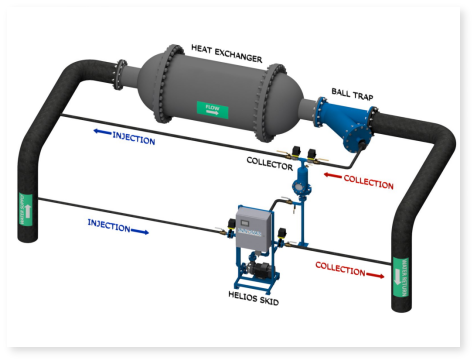
Active Cleaning: Some plants use ingenious sponge-ball cleaning systems, where small, slightly abrasive spongy balls (slightly larger than the tube diameter) are continuously circulated through the pipes to wipe them clean while the unit is running—imagine a Roomba for your heat exchanger. Other systems use automated brushes, acoustic vibration to shake deposits loose, or periodic “backflushing” where flow is temporarily reversed to blast out accumulated debris.
Water Treatment: For cooling water systems, chemical additives can prevent scale formation, disperse particles, and poison biofilm growth. It’s chemical warfare at the molecular level, carefully calibrated to protect equipment without creating environmental problems downstream.
Conclusion
Heat exchanger fouling is a complex interplay of chemistry, fluid dynamics, thermodynamics, and even biology. It transforms a pristine metal surface into a rough, insulated landscape that chokes efficiency and drains billions from the global economy. Yet it also represents a fascinating engineering challenge—a reminder that even the most carefully designed systems must contend with the messy, unpredictable behavior of real-world materials.
By understanding the specific mode of fouling attacking a system and designing equipment that balances deposition with removal, engineers turn what could be a chaotic emergency into a manageable maintenance task. The goal isn’t perfection—it’s resilience. And in achieving that resilience, we keep the world’s industry running cool, efficient, and sustainable, one clean tube at a time.

FAQ
Q: What exactly is heat exchanger fouling and why should we care?
A: Fouling is the buildup of unwanted material—like mineral scale, sludge, or biological growth—on heat transfer surfaces. It matters because it acts as an insulating blanket that forces industrial facilities to burn extra fuel and consume more electricity just to maintain the same output. Globally, fouling costs over $20 billion annually and wastes enough energy to power multiple large cities.
Q: How does fouling actually damage equipment performance?
A: Fouling hits systems with a double blow. First, deposits create a thermal barrier that blocks heat transfer, forcing plants to use more energy to reach target temperatures. Second, the buildup physically narrows flow passages like plaque in arteries, causing pressure drops that make pumps work 2-3 times harder. In severe cases, this can lead to dangerous vibrations and catastrophic equipment failure.
Q: Can fouling be prevented, or is it inevitable?
A: Fouling can't be completely eliminated, but it can be managed. Engineers use strategies like maintaining high fluid velocities to "scrub" surfaces clean, selecting corrosion-resistant materials, treating water with chemicals to prevent scale formation, and even deploying automated sponge-ball systems that continuously wipe tubes while the equipment runs. The goal is reaching a stable "equilibrium dirt level" where the system remains functional between scheduled cleanings.
Keep Learning
Induction Billet Heating: How to Achieve Uniform Heating
Induction billet heating prepares metal for forging, extrusion, or rolling by generating heat inside the workpiece. For steel billets, reaching the required exit temperature is only part of the task: the temperature distribution from surface to core and along the billet must also suit the forming process. Uniformity depends on how frequency, coil geometry, heat transfer, power distribution, and billet movement work together. This guide focuses on through-heating steel billets, particularly in progress......
How to Upgrade a 3D Printer Heated Bed with a Silicone Heater
If your 3D printer heated bed takes too long to reach temperature, develops uneven heating, or struggles to maintain a stable surface temperature, a silicone heater can be a practical upgrade. Faster warm-up and more uniform heat can improve first-layer consistency and reduce temperature-related printing issues. This guide explains how to identify when a heated-bed upgrade is needed, choose a suitable silicone heater, install it safely, and verify the results. Quick Answer A silicone heater can be a s......
How Graphene and MXene Flake Sensors Detect Force
Key Takeaways Flake networks sense force through microstructural change: Graphene and MXene coatings distribute conduction across overlapping platelets whose contacts shift under stretch or pressure, producing measurable resistance changes. Three mechanisms compete: Crack propagation, flake slippage, and quantum tunnelling each dominate at different deformation levels, giving many sensors multiple sensitivity regions rather than one uniform response. The substrate is an active partner: Elastomers, tex......
Conductive 2D Coatings Are a Matching Problem, Not a Miracle Ink
Key Takeaways Ink is a system, not a material: Conductivity depends on the combined effect of flake chemistry, solvent, additives, substrate, coating method, and post-processing—not on the 2D filler alone. Three carbon routes carry different trade-offs: GNPs demand dispersion engineering, GO shifts effort to a reduction step, and MXenes move the bottleneck to synthesis, storage, and oxidation control. Substrate geometry drives method selection: Spray and blade coating suit flat sheets; dip coating nat......
Graphene Heat Spreader Design: Layers and Interfaces
Key Takeaways Conductivity alone is not enough: A record thermal-conductivity value does not guarantee a cooler chip. Effective thickness, interface resistance, hot-spot geometry, and heat-sink connections all belong to the same thermal path. Few-layer graphene can outperform a single layer in practice: A few-layer sheet provides a larger heat-flow cross section and better tolerates transfer, embedding, and defects, even though its intrinsic conductivity is lower. Interface resistance is the bottlenec......
How Graphene Heat Spreaders Cool SOI Chip Hot Spots
Key Takeaways Buried oxide is a thermal bottleneck: SOI's insulating layer improves electrical isolation but traps heat near transistor channels, creating dangerous hot spots that package-level cooling alone cannot fix. Graphene enables lateral heat routing: Placing graphene or few-layer graphene beneath the buried oxide adds a high-conductivity sideways path, redistributing hot-spot energy toward dedicated sinks without removing any heat itself. Multi-source chips benefit most: Finite-element modelin......