Supercharging Thermal Energy: The Science of Heat Transfer Augmentation
10 min
- The Strategic Motivation: Why Augment?
- The Physics of Disruption: Breaking the Barrier
- The Toolbox: How We Enhance Flow
- The Engineer’s Dilemma: There Is No Free Lunch
- The Grimy Reality: Fouling
- Design Best Practices: The Art of Balance
- Final Thoughts
- FAQ
In the exacting world of thermal engineering, “good enough” is rarely acceptable. As global energy costs rise and industrial equipment shrinks, engineers face a persistent paradox: how do we move more heat with less metal and less energy?
Enter the domain of Heat Transfer Augmentation.
Also known as enhancement or intensification, this field represents the difference between a standard machine and a high-performance one. It is the science of disrupting fluid dynamics to gain a strategic advantage. Whether it is shrinking an aerospace component or boosting the efficiency of a power plant, augmentation is the key to doing more with less.
The Strategic Motivation: Why Augment?
Standard, smooth tubes are reliable, but they represent a compromise. They’re the vanilla ice cream of heat exchangers—functional, predictable, but ultimately leaving performance on the table.
By modifying heat transfer surfaces, engineers can effectively “supercharge” the exchange of thermal energy. According to the foundational work of Bergles and Webb, this is typically done to achieve one of three specific goals:
Size Reduction: Shrinking the physical footprint and weight of a heat exchanger while maintaining the same performance. This is critical in automotive and aerospace applications, where every kilogram matters. A Formula 1 car’s intercooler, for instance, must pack maximum cooling into a space barely larger than a shoebox.
Performance Boost: Increasing the heat load capacity of an existing unit without making it physically larger. Imagine a data center that needs to handle twice the server load in the same building—retrofitting enhanced surfaces can double cooling capacity without adding square footage.
Pumping Economy: Reducing the energy required to pump fluid through the system by balancing flow resistance against thermal efficiency. In large industrial facilities, pumping costs can represent millions of dollars annually. Even a 10% improvement translates to substantial savings.
The Physics of Disruption: Breaking the Barrier
To understand how augmentation works, we must look at what stops heat transfer in the first place: the Boundary Layer.
In a standard smooth tube, fluid often flows in a “laminar” state—smooth, orderly, and parallel, like cars on a highway maintaining steady lanes. While this looks elegant, it is thermally inefficient. A thin, stagnant film of fluid clings to the tube wall, acting like an insulating blanket that prevents the hot core fluid from touching the cool metal surface.
This is the thermal equivalent of trying to cool soup by gently waving your spoon above it. The heat is trapped in the middle, unable to reach the walls where it can escape.
Augmentation declares war on this boundary layer. By introducing roughness, fins, or twisted inserts, engineers “trip” the flow. This transitions the fluid from orderly laminar flow to chaotic turbulent flow.
Think of it as stirring a cup of coffee rather than letting the milk sit on top. The turbulence creates swirls and eddies that scrub the walls, mixing hot and cold fluid layers and drastically improving the heat transfer rate. Instead of a stagnant film, you get constant, vigorous mixing—fresh, cool fluid continuously replacing the heated layers at the surface.
The effect can be dramatic. A properly enhanced surface can improve heat transfer coefficients by 200-400%, turning a sluggish exchanger into a powerhouse.
The Toolbox: How We Enhance Flow
The industry categorizes enhancement methods into three distinct families, each with its own physics and applications:
1. Passive Techniques (The Most Common)
These require no external power. They rely entirely on geometric modifications to the surface or flow path to naturally promote mixing. They’re the “set it and forget it” solutions of thermal engineering.
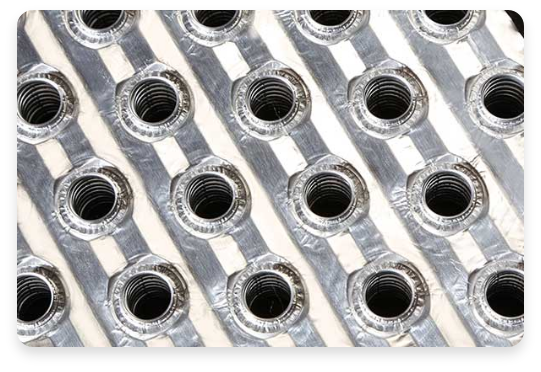
Extended Surfaces: Fins and micro-fins that increase surface area, like adding more fingers to a heatsink. Modern refrigerator evaporators use internal micro-grooves thinner than a human hair to enhance boiling performance.
Roughness: Sand-grain textures or corrugated tubes that disturb the boundary layer. Aircraft engine oil coolers often use precisely machined surface patterns that generate controlled turbulence.
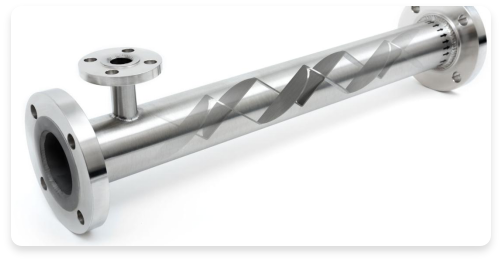
Swirl Devices: Twisted tape inserts that force the fluid into a helical path, similar to how a rifled gun barrel spins a bullet. The fluid spirals along the tube wall, constantly bringing fresh fluid into contact with the surface.
2. Active Techniques
These require external energy to stir the fluid physically—essentially using brute force to overcome thermal resistance.
Mechanical Aids: Rotating surfaces or scrapers, commonly used in food processing where thick, viscous products like chocolate or margarine must be cooled while preventing them from sticking to walls.
Vibration: Using ultrasound or surface pulsation to agitate the fluid. Some experimental nuclear reactor designs use acoustic vibration to prevent local hot spots from forming.
Electrohydrodynamics (EHD): Using electric fields to induce mixing—a technique that sounds like science fiction but is actually used in some specialized transformer cooling systems.
3. Compound Techniques
Using two or more methods simultaneously, such as a rough tube fitted with a twisted tape insert, to create a multiplier effect on efficiency. The synergy can produce results greater than the sum of individual enhancements, though at the cost of increased complexity.
The Engineer’s Dilemma: There Is No Free Lunch
If augmentation is so effective, why don’t we use it everywhere? The answer lies in the Pressure Drop.
In thermodynamics, the “tax” for enhanced heat transfer is friction. The same turbulence that mixes the fluid also resists its flow. An enhanced tube might increase heat transfer by 200%, but it could simultaneously increase the pressure drop—the force required to push the fluid—by 500%.
This is the fundamental trade-off that keeps thermal engineers awake at night.
If the system’s pump cannot handle this increased resistance (ΔP), the flow rate will drop, potentially canceling out any thermal benefits. It’s like trying to drink a thick milkshake through a narrow straw—technically possible, but exhausting and inefficient.
Engineers must calculate the Volume Goodness Factor to ensure the gain in heat transfer justifies the penalty in friction. Sometimes, the math reveals that the “enhancement” actually makes things worse overall. In power generation, for instance, pumping penalties can directly eat into electrical output, making an “improved” heat exchanger a net loser.
The Grimy Reality: Fouling
There is also a practical maintenance issue that often gets overlooked in academic papers but dominates real-world decisions. Complex surfaces are excellent at trapping heat, but they are also excellent at trapping sludge, scale, and biological growth.
A twisted tape insert or a micro-fin tube can become a nightmare to clean. In cooling towers and steam condensers, biological fouling—algae, bacteria, and barnacles—accumulates rapidly. What starts as a high-performance surface can quickly become a clogged mess, its enhanced geometry now working against you by providing more surface area for deposits to cling to.
If a device cannot be easily cleaned—by mechanical brushing or chemical circulation—its theoretical efficiency becomes useless. In the real world, a high-tech surface that clogs in a week is less valuable than a smooth tube that runs for a year. This is why many industrial facilities still use plain tubes despite the availability of superior technology: maintenance practicality trumps thermodynamic elegance.
Design Best Practices: The Art of Balance
Selecting the right augmentation is an art that balances thermal physics with mechanical reality. Here is how practical engineers approach the problem:
Identify the Bottleneck: Heat transfer is a team sport. If the “controlling resistance” is a thick, viscous oil on the outside of the tube, putting fins on the inside (where water flows easily) is a waste of money. You must enhance the side that is struggling. It’s the thermal equivalent of strengthening the weakest link in a chain—everything else is pointless if the bottleneck remains.
Check the Flow Regime: Twisted tapes function best in slow, laminar flow, while surface roughness shines in fast, turbulent flow. Using the wrong technique for your flow conditions is like putting racing slicks on a tractor—technically advanced, but fundamentally mismatched to the application.
Plan for Maintenance: If the fluid is dirty—cooling water from a river, for example—avoid complex internal fins. Use plain tubes that can be “rodded” out with mechanical cleaners. Some offshore oil platforms deliberately use smooth tubes in their heat exchangers, accepting lower thermal performance in exchange for reliable operation in harsh conditions.
Validate with Data: Theory is just a starting point. Real-world factors—like bypass leakage, uneven flow distribution, and manufacturing tolerances—can alter performance dramatically. Manufacturers should always rely on pilot trials (Wilson Plot tests) rather than generic textbook formulas. The history of heat exchanger design is littered with devices that worked beautifully on paper but failed miserably in practice.
Final Thoughts
Heat Transfer Augmentation is a powerful tool in the fight for energy efficiency. By understanding the physics of fluids and respecting the trade-offs of friction and fouling, engineers can design systems that are smaller, lighter, and vastly more efficient than their predecessors.
But perhaps the most important lesson is this: enhancement is not about using the most advanced technology—it’s about using the right technology for the specific application. Sometimes the best solution is a simple, smooth tube that will run reliably for decades. Other times, it’s a cutting-edge compound enhancement that pushes the boundaries of what’s possible.
In the high-stakes game of industrial thermodynamics, data beats theory every time. And understanding when not to enhance is just as valuable as knowing how to enhance.
FAQ
Q: What is heat transfer augmentation and why do engineers use it?
A: Heat transfer augmentation is the practice of modifying heat exchanger surfaces to improve thermal performance. Engineers use it to achieve three main goals: reducing equipment size and weight, increasing heat capacity without expanding physical footprint, or lowering pumping energy costs. It's essentially about doing more with less—moving more heat through smaller, more efficient equipment.
Q: If augmentation improves heat transfer so dramatically, why isn't it used everywhere?
A: The main trade-off is increased pressure drop. Enhanced surfaces create turbulence that improves heat transfer but also increases friction, requiring more pumping power. An enhancement might boost heat transfer by 200% but increase pressure drop by 500%, potentially negating the benefits. Additionally, complex surfaces are harder to clean and more prone to fouling from deposits, algae, or scale—making them impractical for many industrial applications where maintenance matters more than peak performance.
Q: What's the most important principle when selecting an augmentation technique?
A: Enhance the side with the controlling resistance—the bottleneck limiting heat transfer. If thick oil on the outside of a tube is the problem, adding fins to the inside where water flows easily accomplishes nothing. The key is matching the enhancement technique to your specific flow conditions, fluid properties, and maintenance capabilities rather than simply choosing the most advanced technology available.
Keep Learning
Induction Billet Heating: How to Achieve Uniform Heating
Induction billet heating prepares metal for forging, extrusion, or rolling by generating heat inside the workpiece. For steel billets, reaching the required exit temperature is only part of the task: the temperature distribution from surface to core and along the billet must also suit the forming process. Uniformity depends on how frequency, coil geometry, heat transfer, power distribution, and billet movement work together. This guide focuses on through-heating steel billets, particularly in progress......
How to Upgrade a 3D Printer Heated Bed with a Silicone Heater
If your 3D printer heated bed takes too long to reach temperature, develops uneven heating, or struggles to maintain a stable surface temperature, a silicone heater can be a practical upgrade. Faster warm-up and more uniform heat can improve first-layer consistency and reduce temperature-related printing issues. This guide explains how to identify when a heated-bed upgrade is needed, choose a suitable silicone heater, install it safely, and verify the results. Quick Answer A silicone heater can be a s......
How Graphene and MXene Flake Sensors Detect Force
Key Takeaways Flake networks sense force through microstructural change: Graphene and MXene coatings distribute conduction across overlapping platelets whose contacts shift under stretch or pressure, producing measurable resistance changes. Three mechanisms compete: Crack propagation, flake slippage, and quantum tunnelling each dominate at different deformation levels, giving many sensors multiple sensitivity regions rather than one uniform response. The substrate is an active partner: Elastomers, tex......
Conductive 2D Coatings Are a Matching Problem, Not a Miracle Ink
Key Takeaways Ink is a system, not a material: Conductivity depends on the combined effect of flake chemistry, solvent, additives, substrate, coating method, and post-processing—not on the 2D filler alone. Three carbon routes carry different trade-offs: GNPs demand dispersion engineering, GO shifts effort to a reduction step, and MXenes move the bottleneck to synthesis, storage, and oxidation control. Substrate geometry drives method selection: Spray and blade coating suit flat sheets; dip coating nat......
Graphene Heat Spreader Design: Layers and Interfaces
Key Takeaways Conductivity alone is not enough: A record thermal-conductivity value does not guarantee a cooler chip. Effective thickness, interface resistance, hot-spot geometry, and heat-sink connections all belong to the same thermal path. Few-layer graphene can outperform a single layer in practice: A few-layer sheet provides a larger heat-flow cross section and better tolerates transfer, embedding, and defects, even though its intrinsic conductivity is lower. Interface resistance is the bottlenec......
How Graphene Heat Spreaders Cool SOI Chip Hot Spots
Key Takeaways Buried oxide is a thermal bottleneck: SOI's insulating layer improves electrical isolation but traps heat near transistor channels, creating dangerous hot spots that package-level cooling alone cannot fix. Graphene enables lateral heat routing: Placing graphene or few-layer graphene beneath the buried oxide adds a high-conductivity sideways path, redistributing hot-spot energy toward dedicated sinks without removing any heat itself. Multi-source chips benefit most: Finite-element modelin......