The Silent Destroyer: Why Corrosion is More Than Just Rust
8 min
- The High Cost of Decay
- The Science: Nature’s Invisible Battery
- The Shield: Passivation
- The Rogues’ Gallery: How Corrosion Attacks
- The Achilles’ Heel: Welding
- Winning the War: Prevention and Control
- Conclusion
- FAQ
Picture a rusty patch on an old car bumper or a seized bolt in the garden shed. Easy to dismiss as a cosmetic nuisance. But step inside a chemical refinery, an offshore oil platform, or a nuclear power plant, and corrosion transforms from eyesore to existential threat. It is a relentless, multi-billion-dollar adversary that engineers wage a daily war against — one they can never fully win, only manage.
To an engineer, corrosion is the destructive deterioration of a material as it reacts with its environment. Put more poetically: it is nature’s slow, patient effort to reclaim what humans have refined. Every pipe we lay, every vessel we weld, every bridge we build is, thermodynamically speaking, already on its way back to ore. Understanding that journey — and how to slow it down — is one of the defining challenges of modern engineering.
The High Cost of Decay
Why does corrosion command so much attention? Because its consequences reach far beyond a flaky surface. The impact falls on three critical pillars:
• Safety: This is non-negotiable. A vessel wall that thins unnoticed can rupture without warning, releasing toxic chemicals or flammable gases. Industrial history is littered with catastrophic fires and environmental disasters that trace back to a corroded pipe nobody spotted in time.
• Reliability: Unexpected failures trigger unscheduled shutdowns. For a plant producing thousands of units per hour, even a few hours of downtime can translate into millions in lost revenue — to say nothing of the reputational cost of being seen as unreliable.
• Economics: The financial toll is staggering. Global estimates put the annual cost of corrosion in the trillions of dollars. Beyond replacing damaged parts, engineers must “overdesign” equipment from the start — adding extra wall thickness as a “corrosion allowance” — and sometimes specify expensive exotic alloys. Even a thin layer of rust on a heat exchanger surface acts as insulation, forcing pumps to work harder and burning more energy every single day.
The Science: Nature’s Invisible Battery
Here is the remarkable thing: corrosion is not chaos. It is elegantly predictable chemistry. At its core, a corroding piece of metal behaves exactly like a battery — one that nature assembles spontaneously wherever the conditions are right.
Four components must all be present at the same time for corrosion to proceed. Remove any one of them, and the process stops entirely. This insight is the foundation of all corrosion control:
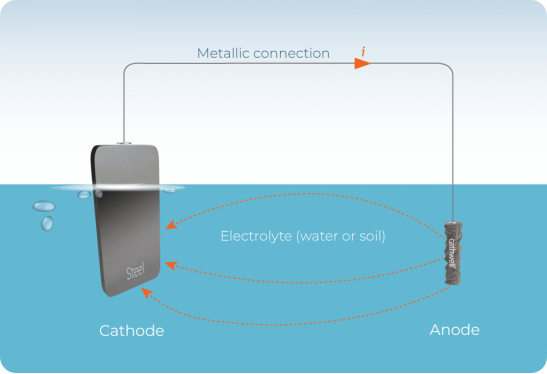
• The Anode: The region where metal atoms surrender electrons and dissolve into solution. This is where destruction actually occurs.
• The Cathode: The region that accepts those electrons. It doesn’t corrode itself, but it drives the reaction that destroys the anode.
• The Electrolyte: A conductive liquid — seawater, acidic condensate, even humid air — that allows ions to migrate between anode and cathode.
• The Metallic Path: A physical connection through which electrons travel from anode to cathode, completing the circuit.
The Shield: Passivation
If metal is so eager to corrode, why does a stainless steel kitchen sink stay gleaming for decades? The answer is passivation. Certain metals — stainless steel, aluminum, titanium — react almost instantly with atmospheric oxygen to form a microscopically thin, tightly bonded oxide layer on their surface. Think of it as the metal pulling on an invisible raincoat. As long as that coat stays intact, the environment never reaches the metal underneath. Break it — with a scratch, a chemical attack, or the wrong electrochemical conditions — and trouble begins.
The Rogues’ Gallery: How Corrosion Attacks
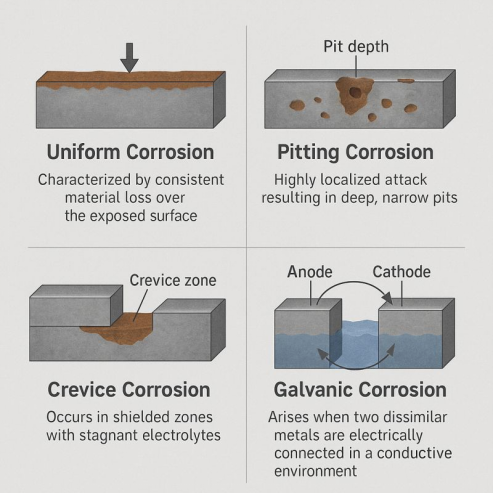
Corrosion is a shape-shifter. Knowing which form you are dealing with is half the battle, because each type demands a different detection and prevention strategy.
Uniform Corrosion is the familiar, even thinning of a metal surface — like a sugar cube dissolving in tea. It’s destructive but predictable, and engineers account for it simply by making metal thicker at the design stage.
Pitting and Crevice Corrosion are the most treacherous. Pitting punches deep, narrow holes through a surface that may otherwise look perfectly healthy. A single pit can perforate a pipe wall long before an inspection would flag anything unusual. Crevice corrosion hides in stagnant pockets — beneath gaskets, under bolt heads — where trapped liquid depletes oxygen and creates an intensely corrosive chemical environment, eating away unseen.
Galvanic Corrosion is the price paid for mixing metals. When a “noble” metal like stainless steel sits in electrical contact with an “active” metal like carbon steel in the presence of a liquid, the active metal becomes a willing sacrifice. A brass valve bolted to a steel pipe is a classic trap — the steel around the joint corrodes aggressively while the brass remains pristine.
Stress Corrosion Cracking (SCC) is perhaps the most insidious. It requires a deadly combination: tensile stress in the metal, a susceptible material, and a specific hostile environment. The result is not slow dissolution but sudden, brittle cracking — often with no visible warning. Stainless steel in chloride-rich environments (like coastal seawater) is a notorious victim.
Microbiologically Influenced Corrosion (MIC) reminds us that even biology is in on the act. Certain bacteria and algae colonize metal surfaces and secrete acids or sulfide compounds that create a highly corrosive microenvironment beneath a layer of slime. MIC is a growing concern in water systems, pipelines, and storage tanks where conditions allow biofilms to thrive.
The Achilles’ Heel: Welding
Welding is indispensable — it is how we join the pipes, vessels, and structural members that form our industrial infrastructure. But every weld introduces a vulnerability. The intense heat of welding creates a Heat-Affected Zone (HAZ) in the surrounding metal. In stainless steels, this heat drives chromium — the very element responsible for corrosion resistance — to combine with carbon and precipitate out of the alloy’s structure. The result is a band of metal flanking the weld that is chromium-depleted and far more vulnerable to attack. This process, called sensitization, can turn a weld from a point of strength into a line of weakness.
Winning the War: Prevention and Control
Because corrosion is electrochemistry, the strategy for fighting it is straightforward in principle: break the circuit. In practice, engineers draw on a layered arsenal of defences:
• Intelligent Design: The cheapest fix is the one made on paper. Eliminating crevices, ensuring tanks drain fully, and avoiding joints between dissimilar metals costs nothing at the design stage and prevents enormous problems later.
• Material Selection: Sometimes the environment simply demands a better suit of armour. Upgrading from carbon steel to duplex stainless steel, or from stainless to titanium, may look expensive on a spreadsheet but pay for themselves many times over across a plant’s lifetime.
• Coatings: Paint, epoxy linings, and thermal-spray coatings create a physical barrier that keeps the electrolyte from ever touching the metal. Their weakness is that they must be maintained; a holiday (pinhole) in a coating can actually accelerate localised corrosion underneath.
• Chemical Inhibitors: These are molecules added to the process fluid that adsorb onto the metal surface, reinforcing the passive film or blocking the electrochemical reactions that drive corrosion. They are widely used in oil and gas pipelines and cooling water systems.
• Cathodic Protection: This is electrochemical judo. By connecting a block of a more active metal — zinc or magnesium — to a structure, engineers force that sacrificial anode to corrode in place of the protected metal. Every ship’s hull, buried pipeline, and offshore platform leg relies on this principle. In impressed current systems, an external power supply takes the role of the sacrificial anode, allowing precise electrical control.
Conclusion
Corrosion is not a problem to be solved; it is a condition to be managed. Thermodynamics guarantees that metals will always seek to return to their lowest energy state, and no coating, alloy, or inhibitor changes that fundamental reality. What engineering does — at its best — is buy time: extending the life of structures by decades, keeping safety margins intact, and ensuring the infrastructure that powers modern civilisation remains trustworthy for the people who depend on it.
In that sense, the battle against corrosion is less like a war to be won and more like a garden to be tended. The moment you stop paying attention, nature quietly takes back what it was always trying to reclaim.

FAQ
Q: Why is corrosion such a big deal in industrial settings?
A: Corrosion threatens three critical areas: safety (corroded pipes can rupture and release hazardous materials), reliability (unexpected failures cause costly shutdowns), and economics (global corrosion costs reach trillions annually). It's not just cosmetic damage—it's an existential threat to infrastructure that requires constant management.
Q: What exactly causes metal to corrode?
A: Corrosion works like a natural battery. Four components must be present: an anode (where metal dissolves), a cathode (which accepts electrons), an electrolyte (conductive liquid like seawater), and a metallic path connecting them. Remove any one element and corrosion stops—this principle guides all prevention strategies.
Q: Can corrosion ever be completely prevented?
A: No. Thermodynamically, refined metals naturally want to return to their ore state. Engineers can't stop corrosion, only slow it down through material selection, coatings, cathodic protection, and smart design. It's about managing the inevitable decay and buying decades of safe, reliable service life.
Keep Learning
Induction Billet Heating: How to Achieve Uniform Heating
Induction billet heating prepares metal for forging, extrusion, or rolling by generating heat inside the workpiece. For steel billets, reaching the required exit temperature is only part of the task: the temperature distribution from surface to core and along the billet must also suit the forming process. Uniformity depends on how frequency, coil geometry, heat transfer, power distribution, and billet movement work together. This guide focuses on through-heating steel billets, particularly in progress......
How to Upgrade a 3D Printer Heated Bed with a Silicone Heater
If your 3D printer heated bed takes too long to reach temperature, develops uneven heating, or struggles to maintain a stable surface temperature, a silicone heater can be a practical upgrade. Faster warm-up and more uniform heat can improve first-layer consistency and reduce temperature-related printing issues. This guide explains how to identify when a heated-bed upgrade is needed, choose a suitable silicone heater, install it safely, and verify the results. Quick Answer A silicone heater can be a s......
How Graphene and MXene Flake Sensors Detect Force
Key Takeaways Flake networks sense force through microstructural change: Graphene and MXene coatings distribute conduction across overlapping platelets whose contacts shift under stretch or pressure, producing measurable resistance changes. Three mechanisms compete: Crack propagation, flake slippage, and quantum tunnelling each dominate at different deformation levels, giving many sensors multiple sensitivity regions rather than one uniform response. The substrate is an active partner: Elastomers, tex......
Conductive 2D Coatings Are a Matching Problem, Not a Miracle Ink
Key Takeaways Ink is a system, not a material: Conductivity depends on the combined effect of flake chemistry, solvent, additives, substrate, coating method, and post-processing—not on the 2D filler alone. Three carbon routes carry different trade-offs: GNPs demand dispersion engineering, GO shifts effort to a reduction step, and MXenes move the bottleneck to synthesis, storage, and oxidation control. Substrate geometry drives method selection: Spray and blade coating suit flat sheets; dip coating nat......
Graphene Heat Spreader Design: Layers and Interfaces
Key Takeaways Conductivity alone is not enough: A record thermal-conductivity value does not guarantee a cooler chip. Effective thickness, interface resistance, hot-spot geometry, and heat-sink connections all belong to the same thermal path. Few-layer graphene can outperform a single layer in practice: A few-layer sheet provides a larger heat-flow cross section and better tolerates transfer, embedding, and defects, even though its intrinsic conductivity is lower. Interface resistance is the bottlenec......
How Graphene Heat Spreaders Cool SOI Chip Hot Spots
Key Takeaways Buried oxide is a thermal bottleneck: SOI's insulating layer improves electrical isolation but traps heat near transistor channels, creating dangerous hot spots that package-level cooling alone cannot fix. Graphene enables lateral heat routing: Placing graphene or few-layer graphene beneath the buried oxide adds a high-conductivity sideways path, redistributing hot-spot energy toward dedicated sinks without removing any heat itself. Multi-source chips benefit most: Finite-element modelin......