How to Use Solder Flux for SMD Rework and Repair (Step-by-Step)
5 min
- Step-by-Step: How to Use Solder Flux for SMD Rework
- Practical Tips for Using Flux During SMD Rework
- Conclusion
Correct flux use is critical for SMD rework and repair. This guide answers key questions, shows step-by-step techniques, and shares practical tips to ensure reliable solder joints.
Before getting into the step-by-step process, let’s answer the most common practical questions asked when using solder flux for SMD rework and repair.
Q1: Should You Always Apply Flux Before Desoldering?
Yes. Applying flux before desoldering helps transfer heat from the iron/hot air to the solder joint faster, reducing the thermal stress on the component and the PCB pad.
Q2: Should You Reapply Flux During SMD Rework?
Absolutely. Once the old component is removed, the old flux is spent. You must clean the area and apply fresh flux before placing the new component to ensure a good bond.
Q3: Which Flux Should You Use for Sensitive Components?
Use No-Clean (NC) or Rosin Mildly Activated (RMA) gel flux. Avoid Water-Soluble (OA) flux for rework unless you can wash the board immediately, as residues trapped under the component can cause corrosion.
Q4: Where Should You Apply Flux During SMD Rework - Pads, Leads, or Both?
Apply flux primarily to the pads on the PCB. If reusing a component, you may also flux the leads/balls.
Q5: How Much Flux Is Too Much During Rework?
Excess flux can boil under the component during hot air reflow, causing the part to "popcorning" or shift out of alignment. Use just enough to coat the pads.
Q6: Can Flux Damage Pads or PCB During Rework?
Flux itself generally doesn't damage pads, but flux exhaustion leads to overheating. If the flux burns off and you keep applying heat, you risk lifting the pads. Keeping fresh flux on the joint protects the pad.
Step-by-Step: How to Use Solder Flux for SMD Rework
1. Thermal Coupling for Removal: Apply a liberal amount of flux to the existing component joints. Before applying hot air, this flux acts as a thermal bridge, transferring heat from the nozzle to the solder alloy efficiently. Without flux, the hot air oxidizes the joints further, requiring higher temperatures to achieve melt (liquidus).
2. Site Remediation (Wicking): Once the component is removed, apply fresh tacky flux over the residual solder on the pads. Use a desoldering braid (wick) to remove the old alloy. Crucial: Never use dry wick on a dry pad; the friction will lift the copper traces. The flux lubricates the wick and ensures the old solder flows into the braid instantly. Clean the area thoroughly with IPA to remove charred residues.
3. Controlled Flux Deposition: Apply a very thin film of Tacky Gel Flux to the clean pads. Do not use liquid flux here, as it will evaporate before the new component is placed. The goal is to provide just enough tackiness to hold the component in place against the airflow, but not enough to cause it to "float" or skew.
4. Reflow & Self-Alignment: Place the new component on the fluxed pads. Apply hot air at a low airflow setting. As the flux activates, it cleans the pads and leads. When the solder paste (or pre-tinned pads) reaches melting point, the high surface tension of the molten solder - facilitated by the flux - will pull the component into perfect alignment with the pads (the "self-alignment mechanism").
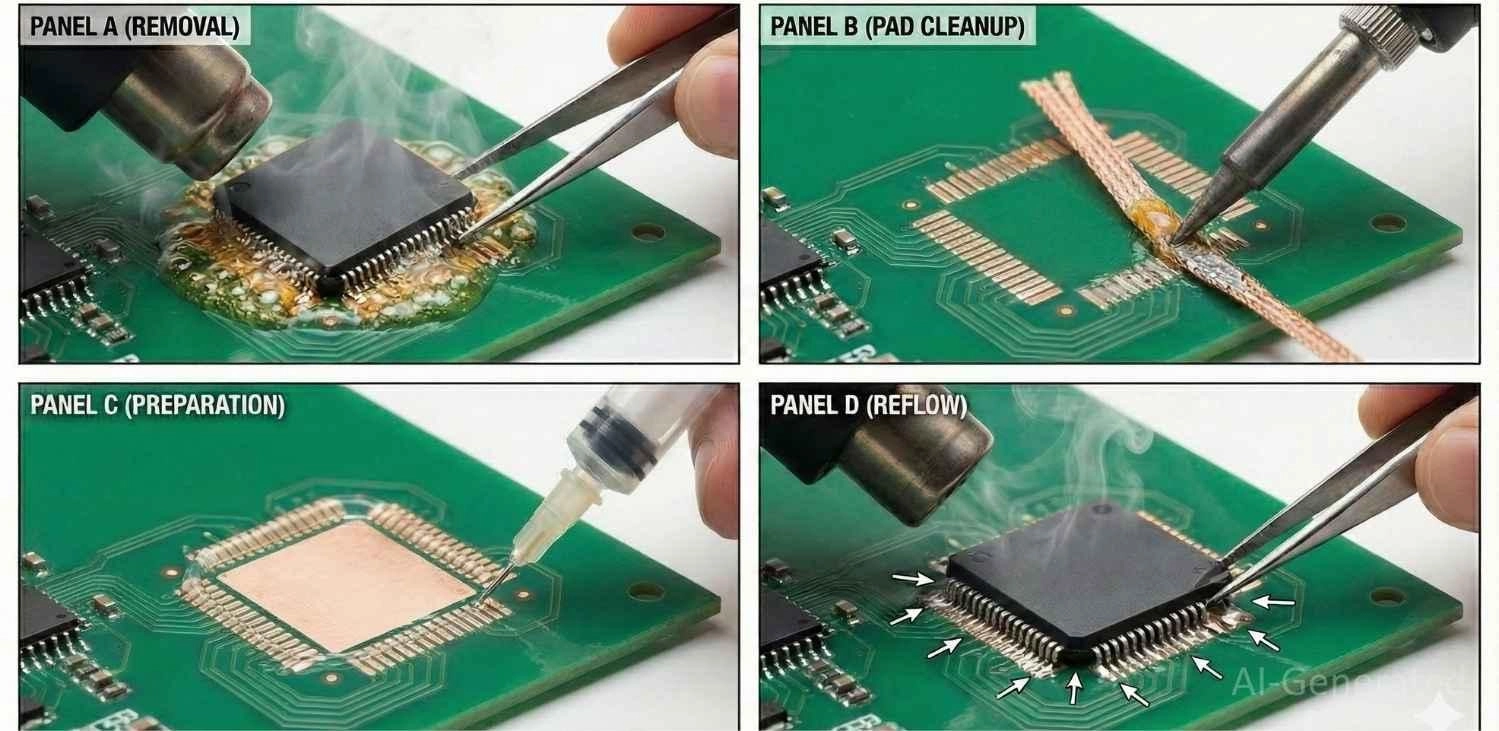
Figure: Step-by-step visual guide for SMD rework: fluxing for removal, cleaning pads with wick, fluxing for placement, and hot air reflow.
Practical Tips for Using Flux During SMD Rework
● Use Gel Flux: Liquid flux evaporates too fast under hot air. Gel stays active longer.
● Ventilation: Rework generates significant smoke; ensure good airflow.
● Shield Neighbors with Kapton Tape: Flux splatter and heat can affect adjacent components. Cover surrounding areas with polyimide (Kapton) tape to create a thermal and chemical shield.
● Avoid the "Floating" Effect: Do not create a pool of flux. If the layer is too thick, the component will "surf" on the boiling flux and skew off the pads. Use a thin film only.
● Clean Before New Application: Always clean charred old flux with IPA before adding fresh flux. Layering new flux over burnt residue creates a thermal barrier that hinders heat transfer.
● Preheat the Area Slightly: Warm the pads slightly before applying hot air. This reduces thermal shock and helps flux activate evenly.
● Use Minimal Airflow: Keep hot air speed low to avoid blowing small components off the pads during reflow.
● Angle the Nozzle Correctly: Position the hot air nozzle at ~45° to the board. This improves heat transfer while minimizing flux splatter.
● Avoid Cross-Contamination: Use a dedicated brush or applicator for flux. Don’t touch fluxed pads with tweezers that handled other components.
● Monitor Flux Color Changes: Some fluxes darken as they reach activation temperature. Use this as a visual cue for proper heating.
Conclusion
Proper flux application is essential for safe and reliable SMD rework and repair. Using the right type of flux, applying it evenly, and controlling heat and airflow helps prevent pad damage and component misalignment.
Following practical tips—such as preheating pads, angling the hot air nozzle correctly, and monitoring flux activation—ensures consistent solder flow, strong joints, and long-term board reliability.
Popular Articles
• SMT Assembly Process Explained and Equipment Used: A Step-by-Step Guide to PCBA Manufacturing
• Common PCB Assembly Methods and Soldering Techniques Explained
• SMD Soldering Tools You Need: Complete Guide from Beginner to Pro
• What Is BGA Void? Causes, IPC Limits, and Solutions
• Reflow Soldering: Everything You Need to Know
Keep Learning
How to Solder Wires to a Circuit Board Properly: Step-by-Step Guide
Learning how to solder wires to a circuit board is a fundamental skill for electronics repair, prototyping, and PCB assembly. Whether you are attaching power leads, signal wires, or test connections, a weak solder joint can cause intermittent failures, lifted pads, or long-term reliability issues. In this step-by-step guide, you'll learn the correct tools, preparation methods, and soldering techniques needed to create strong, clean, and reliable wire-to-PCB connections. From preparing the wire and PCB......
PCB Soldering Basic Techniques and Overview
Soldering means joining metal components with a melted metal called solder, which has a low melting point compared to other metals. Soldering is crucial in the electronics industry and is the primary method of joining electrical components. There are different types of soldering materials based on quality and their melting points. The most common combination is a tin or lead metal alloy mixed with silver or brass. The soldering iron melts the metal so it can be used like glue to connect two pieces. On......
SMT Assembly Process Explained and Equipment Used: A Step-by-Step Guide to PCBA Manufacturing
Today's high-performance electronics, from pocket-sized smartphones and IoT sensors to sophisticated industrial control systems, are made possible by a manufacturing miracle: Surface Mount Technology (SMT). SMT is the backbone of electronics manufacturing, allowing us to have the incredible component density and miniaturization. A bare circuit board is simply a substrate. The process of transforming it into a functional electronic circuit is known as Printed Circuit Board Assembly. This article outlin......
Common PCB Assembly Methods and Soldering Techniques Explained
Whether you're designing your first prototype or scaling up to production, understanding PCB assembly methods and soldering techniques is crucial to achieving reliable, high-performance circuit boards. Modern PCBA primarily relies on Surface Mount Technology (SMT) and Through-Hole Technology (THT)—each offering unique advantages for component density, durability, and manufacturability. In this guide, we'll break down the major PCB assembly methods, key soldering techniques such as reflow and wave sold......
What Is Tombstoning? A Practical Guide to Causes, Reflow Risks, Prevention, and Rework
Key Takeaways Definition: Tombstoning occurs when a small two-terminal component lifts off one pad during reflow and stands upright, leaving one end without a proper solder connection. Root Cause: Unequal solder wetting forces act on the two terminals, often due to differences in pad temperature, solder-paste volume, pad geometry, or thermal mass. Highest Risk: Small passive components, such as 0201 and 0402 resistors and capacitors, are especially susceptible because their low mass and small terminat......
Rigid-Flex PCB Assembly: Design, Process, Quality & Cost
Miniaturization, higher functionality, and mechanical adaptability are three main trends in modern electronics. Circuit boards that can tolerate bending, vibration, and compact or small installation spaces are becoming more and more necessary for modern devices like smartphones, medical implants, and aerospace systems. Combining flexibility and stability, rigid-flex PCBs provide both mechanical strength and design freedom, while flexible PCBs allow for bending and folding in confined spaces. This hybr......