Design Guidelines for Flex PCB Panels on JLCPCB
9 min
- Requirements for Flex PCB Panels on JLCPCB
- Panelization Best Practices for High-Yield Manufacturing
- Panelization Best Practices for High-Yield Manufacturing
- FAQ about Design Guidelines for Flex PCB
- Conclusion
When placing orders for flexible PCBs (FPCs) on JLCPCB, several key points must be noted. Unlike rigid PCB panels, which often use mouse bites or V-cuts for depanelization, FPC panels require bridge (tab) connections.
Requirements for Flex PCB Panels on JLCPCB
FPC panelization differs significantly from rigid boards. Proper design ensures efficient manufacturing, high yield, and compatibility with SMT assembly. Key requirements are as follows:
- Internal Board Spacing: 2 mm (standard); preferably 3 mm when metal stiffeners are used. This extra space accommodates laser cutting and prevents deformation during handling.
- Panel Borders (Process Edges): 5 mm on all sides. These areas must be covered with copper (for grounding/EMI protection), except for 1 mm clearance around fiducials and 0.5 mm around tooling holes.
- Fiducials and Tooling Holes: SMT fiducials: 1 mm diameter, centered 3.85 mm from panel edge. Tooling holes: 2 mm diameter. Place one fiducial and one tooling hole in each corner, offsetting those in one corner by at least 5 mm to indicate panel orientation and prevent 180° rotation errors.
- Connecting Tabs (Bridges): 0.7–1.0 mm wide. For stiffener-reinforced areas, use ~1.0 mm tabs and increase quantity to maintain panel stability during SMT reflow.
- Overall Panel Size: Recommended: 234 × 490 mm (optimal for production efficiency). Acceptable range: 70 × 70 mm minimum to ~250 × 500 mm maximum.
- For SMT Assembly Panels: Add one additional local fiducial next to each individual FPC unit. JLCPCB will paint over the fiducial of defective units to instruct the pick-and-place machine to skip them, reducing assembly costs.
FPCs with Metal Stiffeners: Require 0.8 mm slots (grooves) around each stiffener area for laser cutting/form ing, plus at least 3 mm board-to-board spacing.
| Parameter | Specification | Notes / Recommendations |
|---|---|---|
| Board Spacing | 2 mm (3 mm w/ stiffeners) | Prevents damage during laser depanelization |
| Process Edge | 5 mm all sides | Copper pour recommended |
| Fiducial | 1 mm dia., 3.85 mm from edge | Asymmetric placement for orientation |
| Tooling Hole | 2 mm dia. | One per corner + offset |
| Connecting Tab Width | 0.7–1.0 mm | Stronger/more tabs for heavy panels |
| Panel Size | 70×70 mm min; 234×490 mm recommended | Max ~250×500 mm |
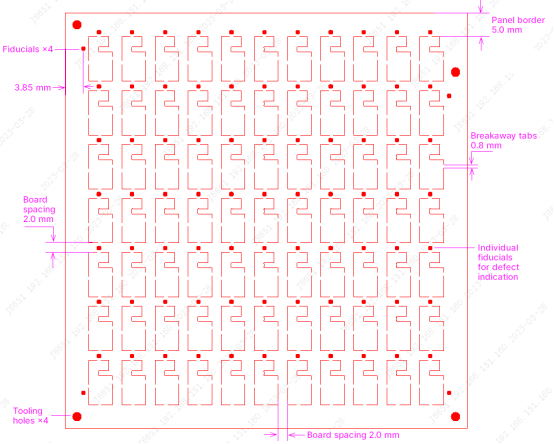
Panelization Best Practices for High-Yield Manufacturing
Proper panelization is critical for flexible PCBs. The thin and flexible polyimide substrate is sensitive to mechanical stress and thermal changes, requiring special design considerations compared to rigid boards.FPC panels rely exclusively on laser-cut bridge tabs rather than V-cuts or mouse bites. This ensures structural integrity throughout fabrication, SMT processing, and final depanelization.
Key Panel Design Recommendations
- Process Edges (Borders): Maintain 5 mm wide borders on all four sides. These edges should be fully copper-poured (except clearances around fiducials and tooling holes) to provide mechanical stability and EMI shielding.
- Recommended Panel Size: Target 234 × 490 mm for optimal production efficiency and lowest cost. Acceptable range is 70 × 70 mm minimum to approximately 250 × 500 mm maximum.
- Material Utilization: Consistent spacing and standard panel dimensions help maximize boards per panel, reduce waste, and lower per-unit costs.
Fiducial and Tooling Hole Design for SMT Compatibility
Global fiducials and tooling holes ensure accurate alignment during fabrication and assembly. Follow these specifications:
1. Use 1 mm diameter SMT fiducials, centered 3.85 mm from the panel edge.
2. Add 2 mm diameter non-plated tooling holes in each corner.
3. Offset one corner’s fiducial and tooling hole by at least 5 mm to clearly indicate orientation and prevent 180° rotation errors.
4. For SMT assembly panels, place one additional local 1 mm fiducial next to each individual FPC unit. This allows JLCPCB to mark defective boards by painting over the fiducial, enabling automatic skip by pick-and-place machines.
Proper fiducial implementation significantly reduces misalignment risks, especially for fine-pitch components on flexible substrates prone to warping.
Panelization Best Practices for High-Yield Manufacturing
Proper panelization is critical for flexible PCBs. The thin and flexible polyimide substrate is sensitive to mechanical stress and thermal changes, requiring special design considerations compared to rigid boards.FPC panels rely exclusively on laser-cut bridge tabs rather than V-cuts or mouse bites. This design ensures structural integrity throughout fabrication, SMT processing, and final depanelization.
Key Panel Design Recommendations
- Process Edges (Borders): Maintain 5 mm wide borders on all four sides. These edges should be fully copper-poured (except 1 mm clearance around fiducials and 0.5 mm around tooling holes) to provide mechanical stability and EMI shielding.
- Recommended Panel Size: Target 234 × 490 mm for optimal production efficiency and lowest cost. Acceptable range is 70 × 70 mm minimum to approximately 250 × 500 mm maximum.
- Internal Board Spacing: Use 2 mm standard spacing, increasing to at least 3 mm when metal stiffeners are present.
Fiducial and Tooling Hole Design for SMT Compatibility
Global fiducials and tooling holes ensure accurate alignment during fabrication and assembly. Follow these specifications:
1. Use 1 mm diameter SMT fiducials, centered 3.85 mm from the panel edge.
2. Add 2 mm diameter non-plated tooling holes in each corner.
3. Offset one corner’s fiducial and tooling hole by at least 5 mm to clearly indicate orientation and prevent 180° rotation errors.
4. For SMT assembly panels, place one additional local 1 mm fiducial next to each individual FPC unit. JLCPCB can then mark defective boards by painting over the fiducial, allowing pick-and-place machines to automatically skip them.
Material Utilization and Cost Optimization Strategies
Effective panelization directly impacts material utilization rate and overall project cost. By maintaining consistent 2 mm inter-board spacing (3 mm with stiffeners) and utilizing the full recommended 234 × 490 mm panel area, designers can achieve significantly higher board counts per panel compared to irregular or undersized layouts. JLCPCB’s production bases are optimized for these standard dimensions, resulting in better economies of scale. Additional best practices include minimizing irregular board shapes where possible, grouping similar designs, and consulting JLCPCB’s third-party panelization service if self-panelization proves complex. These strategies reduce waste, lower per-unit pricing, and shorten lead times while maintaining full compliance with manufacturing tolerances.
FAQ about Design Guidelines for Flex PCB
Q: 1.Why can’t FPC panels use V-cuts or mouse bites?
FPC panels cannot use V-cuts or mouse bites because the thin and flexible polyimide substrate is highly sensitive to mechanical stress. These traditional depanelization methods can easily cause tearing, cracking, or deformation of the flex material. Instead, JLCPCB requires the exclusive use of laser-cut bridge tabs with a width of 0.7–1.0 mm to maintain structural integrity throughout the entire fabrication, SMT processing, and final separation stages.
Q: 2.What are the key requirements for panel borders?
Panel borders must be 5 mm wide on all four sides and should be fully covered with copper, except for the specified clearances around fiducials and tooling holes. These process edges provide essential mechanical support for automated handling equipment and contribute to EMI shielding. Proper implementation of the borders is crucial for panel stability during manufacturing and assembly.
Q: 3.What are the specifications for fiducials and tooling holes?
Global SMT fiducials should be 1 mm in diameter with their centers positioned 3.85 mm from the panel edge, while tooling holes should have a 2 mm diameter. One fiducial and one tooling hole must be placed in each corner of the panel, with those in one corner offset by at least 5 mm to clearly indicate orientation and prevent 180-degree rotation errors. For SMT assembly panels, an additional local 1 mm fiducial should be placed next to each individual FPC unit so that defective boards can be marked by painting over the fiducial.
Q: 4.What special rules apply to panels with metal stiffeners?
When using metal stiffeners, the board-to-board spacing in stiffened areas must be increased to at least 3 mm to accommodate the extra thickness and prevent deformation. Additionally, 0.8 mm wide clearance slots must be designed around each stiffener outline to enable precise laser cutting. Connecting tabs near stiffened regions should use the wider end of the specification (around 1.0 mm) and may require increased quantity to maintain panel stability during reflow soldering. These measures help prevent warping and ensure high assembly yield.
Q: 5.What is the recommended panel size and how to reduce cost?
The recommended panel size is 234 × 490 mm, with an acceptable range from a minimum of 70 × 70 mm to a maximum of approximately 250 × 500 mm. To optimize material utilization and reduce cost, designers should maintain consistent 2 mm (or 3 mm with stiffeners) board spacing, use regular board shapes, group similar designs together, and utilize the full standard panel area as much as possible. These practices maximize the number of boards per panel, minimize waste, lower per-unit pricing, and shorten lead times while remaining fully compliant with JLCPCB’s manufacturing capabilities.
Q: 6.What should I do for complex FPC panel designs?
For complex designs, especially those involving metal stiffeners or multiple different boards, it is best to strictly follow the requirements and best practices outlined in this document. After completing the Gerber files, upload them through JLCPCB’s online ordering system. The factory will perform a free panelization review and provide feedback if any adjustments are needed. Early consultation with JLCPCB support can effectively prevent potential manufacturing issues and ensure a smooth production process.
Conclusion
To achieve optimal performance and reliability in your flexible PCB designs, selecting high-quality materials and adhering to proper panelization guidelines are essential. JLCPCB works with leading global raw material suppliers to provide authentic A-grade polyimide substrates and consistently delivers high-quality flex circuits. With multiple intelligent production bases optimized for flexible PCB manufacturing, JLCPCB achieves excellent economies of scale while maintaining strict process control.
By following the panelization requirements outlined in this document — including 2 mm (or 3 mm with stiffeners) board spacing, 5 mm process edges, proper fiducials, tooling holes, and laser-cut tabs — designers can maximize production yield, reduce assembly defects, and ensure smooth SMT compatibility. These best practices not only improve manufacturing efficiency but also contribute to the overall success and long-term reliability of your flexible electronics projects.
Popular Articles
• Choosing the Right Bend Radius for Durable Flexible PCBs
• Flexible Meets Durable: Understanding Rigid-Flex PCB Technology
• PCB Stiffeners: An Essential Requirement for Flexible Circuits
• The Ultimate Guide to Flexible PCB: Types, Design, and Applications
• 45 Must-Know Flex PCB Design Tips You Can't Afford to Miss!
Keep Learning
Choosing the Right Bend Radius for Durable Flexible PCBs
Key Takeaways Mastering the bend radius is essential for reliable flexible PCB design. Following IPC-2223 guidelines, maintain a minimum of 6× total thickness for static bends and 100× for dynamic applications, while using thinner RA copper, adhesiveless polyimide, staggered traces, and cross-hatched patterns in flex zones. Proper material selection, layer stackup optimization, and adequate clearance from stiffeners can dramatically extend flex life and prevent premature trace cracking or delamination......
Flex PCB Stackup Design Guide: Layers, Materials & Reliability
Key Takeaways A reliable flex PCB starts with the right stackup design. The layer structure, material selection, and copper arrangement directly affect flexibility, bend life, electrical performance, and manufacturing reliability. This guide explains single-sided, double-sided, and multilayer flex PCB stackups, including polyimide materials, coverlay, copper types, and key design considerations for creating durable flexible circuits with JLCPCB. Did you ever wonder how a foldable phone can last for 20......
Flexible Meets Durable: Understanding Rigid-Flex PCB Technology
In the rapidly evolving world of electronics, the demand for smaller, more reliable, and more versatile devices continues to grow. To meet these demands, engineers and designers are increasingly turning to Rigid-Flex PCBs. The circuit boards combine rigid and flexible substrates into a single interconnected structure. This combination allows for complex designs that can bend and flex in specific areas while maintaining rigidity in others. To manufacture rigid flex PCBs, IPC offers advice and best prac......
PCB Stiffeners: An Essential Requirement for Flexible Circuits
A printed circuit board stiffener plays an important role when it comes to offering mechanical support to a PCB. They are particularly helpful for flexible circuit boards, that given their name, are flexible and in need of stiffness in certain places. Stiffeners are particularly required when components are placed in a flex zone & the weight of these components stresses the flex material. These components provide a rigid connection from the flexible portion to the solid board. This solidity makes appl......
The Ultimate Guide to Flexible PCB: Types, Design, and Applications
Key Takeaways JLCPCB 1–4 Layer Flex PCB: Supports 1 to 4-layer FPCs with polyimide (PI) substrates and trace/space down to 3/3 mil. Stiffener Selection: Use PI (0.1–0.25mm) for ZIF connectors, FR4 (0.1–1.6mm) for SMT support, and Stainless Steel (0.1–0.3mm) for high rigidity. Layout Optimization: Use cross-hatched copper ground planes and stagger 2-layer traces to eliminate the "I-Beam effect." Surface & Protection: Combine Immersion Gold (ENIG 1u"/2u") for SMT planarity with flex coverlay to protect ......
Medical Flex Circuits: Manufacturing, Applications, Materials, and Design Guide
Medical flex circuits made to fit inside a 1.0 mm disposable endoscope, wrap around a hearing aid shell, and sit on a patient's arm for ten straight days. When one fails, it is not a warranty return but a device history file and a regulatory conversation. In this guide, you will learn: What separates a medical flex circuit from a consumer one How they are built, tested, and released Polyimide, copper, coverlay, and stiffener choices Fine line, bend radius, and layer count limits What to check before c......