SOIC Package: A Complete Guide to Specifications, Types, Uses, and SMT Assembly
12 min
- What is a Small Outline Integrated Circuit (SOIC) Package?
- SOIC Package Specifications
- Common SOIC Package Applications in Electronics
- SOIC Package vs. Other IC Packages
- SOIC PCB Footprint and Land Pattern Design
- SOIC SMT Assembly and Soldering
- Conclusion
- FAQs about SOIC Package

As designs transition from legacy through-hole components to high-density Surface Mount Technology (SMT), the Small Outline Integrated Circuit (SOIC) remains the industry standard for operational amplifiers, flash memory, sensors, and microcontrollers.
It reflects a well-balanced engineering design, offering a practical compromise between the miniaturisation demanded by modern consumer electronics and the ruggedness required for industrial applications.
In this guide, you will learn:
- SOIC package dimensions: Understand body width variations and the mechanical dimensions that drive footprint design.
- Thermal characteristics: Examine the factors that affect SOIC power handling.
- Leadframe construction: Explore the materials and structure used in SOIC leadframes.
- SMT assembly: Learn key assembly considerations, from stencil aperture design to reflow profiling.
The guide also connects SOIC design considerations with practical SOIC assembly at JLCPCB, supported by its advanced assembly capabilities.
What is a Small Outline Integrated Circuit (SOIC) Package?
Technically defined, a SOIC package, short for Small Outline Integrated Circuit, is a surface-mount integrated circuit (IC) package characterized by two parallel rows of gull-wing leads. It offers a dramatic reduction in footprint.
Compared with equivalent DIP packages, SOIC typically reduces PCB area by roughly 30%–60%, depending on pin count and pitch.
The SOIC represents the "sweet spot" of assembly. SOIC is widely used because it balances density, manufacturability, and reworkability.
SOIC’s gull-wing leads provide mechanical compliance and visible solder fillets, making it more tolerant to PCB warpage and rework than QFN in many production environments.
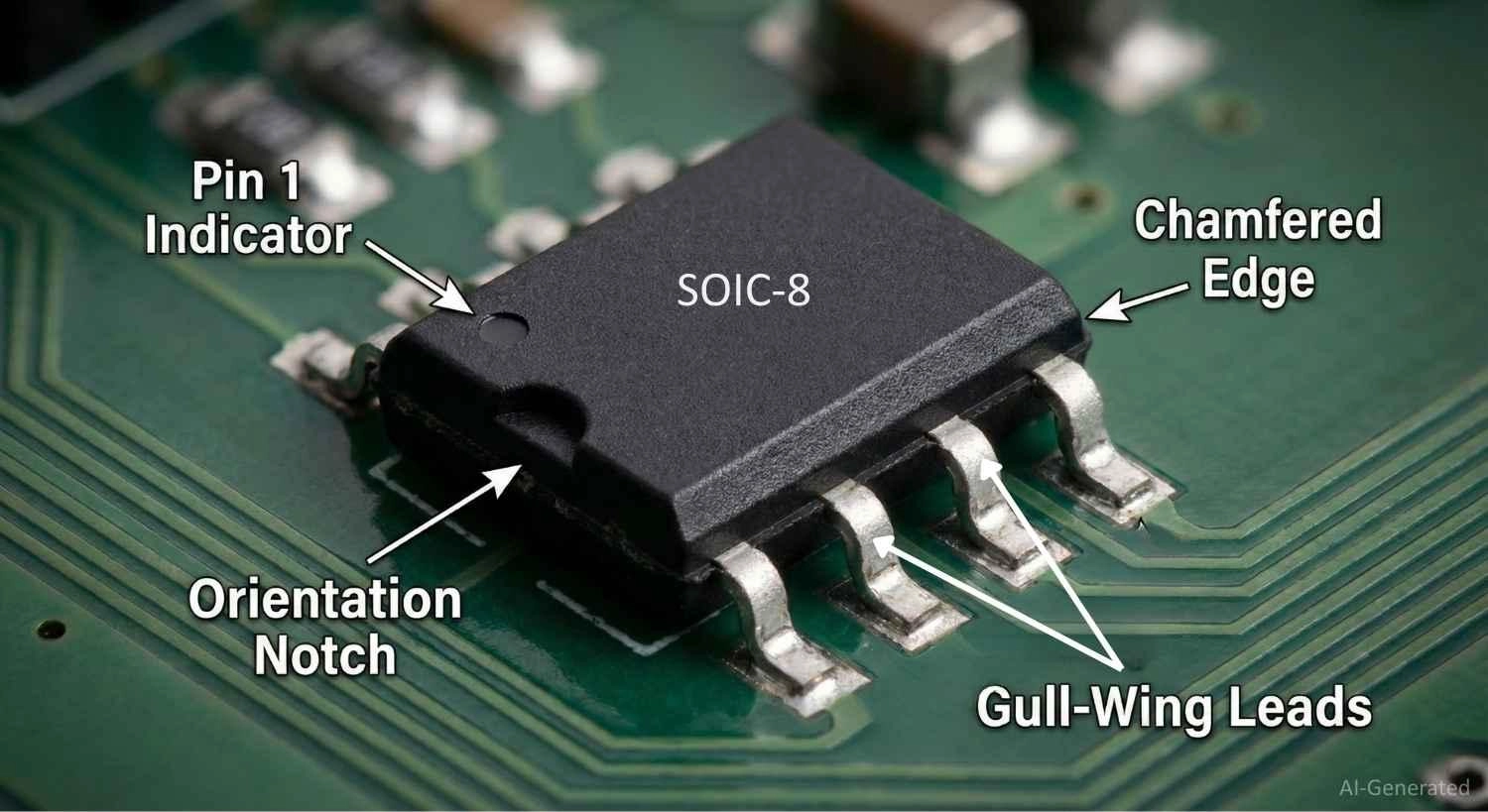
Figure: A Small Outline Integrated Circuit (SOIC) chip mounted on a printed circuit board showing gull-wing leads and pin configuration.
Upload your Gerber files to JLCPCB today for instant DFM analysis and high-precision SMT assembly.
SOIC Package Specifications
Understanding the precise physical attributes of the SOIC is critical for PCB layout and assembly.
| Package Type | Body Width (mm) | Pitch (mm) | Thermal Resistance (𝜃JA) |
|---|---|---|---|
| Narrow Body | 3.90mm (150 mil) | 1.27mm | ~100–120 °C/W |
| Wide Body | 7.50mm (300 mil) | 1.27mm | ~70–80 °C/W |
Note: θJA depends strongly on PCB copper and airflow, but typical SOIC θJA ranges from ~70 to 120 °C/W.
SOIC Package Dimensions and Body Variations
The SOIC package is primarily categorized by its body width. Designers must differentiate between these types to prevent solder mask-defined vs. non-solder mask-defined pad errors in CAD layouts.
1. Narrow Body SOIC:
- Body Width: 3.90mm (approximately 150 mils).
- Typical Pin Counts: 8, 14, and 16 pins.
- Usage: Standard logic gates, op-amps, and timers.
2. Wide Body SOIC:
- Body Width: 7.50mm (approximately 300 mils).
- Typical Pin Counts: 16, 20, 24, and 28 pins.
- Usage: Interface ICs, larger microcontrollers, and memory chips requiring larger die attach pads.
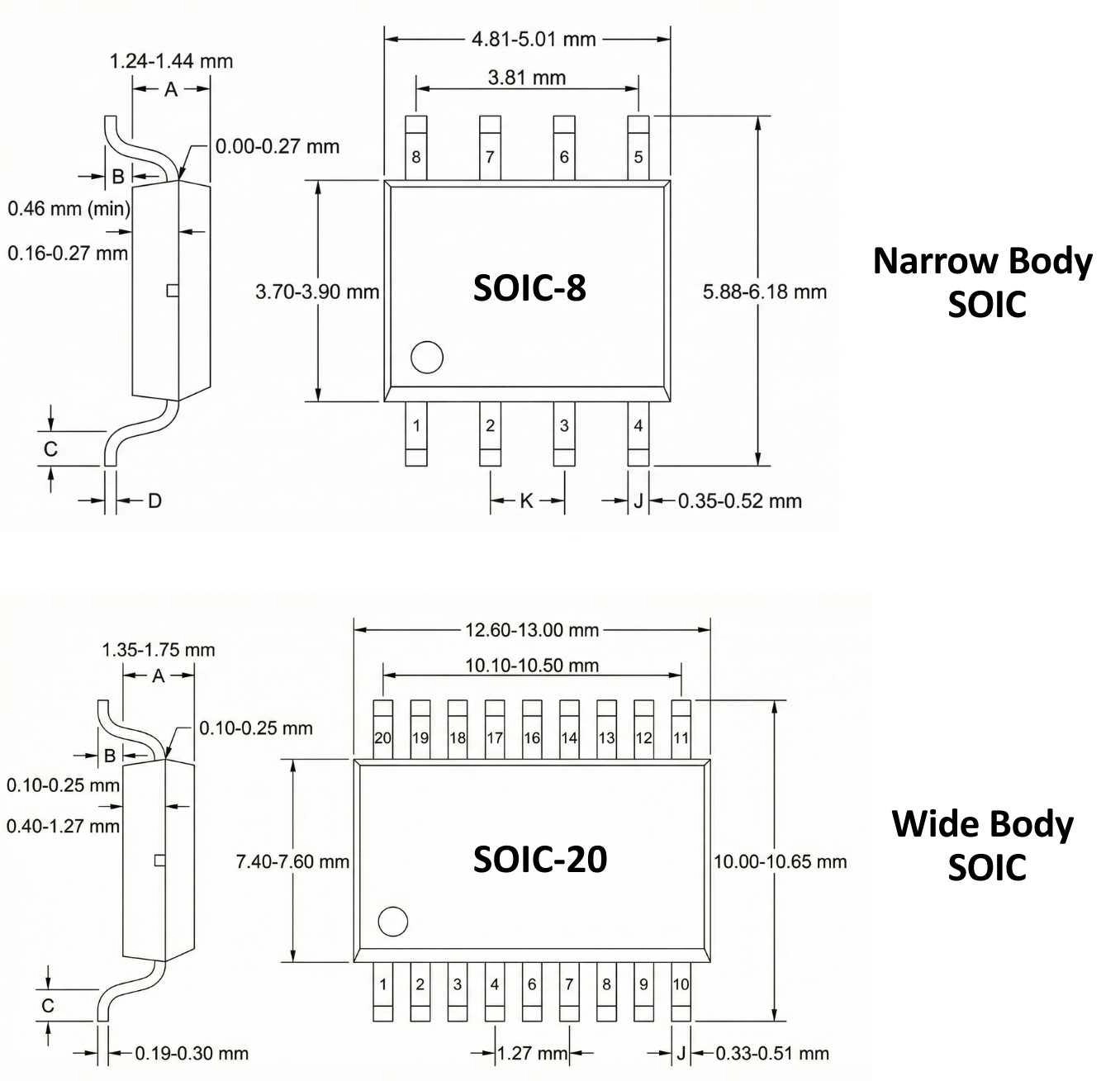
Figure: Comparing JEDEC Narrow Body (SOIC-8) and Wide Body (SOIC-20) Small Outline Integrated Circuit packages showing pin pitch and dimensions.
SOIC Lead Geometry, Pitch, and Coplanarity
The defining feature of the SOIC is its 1.27mm (50 mil) pin pitch. Unlike Fine-Pitch (FP) components such as the SSOP (0.65mm), the 1.27mm pitch allows for a wider process window during solder paste printing, significantly reducing the risk of solder bridging.
The Gull-Wing Mechanics: The leads of an SOIC are formed in a "gull-wing" configuration. Mechanically, this shape provides compliance. During operation, the silicon die, the plastic mold compound, and the FR-4 PCB substrate expand at different rates due to varying Coefficients of Thermal Expansion (CTE).
Gull-wing leads provide mechanical compliance that reduces stress transfer to solder joints during thermal cycling, improving reliability.
It is a critical reliability factor for automotive and industrial PCBs.
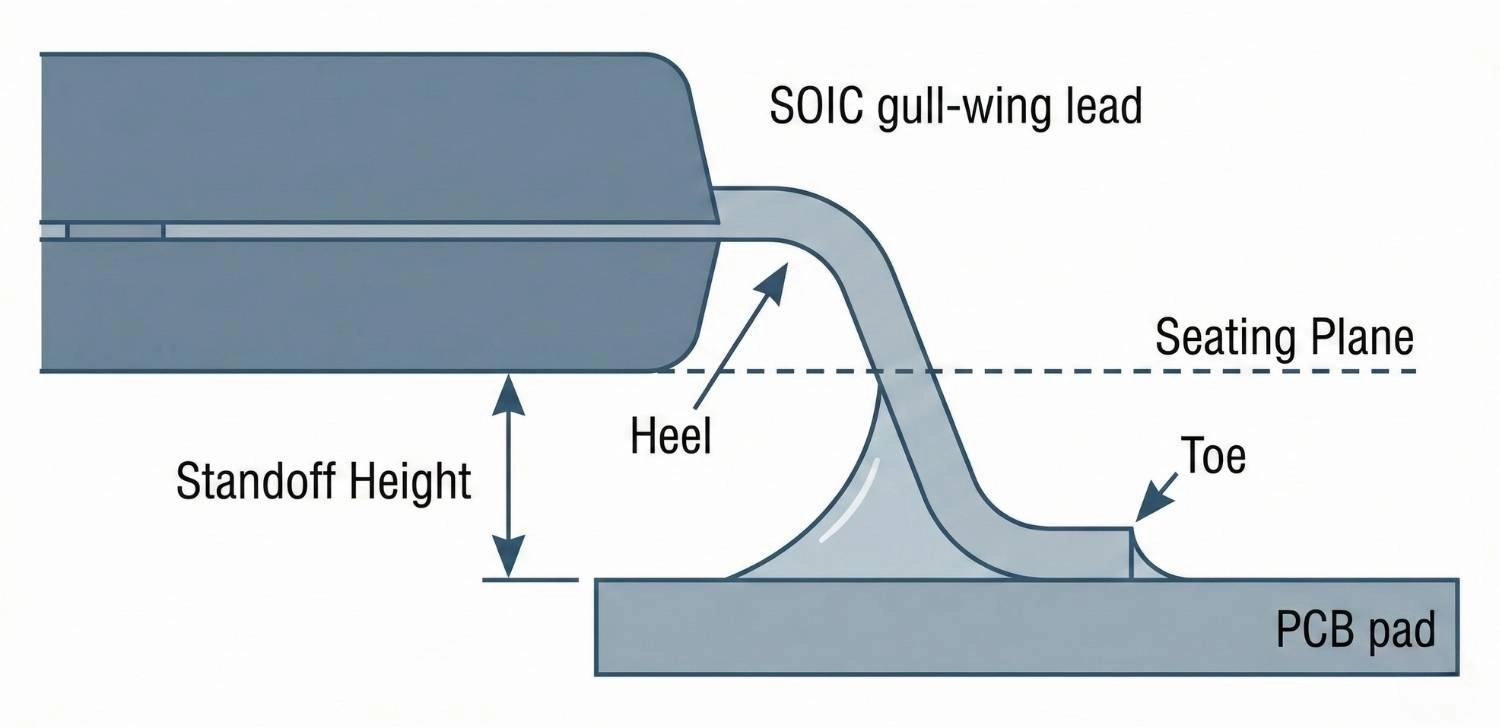
Figure: SOIC gull-wing lead showing the heel, toe, and solder joint formation on a PCB pad.
Lead Coplanarity: For reliable SMT assembly, lead coplanarity—the vertical distance between the highest and lowest lead—must be maintained within 0.10mm (4 mils). Deviations outside this tolerance often result in "open" solder joints during the reflow process, as the lead fails to contact the printed solder paste.
SOIC Materials, Leadframe, and Plating
Leadframe: SOIC leadframes are commonly made from copper alloys (e.g., Alloy 42, 194, 172) depending on manufacturer and thermal requirements. Typically constructed from Copper Alloy 194 (CuFe2.3P) to maximize thermal conductivity (~260 W/m·K), facilitating heat transfer from the die to the PCB.
Plating: Leads are plated with Matte Tin (Sn) or Nickel-Palladium-Gold (NiPdAu). This plating ensures wettability during the JLCPCB PCB assembly process and prevents oxidation during storage.
SOIC Packaging and Handling for SMT Assembly
For automated assembly, SOIC components are supplied in Tape and Reel or Plastic Tubes.
Tape and Reel: Preferred for high-volume SMT production. The components are placed in embossed pockets, carrier tape, sealed with a cover tape, allowing for rapid feeding into pick-and-place machines.
Tubes: Common for smaller quantities or prototyping, but require stick feeders, which can be slower to load.
Common SOIC Package Applications in Electronics
The Small Outline Integrated Circuit is versatile, finding its way into almost every sector of the electronics industry. Its balance of size and manual reworkability makes it particularly popular in scenarios where BGA is too complex to route or test, but DIP is too bulky.
| Industry Sector | Application Context | Why SOIC is Preferred | Common Examples |
|---|---|---|---|
| Medical Devices | Portable patient monitors, Pulse Oximeters | Reliable solder joints withstand drops/vibration; size fits handheld enclosures better than DIP. | Precision Op-Amps (e.g., OPA series), ADCs |
| Telecommunications | Routers, Modems, Base Stations | Excellent high-frequency performance due to short leads; standard footprint for transceivers. | RS-485 Transceivers (MAX485), Line Drivers |
| Development Boards | Arduino clones, ESP32 breakout boards, DIY Kits | Hand-solderable for hobbyists and students; easy to probe for debugging compared to QFN. | USB-to-UART bridges (CH340, CP2102), Regulators |
| Automotive | ECU (Engine Control Units), Dashboard Controllers | High tolerance for thermal cycling (gull-wing stress relief); AEC-Q100 qualified parts often utilize SOIC packaging. | CAN Bus Transceivers (TJA1050), Voltage Regulators |
| Wearable Tech | Smart watches (older generations), Health trackers | Used for power management where ultra-miniaturization (CSP) isn't strictly required but z-height matters. | Serial Flash Memory (SPI Flash), EEPROM |
| Industrial Automation | PLC Inputs, Motor Drivers | Robustness against factory vibration; ease of replacement/repair in the field. | Gate Drivers, Isolators, Solid State Relays |
| IC Type | Typical Applications |
|---|---|
| Op-amps | Analog signal conditioning |
| Memory ICs | EEPROM, Flash |
| Interface ICs | RS-232, RS-485, CAN |
| Power ICs | Regulators, drivers |
| Controllers | Industrial and embedded systems |
SOIC Package vs. Other IC Packages
Choosing the right package is a trade-off between electrical performance, thermal management, and assembly yield.
SOIC vs DIP (Dual In-line Package): Through-Hole vs SMT
While DIP is easier for breadboarding, it is electrically inferior. The long leads of a DIP package introduce significant parasitic inductance (L) and capacitance (C).
- Signal Integrity: The shorter leads of the SOIC minimize parasitic inductance, allowing for faster switching speeds and higher frequency operation (>100 MHz) with less signal degradation.
- Thermal Path: The SOIC sits flush against the PCB surface. Heat generated by the die has a shorter path to travel through the leads to the copper traces (R<sub>θJL</sub> is lower), improving thermal dissipation.
SOIC vs SOP (Small Outline Package): Understanding the JEDEC vs EIAJ Difference
A common technical pitfall is confusing the SOIC with the SOP (Small Outline Package), often defined by EIAJ/JEITA specifications.
- The Difference: EIAJ SOP packages typically have a body width of 5.3mm—wider than the Narrow SOIC (3.9mm) but narrower than the Wide SOIC (7.5mm).
- The Risk: Placing a standard SOIC footprint for an EIAJ SOP component often results in leads barely touching the pads, leading to weak or open joints.
- Solution: Always cross-reference the specific body width parameters in the datasheet when using the JLCPCB Parts Library.
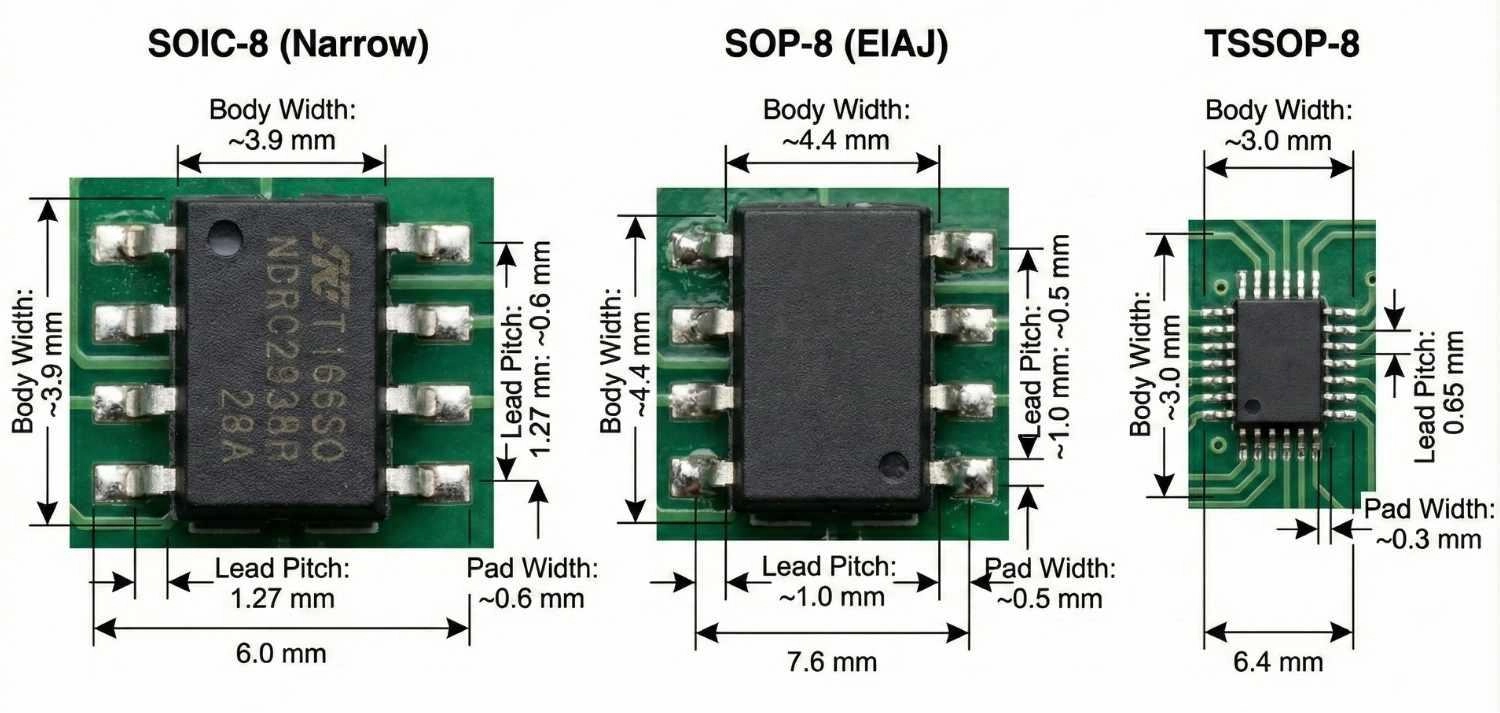
Figure: Comparing footprints of JEDEC SOIC, EIAJ SOP, and TSSOP packages to highlight dimensional differences and pad spacing.
SOIC vs TSSOP and QFN: Size, Density, and Robustness
- TSSOP (Thin Shrink Small Outline Package): Features a thinner profile (1.1mm max) and tighter pitch (0.65mm). While space-saving, it is more susceptible to solder bridging and requires thinner stencils.
- QFN (Quad Flat No-lead): Offers superior thermal performance due to the direct thermal pad, but is difficult to prototype and inspect. SOIC allows for visual inspection of solder fillets without X-ray, simplifying Quality Control (QC).
SOIC PCB Footprint and Land Pattern Design
To ensure zero-defect manufacturing at JLCPCB, your PCB layout must adhere to strict Design for Manufacturing (DFM) guidelines. The physical land pattern determines the volume of solder paste deposited.
SOIC Land Pattern and Pad Design Requirements
The land pattern geometry dictates the formation of the solder joint.
- Toe Fillet (Outer): The pad must extend 0.35 mm- 0.55 mm beyond the lead end. This allows a visible meniscus of solder, essential for Automated Optical Inspection (AOI) to verify the joint.
- Heel Fillet (Inner): The most critical joint for mechanical strength. The pad should extend inward sufficiently to allow solder to wet the "knee" of the lead.
- Solder Mask Dam: Ensure a solder mask web of at least 0.1mm (4 mils) exists between pads to prevent solder bridging, although the wide 1.27mm pitch makes this easily achievable.
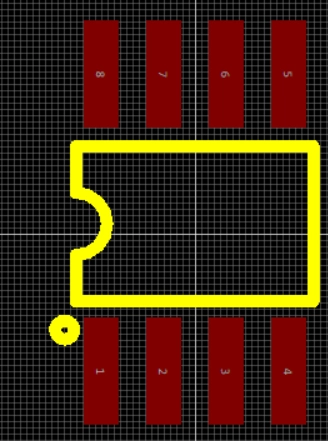
Figure: IPC-7351 compliant PCB footprint land pattern for SOIC-8.
Thermal Management for SOIC and SOIC-EP Packages
High-power ICs often use the SOIC-EP (Exposed Pad) variant, which includes a thermal slug on the bottom.
- Via-in-Pad Strategy: Place an array of 0.3mm thermal vias directly in the central ground pad. These should stitch to internal ground planes to dissipate heat.
- Stencil Aperture: Do not use a 100% aperture opening for the exposed pad. Use a "window pane" design (50-80% coverage) to prevent excessive solder lift, which can cause the package to float and disconnect the signal pins.
Pro Tip: Use EasyEDA or download validated footprints directly from the JLCPCB Parts Library to minimize geometry errors.
SOIC SMT Assembly and Soldering
JLCPCB SMT Assembly service utilises precision pick-and-place machines, but understanding the process helps in designing robust boards.
Reflow Soldering Profile for SOIC Package
- Soak Zone (150°C–200°C): 60–120 seconds. Activates flux and ensures the plastic body and internal die reach thermal equilibrium to prevent warping.
- Reflow Zone: Peak temperature: typically 235–245°C for SAC305, not exceeding the JEDEC maximum of 260°C.
- Cooling: Rate of <4°C/s to ensure a fine-grained solder structure without thermal shock.
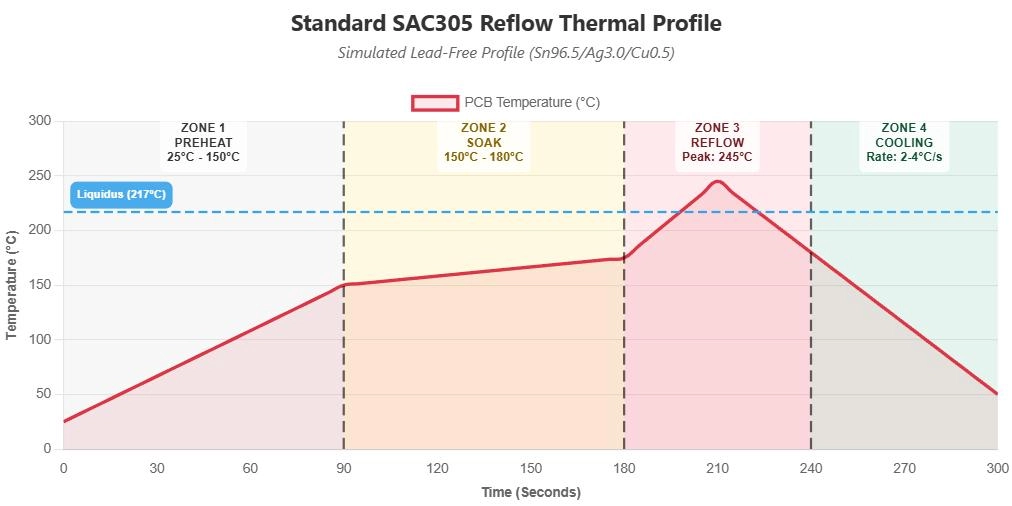
Figure: SMT reflow soldering temperature profile graph showing preheat, soak, peak reflow, and cooling zones for lead-free SAC305 assembly.
SOIC Moisture Sensitivity Level (MSL) and Storage
SOIC packages are hygroscopic. If moisture is trapped inside the plastic encapsulation during reflow, it expands into steam, causing "popcorning" (package cracking).
Protocol: High MSL components (Level 3+) are baked before assembly if exposure time is exceeded, following strictly controlled storage procedures.
Common SOIC Assembly Defects and Prevention Strategies
- Solder Bridging: Rare on 1.27mm pitch. If occurring, check if stencil thickness exceeds 0.15mm.
- Lead Lifting or Uneven Wetting: Ensure symmetric thermal relief connections on pads tied to large copper planes. Imbalanced heat flow during reflow can cause uneven wetting forces, resulting in lifted leads or insufficient fillet formation.
- AOI Verification: The gull-wing geometry allows top-down cameras to easily verify wetting angles, making SOIC one of the most reliable packages to inspect.
Conclusion
The Small Outline Integrated Circuit (SOIC) remains a titan in the electronics industry. Its balanced physical characteristics make it the ideal choice for engineers who need higher density than DIP but require easier handling and better robustness than QFN or BGA packages.
By understanding technical specifications and optimizing your PCB footprints, you ensure seamless manufacturing.
FAQs about SOIC Package
Q: What is the typical thermal resistance (𝜃JA) of a standard SOIC-8 package?
A standard Narrow Body SOIC-8 typically has a Junction-to-Ambient thermal resistance (θJA) of approximately 100°C/W to 120°C/W on a standard FR-4 board. This means for every Watt of power dissipated, the junction temperature rises by ~100°C. For power applications, use the SOIC-EP variant or ensure substantial copper pours on the PCB.
Q: Can SOIC packages withstand Wave Soldering?
Yes, standard SOIC packages can withstand wave soldering, provided they are glued to the bottom side of the PCB. However, due to the risk of solder bridging on the trailing leads, Reflow Soldering is the preferred method for modern SMT assembly at JLCPCB.
Q: Why do some datasheets specify a "Power SOIC"?
A "Power SOIC" usually refers to the SOIC-EP (Exposed Pad) variant or a specific leadframe design where multiple pins are fused internally to the die paddle (often GND pins) to serve as heat sinks. These require specific PCB layout strategies for heat dissipation.
Q: Can I hand-solder an SOIC package?
Absolutely. The 1.27mm pitch is considered "hand-solder friendly." It is spacious enough to use a fine-tip soldering iron without needing a microscope, making it ideal for prototyping before moving to mass production with JLCPCB SMT.
Q: How does lead plating affect the shelf life of SOIC components?
SOIC leads plated with Matte Tin typically have a shelf life of 1-2 years before "tin whiskers," or oxidation becomes a concern. NiPdAu (Nickel-Palladium-Gold) plating offers a longer shelf life and better resistance to oxidation, which is crucial if you are stocking parts for long-term production.
Popular Articles
• SMD Resistor Package Sizes: Complete Size Chart, Footprints & How to Choose
• How to Solder SMD Components Like a Pro [2026 Updated]
• SMD Resistor Codes: How to Read 3-Digit, 4-Digit, and EIA-96 Markings
• SMD Capacitor Codes: Identification, Markings, and Polarity
• SMD Capacitor Sizes: Complete Size Chart and Selection Tips for PCB Design and Assembly
Keep Learning
SOIC Package: A Complete Guide to Specifications, Types, Uses, and SMT Assembly
As designs transition from legacy through-hole components to high-density Surface Mount Technology (SMT), the Small Outline Integrated Circuit (SOIC) remains the industry standard for operational amplifiers, flash memory, sensors, and microcontrollers. It reflects a well-balanced engineering design, offering a practical compromise between the miniaturisation demanded by modern consumer electronics and the ruggedness required for industrial applications. In this guide, you will learn: SOIC package dime......
What Is a 100nF Capacitor and How Do You Choose the Right One
Key Takeaways Value: A 100nF capacitor has a nominal capacitance of 0.1 µF, or 100,000 pF, and all three names describe the same part value. Marking: Many through-hole ceramic and film capacitors use the three-digit code 104, while most SMD MLCCs are unmarked. Main use: Its most common function is local decoupling at an IC power pin, where it supplies fast transient current and shunts high-frequency noise to ground. Default choice: For general decoupling, an X7R or X5R MLCC is a common starting point;......
SMD Resistor Package Sizes: Complete Size Chart, Footprints & How to Choose
Surface Mount Device (SMD) resistors are fundamental to modern electronics, and selecting the correct package size is a crucial engineering decision that impacts a PCB’s electrical performance, thermal reliability, and manufacturing cost. In this article, you will find practical, authoritative guidance on: The complete SMD resistor size chart (01005 to 2512) with exact dimensions and power ratings. Recommended PCB footprints and guidelines for reflow reliability. Critical trade-offs concerning power d......
PCB Connector Types Explained: Categories, Comparison, Applications and How to Choose the Right One
PCB connectors are essential components for connecting circuit boards with external devices, cables, or other PCBs. Choosing the right connector type affects signal reliability, mechanical stability, and overall product performance. Factors such as current rating, frequency requirements, pitch size, and mounting method should be considered during selection. In this guide, you will learn: The major types of PCB connectors and their applications. How different connector types compare. How to select the ......
What Is a System on a Chip (SoC)? A Complete Guide for PCB Designers
Nearly every electronic device you interact with today, from smartphones and IoT sensors to industrial controllers and AI edge systems, is powered by a System on a Chip (SoC). By integrating processors, memory controllers, communication interfaces, and specialized accelerators onto a single piece of silicon, SoCs deliver the performance, power efficiency, and compact form factors modern electronics demand. Whether you're selecting a processor for an embedded Linux design, evaluating an AI-capable plat......
Capacitors in PCB Design_ A Complete Guide to All Types
Capacitors are indispensable components in PCB (Printed Circuit Board) design, providing functionality from energy storage and noise filtering to voltage regulation. Whether you're designing a simple circuit or a complex multi-layer board, understanding the different types of capacitors and their applications is crucial. The basic structure of a capacitor consists of two metal plates separated by a layer of dielectric. Capacitors can be of fixed or variable type. The ability of the capacitor to hold e......