Understanding SMT Stencil Printers for Accurate PCB Solder Paste Printing
7 min
Stencil printing is a critical process in SMT (Surface Mount Technology) assembly, significantly impacting the quality and reliability of solder joints on PCBs. The crucial machine for implementing this is the SMT Stencil Printer, which applies an appropriate measure of solder paste to each pad of the PCB board before it goes to the placement of components.
For those of you looking to work out what a stencil printer is and why it matters in manufacturing, you've come to the right place. This is the basis for better assembly success, even on contemporary PCBs, which are smaller, denser, and more complex. Stencil registration and paste deposition are of utmost importance for the accurate deposition of solder, as even slight errors (either misalignments or lack of paste) can cause bridging, tombstoning, and/or weak joints. They are also more important for fine-pitch devices, such as QFNs, BGAs, and high-density PCBs.
This guide is a manual for electronics enthusiasts, engineering students, and practicing engineers, which shows step-by-step insights into the functions of SMT stencil printers in high-fidelity PCB assembly.
What Is an SMT Stencil Printer?
Definition and Working Principle of an SMT Stencil Printer
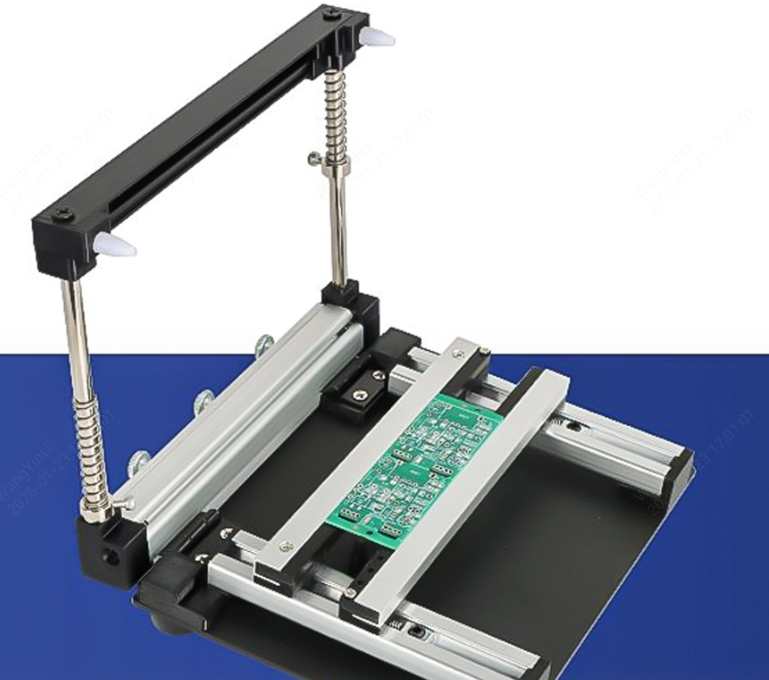
An SMT stencil printer is a device that deposits solder paste on a PCB by using a metal stencil with holes matching those of the desired deposit points. These are lined up with the solder pads on the PCB. As in the print process, the solder paste is wiped through the stencil with a squeegee blade. As the blade moves across, paste is extruded through holes in the stencil and onto pads.
This technique relies on the precision of alignment of the PCB to the stencil, consistently applied pressure from the squeegee, and uniform printing speed, in addition to the masked height above the board onto the stencil for printing. Assuming those factors are well controlled, the printer will also deliver a proper volume of paste to all pads, resulting in a reliable joint for reflow.
SMT Stencil vs SMT Stencil Printer
"SMT stencil" and "SMT stencil printer" are closely related, but they don't provide the same service. The stencil is a fine stainless-steel sheet that tells exactly where solder paste has to be deposited. The amount of paste dispensed is controlled by the registration of its thickness, aperture opening, and print quality.
The stencil printer is a mechanical system that securely holds both the PCB and the stencil in proper alignment and stability, where the printing process is carried out. A well-designed stencil cannot compensate for bad placement or unstable print settings. The problem is that they need to start thinking of the stencil and printer as a holistic process.
Key Printing Parameters Engineers Care About
Many factors are important for successful stencil printing. With alignment accuracy, the paste will only be deposited directly on the pads. Bad vs. Good pad Bondline Quality! The pressure of the squeegee and its angle can change aperture fill or paste release. The rolling of paste is affected by the printing speed, and the efficiency of paste transfer is influenced by the separation speed of the stencil. Control over these parameters is crucial for repeatable and defect-free printing.
Types of SMT Stencil Printers
1. Manual SMT Stencil Printer
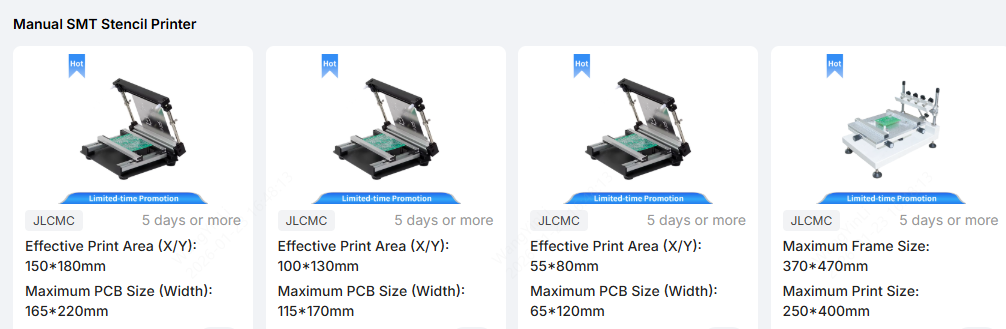
Prototypes, laboratory work, and small-scale production all benefit greatly from the SMT Manual stencil printer. In these systems, solder paste is applied using manually operated squeegees, and PCB alignment is carried out by mechanical rail mechanisms. They are primarily used for limited production runs and prototype development due to their affordability, ease of usage, and adaptability.
But manual printing requires a high degree of skill from the operator. Differences in pressure, velocity, and registration of the paste can result in irregularly deposited pastes. Manual printers are fine for larger parts and looser pad spacing, but can be difficult to use for fine-pitch and high-density PCBs.
2. Semi-Automatic SMT stencil Printer
Semi-automatic SMT stencil printers automate certain aspects of the printing process, such as squeegee movement, pressure, and velocity, but leave PCB loading and alignment to manual operation. These printers provide more uniform solder paste deposition, as they minimize human influence on critical printing variables compared with manual systems. Semi-automated printers are commonly found in small-batch production and R&D facilities that require moderate-level production volumes and better levels of repeatability. They offer a great balance between operability, precision, and cost.
3. Automatic SMT Stencil Printer
SMT automatic stencil printers are fully automated machines that deposit solder paste accurately for SMT assembly. The systems employ vision-guided alignment to provide accurate positioning of the stencil and PCB, while all printing parameters (squeegee speed, pressure, stencil separation) are programmable and tightly controlled. Automatic screen printers deliver the best accuracy and repeatability for fine-pitch components, BGAs, QFNs, or high-density board designs. Due to their complexity and high cost, these are only employed on a plant scale.
4. Desktop or Entry-Level SMT Stencil Printer
Basic automatic printers increase precision with programmable features and visual position alignment. They are gaining popularity with small manufacturers and start-ups who don’t want to invest in the cost of full production equipment.
How to Choose the Right SMT Stencil Printer
From a manual stencil printer perspective, frame rigidity, alignment accuracy, ease of stencil mounting, and capability to handle PCB sizes are some key criteria that engineers need to pay attention to during selection. The combination of a rigid frame and fine adjustments really improves the quality of the prints that are formed, even when manually placed.
Applications and Selection Considerations
PCB Prototyping and Low-Volume Assembly
It's necessary in stencil printing when doing SMT PCB prototype and small batch production. In development, designs can change frequently, and manual (or semi-automatic) printers offer fast setup and easy operation. Engineers can examine how solder paste is performing and how well assemblies are being produced before transitioning to higher volumes. Manufacturing partners such as JLCPCB offers an all-in-one solution for PCB fabrication, laser-cut SMT stencils, and circuit board assembly. Even during the prototyping phase, good assembly quality may be maintained by using properly made stencils and carefully regulated printing procedures.
Fine-Pitch, QFN, and High-Density PCBs
With smaller component packages, your Stencil Print Tolerances must get smaller as well, usually a ‘way’ lot tighter! With fine-pitch ICs, QFN packaging, tightly spaced components, and high component densities come problems of maintaining pinpoint solder paste deposits to avoid defects such as solder bridging, voiding, or insufficient joints. Stencil design optimization and printer precision are particularly critical for such scenarios.
This is why the majority of engineers prefer to rely on experienced assembly services when complicated designs need be implemented.
Factors to Consider When Selecting an SMT Stencil Printer
There are multiple factors to consider when selecting the perfect SMT stencil printer, and they depend on various parameters, such as production volume, PCB complexity, budget, and required repeatability. Manual printers function well for basic prototyping and educational purposes. Semi-automatic printers are used with small production lots and a higher quality control threshold. Robotic printers deliver the ultimate in reliable, high-precision printing for volume production.
Engineers should consider the entire manufacturing process. It can simplify process control, reduce setup errors, and improve the assembly yield across compatible PCB fabrication, stencil manufacture, and assembly partners.
An SMT stencil printer is a fundamental component of any reliable surface-mount PCB assembly. The Positioning of the solder paste is crucial for the survival of both the board-solder joint and long-term product reliability, as well as component placement on the board. With the increasing density of PCBs and smaller components, it has become crucial to print stencils with high precision.
Once there is a good understanding of stencil printers and the advantages and disadvantages of hand printing, engineers can make a rational decision for both prototyping and low-volume production. Whether you are manufacturing or outsourcing to a third-party assembly service, what you need is an effective SMT and PCB stencil printer that will provide consistent, high-quality results.
JLCPCB’s SMT assembly capabilities, combined with high-quality stencils and optimized printing parameters, help ensure reliable results for high-density and fine-pitch PCB designs, enabling manufacturers to deliver reliable electronic products.

Keep Learning
Low-Temperature Solder Paste: A Practical Sn-Bi Guide
Key Takeaways Sn42Bi58 is the mainstream low-temp alloy and melts at 138 C. Typical reflow peak is 165 to 180 C, about 25 to 30 C above the melt. It protects heat-sensitive components and reduces warpage on large, thin boards. It enables step soldering, because 165 to 180 C will not remelt SAC305 joints. Bismuth joints are more brittle than SAC305, so avoid drop-critical products. Never mix Sn-Bi with leaded (Sn-Pb) solder. Bi, Sn and Pb form a ternary eutectic that melts near 95 C. Some parts and som......
Pin-in-Paste: Through-Hole Reflow With a Stencil
Key Takeaways One Reflow Process: Pin-in-paste combines SMT and through-hole soldering into a single reflow pass, eliminating the need for separate wave, selective, or hand-soldering steps when the board has only a few through-hole components. Paste Volume Is Critical: Solder paste is roughly 50% flux by volume, so you need to print about twice the solder volume the finished joint requires. Stencil design—overprint apertures and step-up zones—makes or breaks the process. Target 75% Barrel Fill: Per IP......
Mixed Technology PCB Assembly: Combining SMT and THT on One Board
As technologies become increasingly more complex, the demand for sophisticated printed circuit boards continues to rise. In the electronics industry, the two most prevalent PCB Assembly technologies are SMT and THT, which differ mainly in the manner at which the components are attached. SMT places the components on the surface of the board whereas THT makes use of drilled holes to solder components. While these technologies individually cater to specific applications, advancements in the electronics i......
Moisture Sensitivity Level (MSL): Baking Guide
Key Takeaways Moisture Sensitivity Level (MSL) is a 1-6 classification under IPC/JEDEC J-STD-020 that indicates how quickly a non-hermetic surface-mount package can absorb enough moisture to become vulnerable during reflow. MSL 1 has unlimited floor life at its reference condition, while MSL 6 requires baking before use and reflow within the time printed on the caution label. The floor-life clock begins when the moisture barrier bag is opened and exposure to factory air starts. Baking according to IPC......
Understanding SMT Stencil Printers for Accurate PCB Solder Paste Printing
Stencil printing is a critical process in SMT (Surface Mount Technology) assembly, significantly impacting the quality and reliability of solder joints on PCBs. The crucial machine for implementing this is the SMT Stencil Printer, which applies an appropriate measure of solder paste to each pad of the PCB board before it goes to the placement of components. For those of you looking to work out what a stencil printer is and why it matters in manufacturing, you've come to the right place. This is the ba......
Surface Mount Stencil: A Practical Guide for SMT Printing and Solder Paste Application
It starts with a slim piece of metal, slipped in early during assembly. Before any part lands in place, before heat ever touches the board, that layer shapes the flow. Where the paste spreads comes down to its design. How thick it is, how it's cut - those details decide what sticks and what washes away. For engineers looking for reliable stencils, JLCPCB provides high-precision SMT stencils that integrate seamlessly with PCB production workflows. Down goes solder paste, slipping through narrow cuts in......