Custom Cut Stencils for PCB Assembly: How to Cut, Use and Choose the Right PCB Stencil
6 min
- What Are Custom Cut Stencils in PCB Assembly
- How to Cut Stencils for PCB
- How to Choose a Custom Cut Stencil Company
- Best Practices for Using Custom Cut Stencils
Custom-cut stencil and Solder paste printing are two of the most vital processes in Surface Mount Technology (SMT) PCB assembly, concerning solder joint quality, electrical performance, and product reliability over time. SMT stencils are used to deposit solder paste in accurate amounts onto PCB pads, or for depositing and compressing adhesive pastes which are arranged in the form of a column on components such as connectors and sockets.
While PCB designs have seen a trend toward increased density, finer pitch components, and smaller packages, the need for more accurate stencils has also risen. Most generic cut out stencils struggle to achieve the tight tolerance levels of today's layouts. Therefore, custom-cut stencils have come to be relied upon for achieving uniform and defect-free solder paste printing.
Professional services such as JLCPCB stencils are precision-engineered by custom-cutting to fit PCB designs exactly. These solutions help engineers, students, and manufacturers improve assembly quality, production intent, reduce rework, and perform on-production products.
What Are Custom Cut Stencils in PCB Assembly
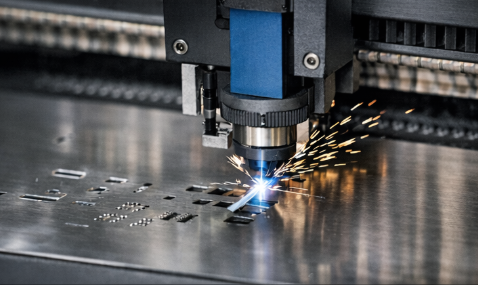
Custom-cut stencils are PCB-Mounting stencils designed to match the PCB designs, with support for accurate alignment of apertures on each solder pad. These stencils are manufactured on precision laser stencil cutting machines to achieve accurate depth control and smooth, well-defined aperture walls.
Unlike generic stencil cut designs, custom-cut stencils are optimised to match pad geometry, type of component, solder paste, and your production volume. In today’s PCBA manufacturing processes, which have smaller margins for error and tighter tolerances, this customization is even more critical.
Why Custom Cutting Is Needed
PCBs today are loaded with fine-pitch ICs, BGA, QFNs, and CSPs, as well as very small passive components such as 0201 and even smaller 01005 packages. These types of characteristics need to control the volume of the solder and how it is released from the lead paste.
Custom cutting allows engineers to:
● Modify aperture sizes for optimal solder volume.
● Reduce solder bridging in small pin-spacing components.
● Improve paste release for micro pads.
● Provides support for high-density, multi-layer PCB design.
Professional solutions such as JLCPCB’s stencil services can provide you with tailored cut stencils for both prototyping and production in a range of high-quality materials, ensuring consistent solder paste printing.
Benefits of Using a Custom Cut Stencil in PCBA
The benefits of using a custom cut stencil in PCBA include:
● Accurate solder paste deposition
● Improved solder joint consistency
● Reduced rework and assembly defects
● Good performance on fine-pitch and high-density PCBs
● It is desirable for the repeatability of mass production.
These benefits make custom-cut stencils a cornerstone for trustworthy and repeatable PCB assembly.
How to Cut Stencils for PCB
To cut PCB stencils, you need machines and controlled processes, as well as to select the right material. The cutting procedure will influence the stencil life, the release of solder paste, and printing quality
Using Stencil Cutting Machines
The vast majority of professional stencils are produced using a stencil cutting machine, typically employing laser systems of a similar type. These devices offer high precision, clean aperture edges, and excellent repeatability.
Common stencil cutting technologies include:
● Fiber laser stencil cutting machines.
● CO₂ laser cutting systems
● Precision mechanical cutting (limited applications)
Laser stencil cutting machines are frequently used in electronics manufacturing due to their ability to generate smooth aperture sidewalls and sharp edges. Laser is excellent for fine-pitch PCBs and QFN or BGA devices where exact control of solder volume is essential.
The main factors to consider when cutting a stencil are:
● Precision: Buy a necessity for fine-pitch and micro parts
● Stencil thickness: Generally 0.1–0.15 (mm) depending on application
● Repeatability: Key focus is on consistent production output
High-precision stencil cutting machines provide smooth aperture walls, which can greatly enhance solder paste transfer efficiency.
DIY vs Professional Cutting
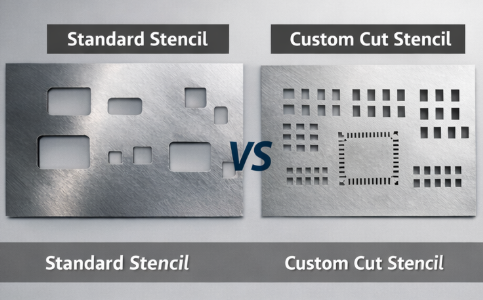
For simple boards, or educational purposes (not industrial production), small-scale DIY stencil-cutting methods, such as manual cutting or inexpensive plotters, may be sufficient. But these approaches don’t deliver the fine accuracy needed for PCB designs in today’s time.
DIY stencil cutting is suitable for:
● Low-density layouts
● Basic prototyping
● Hobby or learning projects
Professional stencil cutting is recommended for:
● Fine-pitch and high-density PCBs
● BGA and QFN components
● Production-grade PCBA
Calibrated stencil cutting machines are used by professional manufacturers because precision and consistency just can’t be retained with DIY methods.
How to Choose a Custom Cut Stencil Company
When it comes to reliable PCB assembly, selecting the proper custom cut stencil company is critical.
Key Considerations
When choosing a company to purchase your stencils from, consider the following:
● Material quality: The reliability and consistency in the implementation are targeted at stainless steel
● Precision capability: Compatible with fine pitch and high-density design
● Lead time: Prototypes and production in no time at all
● Cost: Competitive pricing, quality accepted
● After-sales support: Technical guidance and hand-feel adjustment of the template.
When you are looking for “custom stencil near me,” you should be picking a supplier of modern stencil cutting machines, experienced in manufacturing and customer service. Most engineers choose JLCPCB because it offers integrated PCB production, assembly, and stencil services on a platform, which is easy to use and reliable for both engineers and start-ups.
Best Practices for Using Custom Cut Stencils
A good stencil must be positively controlled and managed carefully to function ideally.
Correct Installation on PCB
● Alignment of the stencil using fiducials
● Guarantee even pressure between stencil and PCB
● Use stable framing or mounting systems.
Tips for Solder Paste Printing
● Prefer the stencil thickness according to your solder paste.
● Use a consistent squeegee speed and pressure throughout
● Inspect solder paste deposits regularly.
Cleaning and Maintenance
● Don't allow the stencil paste to accumulate; clean stencils out after each use.
● Do use specified solvents to prevent the aperture from damage
● Always lay stencils flat so they won’t warp.
The following practices will prolong stencil life and guarantee consistent solder paste printing quality.
Custom-cut stencils are the key to consistent solder-paste printing, symmetrically shaped solder joints, and dependable PCB assembly-line performance. As printed circuit board designs continue to increase in pin density, component count, and overall complexity, the use of standard stencils has become less than optimal. Custom-cut stencils give us the precision, consistency, and process control necessary for high-end prototyping and production runs.
The most important thing for the best results is to work with professional stencil makers in your area who have modern stencil cutting machines and know how to properly optimize the design, materials, and methodology. Reputable manufacturers like JLCPCB stencil services are a reliable option as they provide high-precision SMT stencils and have quick delivery, both ideal for engineers, startups, or producers. When high-quality stencil making is paired with correct handling and printing techniques, custom-cut stencils are transformed into true tools.

Keep Learning
DIY PCB Stencil: How to Make a Solder Paste Stencil
Key Takeaways DIY is possible: You can make a working solder paste stencil from Kapton, Mylar, or vinyl using a craft knife, vinyl cutter, or laser for larger SMD components and low-volume prototyping. 0.5 mm pitch is the practical boundary: DIY stencils work well above 0.5 mm pitch but struggle with finer QFNs, QFPs, and BGAs due to poor aperture quality and paste release. Match thickness to your smallest pad: Use 0.10–0.15 mm (4–6 mil) sheet stock, choosing thinner material for smaller pads and thic......
How to Choose an SMT Stencil
What is an SMT stencil? SMT Stencil is a thin metal sheet used in the soldering process for SMT (Surface Mount Technology) and it plays an essential role in the SMT soldering process. Smt Stencil allows the direct placement of solder paste onto the SMD pads of PCB, which can help prevent errors and defects during the reflow soldering process. This results in a precise amount of tin coverage once the work is completed. Types of SMT Stencils Depending on the application of solder paste, there are three ......
Order Custom Stencils for PCB Assembly: How to Make, Buy, and Choose the Right Supplier
Surface Mount Technology (SMT) stencils are essential tools in modern PCB assembly. They are thin sheets of metal, usually stainless steel, with precise cut-outs that allow solder paste to be applied accurately to PCB pads. The quality of the stencil directly affects solder paste deposition, which in turn impacts the reliability of the final assembled PCB. Engineers often need to order custom stencils instead of relying on generic options. Every PCB design has unique pad layouts, component densities, ......
Custom Stencils for PCB Assembly: Design, Ordering, and Usage Guide
Have you ever faced solder bridging or insufficient solder issues that ruined an entire production batch? In many cases, the problem is not the pick-and-place machine, but the very first step of the process: solder paste printing. This is where custom stencils make the difference between a reliable product and one that requires extensive rework. Unlike rigid standard stencils, a custom SMT stencil gives engineers full control over solder paste volume, allowing precise adjustment to match increasingly ......
SMT Stencil Thickness Guide 2026: How to Choose the Right Solder Paste Stencil
In SMT assembly, the stencil quietly decides whether a production run succeeds or fails. Problems like bridging, tombstoning, and insufficient wetting are frequently traced back not to PCB design errors, but to incorrect stencil selection or poorly controlled paste volume. Quick Answer: How to Choose a Solder Paste Stencil If you need to define your stencil parameters immediately, follow this quick decision guide: Select thickness based on component pitch: Use component density as your primary baselin......
Custom Cut Stencils for PCB Assembly: How to Cut, Use and Choose the Right PCB Stencil
Custom-cut stencil and Solder paste printing are two of the most vital processes in Surface Mount Technology (SMT) PCB assembly, concerning solder joint quality, electrical performance, and product reliability over time. SMT stencils are used to deposit solder paste in accurate amounts onto PCB pads, or for depositing and compressing adhesive pastes which are arranged in the form of a column on components such as connectors and sockets. While PCB designs have seen a trend toward increased density, fin......