The History and Evolution of Polyimide (PI) Film
8 min
- Polyimide Film: The Material Behind the History
- Key Milestones in the History of Polyimide Film
- The Origins of Commercial Polyimide Film
- Why Polyimide Film Found Uses Beyond Space
- From Aerospace to Electronics: The Expansion of Applications
- How the Polyimide Film Industry Diversified
- Polyimide Film's Continuing Role in Space Engineering
- From Material Development to Modern Flexible Heaters
- FAQs About the History of Polyimide Film
Polyimide film has become a critical material in aerospace, electronics, flexible circuits, and other demanding applications. Its history is a progression from making a heat-resistant polymer into a usable film to adapting that film for increasingly specialized engineering needs.
This article traces the history and evolution of polyimide (PI) film through Kapton's early commercialization, space applications, the expansion of electronics, and newer developments in optical and high-frequency materials.
Polyimide Film: The Material Behind the History
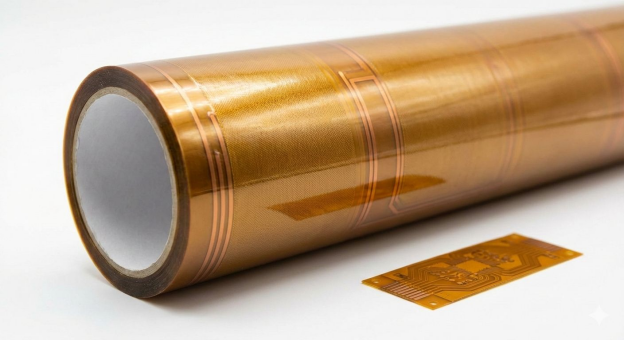
Polyimide film is a thin polymer film containing imide groups in its molecular structure. Many commercial grades combine heat resistance, electrical insulation, and mechanical flexibility. These characteristics help explain its adoption, but the properties of one grade should not be treated as specifications for every PI film.
Key Milestones in the History of Polyimide Film
| Period | Development | Why It Mattered |
|---|---|---|
| 1960s | Kapton emerged as a commercial polyimide film and entered space applications. | Heat-resistant polymer chemistry became a practical, lightweight insulating film. |
| 1983–1984 | UBE began polyimide film production in 1983; Kaneka marketed APICAL in 1984. | The industry expanded with additional manufacturers and material families. |
| 2019 | Toray announced a low-dielectric-loss polyimide material for high-frequency electronic components. | Development increasingly addressed signal performance alongside thermal and mechanical requirements. |
| 2022 | The James Webb Space Telescope's five-layer Kapton sunshield was fully deployed. | Engineered film assemblies continued to support demanding space missions. |
| 2025 | Mitsubishi Gas Chemical announced mass production of fluorine-free transparent PI film made from Neopulim varnish. | Optical performance and formulation choices opened further development paths. |
The Origins of Commercial Polyimide Film
From Polymer Chemistry to a Usable Film
A heat-resistant polymer is useful only if it can be processed into the form an application needs. For polyimide film, an important processing route uses a soluble polyamic acid precursor that can be cast before conversion into polyimide. This made film formation possible without requiring the final heat-resistant polymer to behave like an ordinary melt-processable plastic.
The significance was practical: engineers could obtain a thin insulating layer rather than only a polymer with promising laboratory properties. Toray's explanation of polyimide chemistry describes this precursor-to-polyimide conversion. It is an important route, rather than the only route used for every modern formulation.
Kapton and the Space Race
DuPont's Kapton became a defining commercial example during the 1960s. The Space Race provided a demanding application: spacecraft needed lightweight materials that could function through large temperature changes while providing electrical insulation and supporting thermal protection.
According to DuPont's account of Kapton in space missions, the film supported spacecraft missions including Apollo 11 in July 1969. Its use established a long association between polyimide film and space engineering.
Spacecraft thermal protection depends on the complete assembly. Reflective coatings, multiple layers, spacing, and installation all contribute to performance. Bare PI film should not be understood as providing the same thermal protection as a finished spacecraft insulation blanket.
Why Polyimide Film Found Uses Beyond Space
Polyimide film combines several characteristics that are useful together: resistance to heat, electrical insulation, and a thin, flexible form. This combination helped it move beyond specialized aerospace uses into electrical and electronic assemblies.
The important engineering change was the ability to place insulation where bulky or less heat-resistant materials could limit the design. Exact temperature capability, dielectric performance, and mechanical behavior remain dependent on the grade, thickness, test conditions, and finished assembly. They are material-selection questions rather than a single set of universal PI values.
From Aerospace to Electronics: The Expansion of Applications
Flexible Circuits and Compact Electronic Assemblies
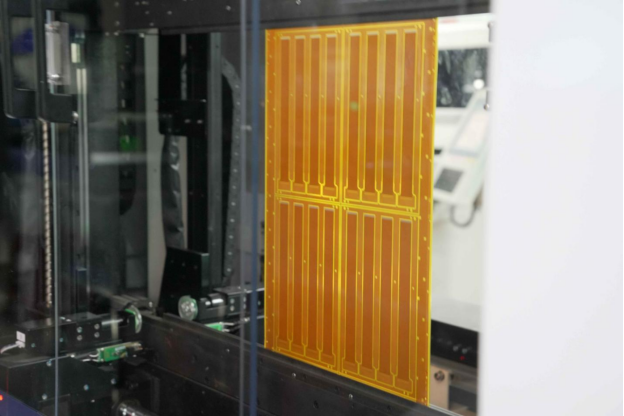
Flexible printed circuits created a major role for polyimide film in electronics. Copper circuitry supported by an insulating film can connect components within compact products and accommodate bends during installation. The film must work with the conductor, bonding system, and assembly process.
This expanded the material's role from protecting specialized equipment to enabling the layout of everyday electronic products. For the construction and design requirements of these circuits, see the polyimide flexible PCB guide.
Electrical Equipment and Automotive Electronics
Electrical insulation offered another route into broader industrial use. Kaneka lists motor and generator wire insulation, aircraft wire coverings, and flexible circuit materials among the applications of its polyimide film products. These applications illustrate the variety of components that can use the same broad material family.
Automotive and battery-related designs also create requirements for compact insulation and flexible interconnections. Suitability depends on the component and its qualification requirements. A film used in a flexible circuit, an insulating tape, and a battery assembly does not automatically have the same construction or rating.
How the Polyimide Film Industry Diversified
Additional Manufacturers and Material Families
The industry's expansion included new manufacturers and formulations. UBE's corporate history records the start of polyimide film production in 1983. Kaneka's history records the development and marketing of APICAL in 1984.
These developments broadened the commercial material landscape. Product families such as Kapton, UPILEX, and APICAL should be understood as distinct commercial families, not interchangeable names for an identical film. Their relevance here is the diversification of the industry; selecting a particular grade requires its own technical comparison.
Transparent Materials for Optical and Display Applications
Optical applications brought a different challenge. The amber appearance associated with many conventional aromatic PI films can be unsuitable where light transmission matters. Transparent polyimide formulations address a requirement that is separate from heat resistance alone.
Mitsubishi Gas Chemical's Neopulim is an example of a transparent, solvent-soluble polyimide varnish that can form films. In February 2025, the company announced mass production of fluorine-free transparent polyimide film made from this material, with a production system established in January 2025. This milestone concerns that formulation and production development, not the first invention of transparent PI.
Transparent PI can support optical and display designs, but the performance of a foldable display depends on its complete layer structure. A fold-life figure from one device or film cannot be applied to all transparent polyimides.
Lower Dielectric Loss for High-Frequency Electronics
Higher operating frequencies introduced further demands on insulating materials. In May 2019, Toray announced a low-dielectric-loss polyimide material for electronic components in 5G communications and millimeter-wave radar.
The development illustrates a broader shift toward application-specific electrical performance. It does not mean that every modified PI is fluorinated or that all PI films provide the same high-frequency behavior.
Polyimide Film's Continuing Role in Space Engineering
The history did not end when electronics adopted the material. NASA's James Webb Space Telescope provides a later example: its sunshield uses five layers of Kapton film with coatings and a carefully engineered separation between the layers.
NASA confirmed full sunshield deployment on January 4, 2022. Its sunshield overview explains the film, coatings, and geometry. This is a useful example of how a familiar material can support a new mission through advances in assembly design.
From Material Development to Modern Flexible Heaters
Flexible heaters are another application of the material's thin, electrically insulating form. In a typical etched-foil PI heater, the resistive circuit generates heat, while the surrounding PI layers provide insulation and support.
The history explains why PI became useful; it does not establish a finished heater's temperature rating. Bonding layers, mounting, terminations, heat transfer, and control all affect the usable assembly. Readers evaluating that application can compare the practical trade-offs in choosing insulating materials for flexible heaters.
JLCPCB uses polyimide film in its custom flexible heater service. The relevant next step is to match the complete heater construction to the application, rather than transfer a raw-film property directly to the finished product.
FAQs About the History of Polyimide Film
Was Polyimide Film Developed Only for Spacecraft?
No. Polyimide film is a material technology with applications beyond spacecraft. Space missions were an important early use, while electrical insulation and flexible electronics created additional applications with their own requirements.
Did Electronics Replace Aerospace as a Use for PI Film?
No. The uses expanded rather than replacing one another. The Webb sunshield is a modern space example, while flexible circuits and other electronic assemblies show how the material family serves different engineering needs.
Why Do New PI Formulations Continue to Appear?
Applications require different combinations of optical clarity, dimensional stability, adhesion, electrical behavior, and heat resistance. New formulations address those combinations. A newer grade is therefore not automatically a better replacement for every older grade.
Keep Learning
JLCPCB Flexible Heater Manufacturing Process: A Comprehensive Guide
In various industries, resistive heating elements play a critical role in converting electrical energy into heat. As demand grows for more compact and customizable thermal solutions, flexible heater manufacturing has become essential to producing efficient and reliable heating components. Flexible heaters, particularly polyimide (PI) flexible heaters, are known for their thin, lightweight, and adaptable design, which is crucial for effective thermal management across a wide range of applications—from ......
The History and Evolution of Polyimide (PI) Film
Polyimide film has become a critical material in aerospace, electronics, flexible circuits, and other demanding applications. Its history is a progression from making a heat-resistant polymer into a usable film to adapting that film for increasingly specialized engineering needs. This article traces the history and evolution of polyimide (PI) film through Kapton's early commercialization, space applications, the expansion of electronics, and newer developments in optical and high-frequency materials. ......
What Is a Flexible Heater? A Complete Guide
Flexible heaters provide customizable heating for applications where space, shape, or installation conditions make conventional rigid heaters difficult to use. But different materials offer different specifications, so selecting the right heater requires more than choosing a size and target temperature. This guide explains what flexible heaters are, how they work, the main types available from JLCPCB, and the differences between polyimide and silicone rubber heaters. It also covers common applications......
The Complete Guide to Silicone Rubber: Properties, Applications, and Benefits
When we think of rubber, we often imagine car tires or elastic bands. However, there is a "super-material" in the elastomer family that operates where ordinary rubbers fail: Silicone Rubber. From the seal in your smartphone to life-saving medical implants and the turbocharger hoses in high-performance cars, silicone rubber is the silent hero of modern engineering. Consider this: the same material that makes your flexible phone case also keeps astronauts safe in space, helps premature babies breathe in......
What Are the Difference between Polyimide Flexible Heater and FPC?
Introduction While polyimide (PI) flexible heaters and flexible printed circuit boards (FPCs) may appear similar in structure, their materials, tolerances, and purposes are fundamentally different. PI flexible heaters are designed for heat generation and thermal management, whereas FPCs focus on signal transmission and electrical interconnection. This article explains their differences in features, structures, and functions, helping engineers choose the optimal solution for their applications. Feature......
The Evolution of Flexible Heaters: From Early Prototypes to Modern Applications
The history of engineering is often narrated through grand monuments that dominate the horizon—soaring cross-sea bridges, colossal skyscrapers, and the rhythmic thunder of steam engines. Yet, there is a narrative just as profound and compelling to be found in the subtle, thin, and often invisible components that form the hidden foundations of modern life. Among these, the trajectory of the Flexible Heating Film stands as a testament not only to breakthroughs in materials science but to the persistent ......