The Evolution of Flexible Heaters: From Early Prototypes to Modern Applications
6 min
- The Foundation Era: Early Explorations in Flexible Heating (Late 19th - Mid-20th Century)
- The Material Revolution: Polymers Usher in the Thin-Film Era (Mid-20th - Late 20th Century)
- The Maturity Phase: The Dual-Dominance of PI and Silicone (21st Century - Present)
- Conclusion: Why Flexible Heating Matters Today
The history of engineering is often narrated through grand monuments that dominate the horizon—soaring cross-sea bridges, colossal skyscrapers, and the rhythmic thunder of steam engines. Yet, there is a narrative just as profound and compelling to be found in the subtle, thin, and often invisible components that form the hidden foundations of modern life. Among these, the trajectory of the Flexible Heating Film stands as a testament not only to breakthroughs in materials science but to the persistent human quest for precision control and the microscopic distribution of thermal energy.
The Foundation Era: Early Explorations in Flexible Heating (Late 19th - Mid-20th Century)
When we examine the origins of flexible heating, we must look back to the late 19th century, an era of feverish electrical experimentation. It was a turning point where engineers sought to unravel the nature of resistance and find the limits of efficiency in converting current into work. In 1879, Joseph Wilson Swan and Thomas Edison did more than just invent the light bulb; through their experiments with carbonized bamboo fibers and various organic filaments, they inadvertently revealed the immense potential of resistive heating. While their primary intent was to capture light, the attendant heat posed a new question: how could this searing energy be tamed and packaged into a form that was flexible, wrappable, and enduringly durable?
The transition from rigid filaments to flexible "films" began with a series of early attempts that were as fascinating as they were somewhat clunky. In 1894, Dr. S. Salaghi demonstrated a device in Rome called "electrical thermo plasms." To modern eyes, these appeared more like industrial textiles—essentially fragile heating wires hand-sewn into thick asbestos pads. In 1895, John Emory Meek patented an asbestos-metal composite fabric, further strengthening the structural integrity of these rudimentary heaters by weaving conductive metal weft into asbestos warp. These inventions marked the first stage of engineering evolution: a logic of "bricolage," utilizing ancient weaving crafts to constrain and distribute nascent electricity.
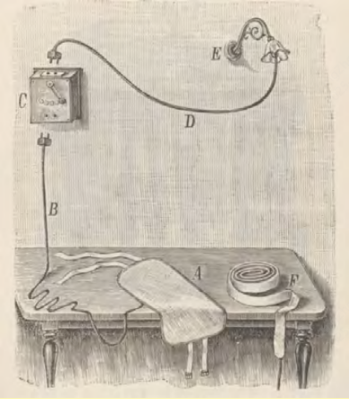
Dr. S. Salaghi's Thermoplasma (1893). The oval-shaped one (A) can be used for truck heating, while the long strip-shaped one (F) can be used for full-body applications from head to toe.
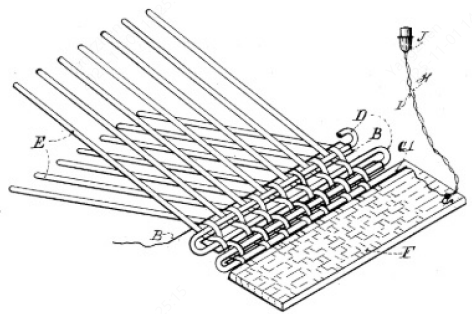
On June 4, 1895, Patent No. 540,398 was granted to John Emory Meek of Denver, who described for Johns Manufacturing Company of New York a heating fabric wherein the warp yarns (E) were made of asbestos, and the weft yarns (B) were made of conductive metal, with an additional asbestos interlayer in the weft (D). The ends of the heating element (F) did not contain a heating wire.
However, from a Petroskian engineering perspective, these early solutions were fraught with the risk of "inevitable failure." While asbestos performed admirably in heat resistance, its physical thickness severely limited thermal conduction efficiency, leading to highly uneven heat distribution. Furthermore, the carcinogenic nature of asbestos fibers remained unrecognized at the time. Although the two World Wars greatly stimulated technical demand—producing heated suits to protect high-altitude pilots from frostbite and transparent heating layers to solve aircraft wing icing—stagnation in materials science meant these devices remained bulky, brittle, and prone to mechanical fatigue and circuit breakage under repeated bending.
The Material Revolution: Polymers Usher in the Thin-Film Era (Mid-20th - Late 20th Century)
True paradigm shifts in engineering rarely stem from minor design tweaks; they arise from the subversion of underlying materials. In the 1950s, DuPont successfully commercialized polyimide (PI) film, famously known as Kapton. The advent of polyimide was nothing short of an apocalypse for the field of flexible heating: this material possessed a paper-like thinness while achieving a near-perfect balance in engineering performance. It remained resilient and maintained its electromechanical integrity in extreme environments—from the searing 400°C that would melt conventional plastics to the cryogenic -269°C where they would shatter into powder.
The appearance of PI film marked the leap of heating elements from "heavy woven bodies" to "ultimate thin films." The material's inherent radiation resistance and chemical inertness quickly made it a core component of the Cold War space race. Whether in orbiting satellites or the sensor shields of deep-space probes, PI heating films provided stable thermal output under the constant erosion of the vacuum environment and solar winds, preventing precision instruments from failing due to extreme cold.
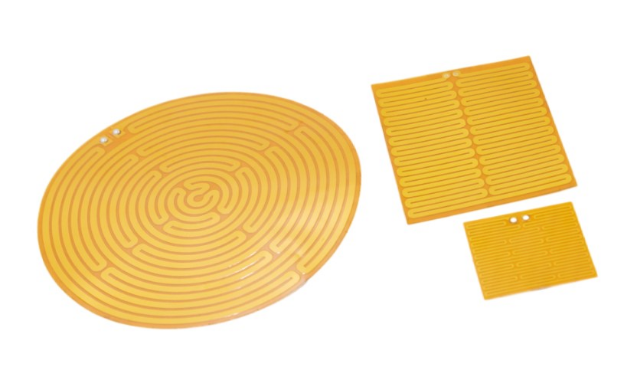
PI Heater
Simultaneously, Silicone Rubber established itself in the industrial sector as another high-potential insulating substrate. Compared to PI film, silicone offered a thicker, more elastic, and exceptionally weather-resistant protection. However, early silicone heaters encountered a classic engineering challenge: the uniform dispersibility of conductive fillers. Engineers attempted to mix nickel-chromium or graphite powders into liquid silicone, but microscopic dispersion limits often led to "hot spots" caused by filler aggregation. These hot spots not only scorched the substrate but posed significant safety hazards. The "imperfections" shown by this material forced subsequent engineers to relentlessly explore refined vulcanization processes and nano-dispersion formulas, eventually achieving performance stability through persistent trial and error.
The Maturity Phase: The Dual-Dominance of PI and Silicone (21st Century - Present)
In the 21st century, flexible heating technology has reached a peak of refined design, presenting a dual landscape of cutting-edge high-tech applications alongside large-scale civilian adoption.
By bridging the gap between historical engineering wisdom and modern high-definition manufacturing, the "thin film" concept has been perfected. Modern Polyimide heaters now leverage high-definition etched foil circuits—a direct descendant of Flexible PCB technology—to achieve micron-level precision. Meanwhile, reinforced Silicone heaters have evolved into robust industrial workhorses, utilizing advanced fillers to ensure the uniform heat distribution that eluded early pioneers.
Whether it is the precision thermal control of a satellite in the silent vacuum or the battery guardian of an electric vehicle in a polar blizzard, the story of the heating film is more than just a succession of materials. It reveals a profound engineering philosophy: the most exceptional designs are often those that are the least conspicuous.
Conclusion: Why Flexible Heating Matters Today
In today's wave of design pursuing extreme energy efficiency and spatial miniaturization, the engineering significance of heating films is more prominent than ever. It has completely shattered the formal constraints of traditional heating tubes, allowing heating elements to conform to any complex geometric surface like skin. Compared to bulky point-source heating, the film's large-area surface heating significantly reduces energy loss and improves system response speed.
Hidden in the deepest recesses of equipment, resisting the cold with a form as thin as a cicada's wing, these films condense and carry the crystallized wisdom of over a century of human mastery over thermal energy. In the hands of modern platforms like JLCPCB, which streamline the journey from prototype to production, this wisdom is now more accessible than ever, ready to power the next generation of technological breakthroughs.
Keep Learning
JLCPCB Flexible Heater Manufacturing Process: A Comprehensive Guide
In various industries, resistive heating elements play a critical role in converting electrical energy into heat. As demand grows for more compact and customizable thermal solutions, flexible heater manufacturing has become essential to producing efficient and reliable heating components. Flexible heaters, particularly polyimide (PI) flexible heaters, are known for their thin, lightweight, and adaptable design, which is crucial for effective thermal management across a wide range of applications—from ......
The History and Evolution of Polyimide (PI) Film
Polyimide film has become a critical material in aerospace, electronics, flexible circuits, and other demanding applications. Its history is a progression from making a heat-resistant polymer into a usable film to adapting that film for increasingly specialized engineering needs. This article traces the history and evolution of polyimide (PI) film through Kapton's early commercialization, space applications, the expansion of electronics, and newer developments in optical and high-frequency materials. ......
What Is a Flexible Heater? A Complete Guide
Flexible heaters provide customizable heating for applications where space, shape, or installation conditions make conventional rigid heaters difficult to use. But different materials offer different specifications, so selecting the right heater requires more than choosing a size and target temperature. This guide explains what flexible heaters are, how they work, the main types available from JLCPCB, and the differences between polyimide and silicone rubber heaters. It also covers common applications......
The Complete Guide to Silicone Rubber: Properties, Applications, and Benefits
When we think of rubber, we often imagine car tires or elastic bands. However, there is a "super-material" in the elastomer family that operates where ordinary rubbers fail: Silicone Rubber. From the seal in your smartphone to life-saving medical implants and the turbocharger hoses in high-performance cars, silicone rubber is the silent hero of modern engineering. Consider this: the same material that makes your flexible phone case also keeps astronauts safe in space, helps premature babies breathe in......
What Are the Difference between Polyimide Flexible Heater and FPC?
Introduction While polyimide (PI) flexible heaters and flexible printed circuit boards (FPCs) may appear similar in structure, their materials, tolerances, and purposes are fundamentally different. PI flexible heaters are designed for heat generation and thermal management, whereas FPCs focus on signal transmission and electrical interconnection. This article explains their differences in features, structures, and functions, helping engineers choose the optimal solution for their applications. Feature......
The Evolution of Flexible Heaters: From Early Prototypes to Modern Applications
The history of engineering is often narrated through grand monuments that dominate the horizon—soaring cross-sea bridges, colossal skyscrapers, and the rhythmic thunder of steam engines. Yet, there is a narrative just as profound and compelling to be found in the subtle, thin, and often invisible components that form the hidden foundations of modern life. Among these, the trajectory of the Flexible Heating Film stands as a testament not only to breakthroughs in materials science but to the persistent ......