The Complete Guide to Silicone Rubber: Properties, Applications, and Benefits
12 min
- What is Silicone Rubber?
- Outstanding Properties of Silicone Rubber
- Physical and Mechanical Characteristics
- Thermal and Electrical Performance
- Chemical Stability and Durability
- Types of Silicone Rubber
- Processing and Manufacturing Methods
- Industries and Applications
- Advantages & Limitations
- The Environmental Consideration
- Future Trends
- FAQ about Silicone Rubber
- Conclusion: Silicone Rubber Properties and Applications
When we think of rubber, we often imagine car tires or elastic bands. However, there is a "super-material" in the elastomer family that operates where ordinary rubbers fail: Silicone Rubber. From the seal in your smartphone to life-saving medical implants and the turbocharger hoses in high-performance cars, silicone rubber is the silent hero of modern engineering.
Consider this: the same material that makes your flexible phone case also keeps astronauts safe in space, helps premature babies breathe in incubators, and prevents your car engine from overheating. What makes silicone rubber so remarkably versatile? The answer lies in its unique molecular architecture.
What is Silicone Rubber?
At its heart, silicone rubber is an "inorganic-organic" hybrid—a molecular chimera that combines the best of two worlds. While most rubbers have a backbone made of carbon-carbon ($C-C$) bonds, silicone rubber features a primary chain of alternating silicon and oxygen atoms ($Si-O-Si$).
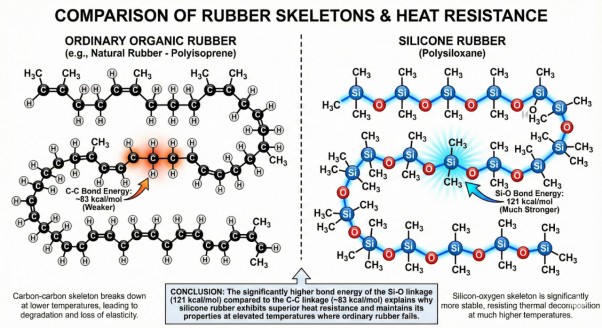
This difference is crucial. The $Si-O$ bond energy is approximately $121\text{ kcal/mol}$, significantly higher than the $C-C$ bond. This "molecular skeleton" is more stable, longer, and more flexible, giving silicone its legendary resistance to heat and aging. Essentially, while organic rubbers are like wooden bridges that might rot or burn, silicone is more like a flexible steel structure.
The silicon atom itself comes from sand—the second most abundant element in Earth’s crust. Yet through chemical wizardry, we transform beach grains into a material that can withstand the harshest environments known to engineering.
Outstanding Properties of Silicone Rubber
Why do engineers choose silicone? It’s all about surviving extremes.
Exceptional Temperature Resistance
Imagine a material that laughs at temperature swings that would destroy other rubbers. Silicone remains stable from as low as $-50^\circ\text{C}$ (colder than a typical Arctic winter) to as high as $+250^\circ\text{C}$ (hot enough to bake a pizza). Special formulations can even stretch this range from $-110^\circ\text{C}$ to $+300^\circ\text{C}$. This is why NASA uses it in spacecraft, where the sun-facing side might be scorching while the shadow side plunges to frigid depths.
Superior Flexibility
Even in the deep freeze of the Arctic or the vacuum of space, silicone won’t become brittle. Drop a regular rubber ball at -40°C and it might shatter like glass. A silicone ball? It bounces.
Electrical Insulation
It is a world-class insulator, maintaining its dielectric properties even under fluctuating temperatures. Think of it as the perfect bodyguard for electrons—it keeps them exactly where they need to be, preventing dangerous electrical leakage.
Weather and UV Resistance
Unlike plastic that cracks in the sun or rubber that degrades in the rain, silicone is virtually immune to ozone, UV radiation, and moisture. Leave a silicone gasket outdoors for a decade, and it will look nearly the same as the day you installed it.
Biocompatibility
It is chemically inert, meaning it doesn’t react with human tissue, making it the gold standard for medical use. Your body treats silicone like a polite stranger—it doesn’t trigger inflammation or rejection, which is why it can stay implanted for decades.
Physical and Mechanical Characteristics
Silicone is highly customizable, like having a material with adjustable settings. Its hardness is measured on the Shore A scale, ranging from 3 (as soft as a gel, like those squishy stress toys) to 90 (as hard as a plastic skateboard wheel).
While silicone isn’t the "strongest" rubber in terms of raw tensile strength (averaging $4\text{ to }12\text{ MPa}$), it excels in elongation. It can stretch between 100% and 1100% of its original length before breaking—imagine pulling a rubber band to eleven times its original size! Furthermore, it has excellent compression set resistance, meaning if you squash it, it springs back to its original shape better than almost any other material. This "memory" is crucial for seals and gaskets that experience millions of compression cycles.
Thermal and Electrical Performance
Silicone’s thermal conductivity is naturally low ($0.2\text{ W/m}\cdot\text{K}$), making it a great heat shield. However, by adding fillers like alumina or boron nitride, it can be transformed into a thermal interface material to help cool computer chips—turning an insulator into a heat highway.
Electrically, it is a powerhouse. With a volume resistivity of $10^{14}\text{ to }10^{15}\text{ }\Omega\cdot\text{cm}$, it prevents electricity from leaking even in high-voltage environments. To put this in perspective, silicone is about a trillion times more resistant to electrical current than seawater. This is why it’s used to coat high-tension power lines, where a single failure could black out entire neighborhoods.
Chemical Stability and Durability
Silicone is tough against the elements but has a specific Achilles’ heel.
The Good: It stands up to acids, alkalis, salt spray, and seawater. Dunk it in battery acid or ocean water, and it emerges unscathed. This makes it perfect for marine environments, where saltwater corrodes metal and degrades most plastics within years.
The Bad: Watch Out for Petroleum
Silicone does not like petroleum. Standard silicone will swell and weaken if exposed to gasoline or mineral oils—like a sponge absorbing water. For those cases, engineers use a special variant called Fluorosilicone, which combines silicone’s temperature resistance with fuel resistance.
Types of Silicone Rubber
1High Temperature Vulcanizing (HTV)
Also known as Heat Cured Rubber (HCR). It comes as a solid block and is used for heavy-duty industrial parts. Think of it as the "bake-at-home bread" of silicones—you mix it, shape it, and cure it with heat.
2Liquid Silicone Rubber (LSR)
A two-part system with the consistency of honey. It’s used for high-precision injection molding (like infant bottle nipples and medical devices). LSR is the gold standard when you need microscopic precision and perfect repeatability.
3Room Temperature Vulcanizing (RTV)
These are the sealants and glues that cure just by being exposed to air or mixed at room temperature. This is the silicone you can buy at the hardware store to seal your bathtub or aquarium.
Processing and Manufacturing Methods
- Compression Molding — like a waffle iron, raw silicone is pressed into a hot mold. Simple, reliable, and perfect for making gaskets and seals in moderate volumes.
- Injection Molding — best for LSR, where the liquid is "injected" into a mold for fast, high-volume production. This method can produce thousands of identical parts per day with incredible precision.
- Extrusion — used for making long tubes, seals, or wire insulation. Imagine squeezing toothpaste through a shaped nozzle—that’s essentially extrusion, but with hot silicone.
- Dip Coating — thin layers are applied to fabrics or wires to give them a protective silicone skin. This is how surgical gloves get their coating and how wires get weatherproof insulation.
Industries and Applications
1Automotive Industry
Silicone keeps your car running smoothly through extremes. It’s in the ignition cables to prevent sparks from misfiring, in turbocharger hoses that handle air heated to 200°C, and in gaskets that prevent oil leaks in engines operating at temperatures that would melt ordinary rubber. It even acts as the adhesive that ensures your airbags deploy correctly in a crash—a life-or-death application where failure is not an option.
Modern electric vehicles rely even more heavily on silicone. Battery pack seals must prevent water ingress while allowing thermal expansion, and high-voltage cable insulation must perform flawlessly for 10+ years.
2Aerospace Applications
At 30,000 feet, temperatures drop drastically to -40°C or colder, and cosmic radiation increases. Silicone is used for cabin seals that maintain pressure, vibration dampening systems that protect sensitive instruments, and avionics insulation because it won’t fail when the environment gets hostile. When SpaceX launches rockets, silicone seals protect critical systems during the violent acceleration and extreme temperature swings from Earth to orbit.
3Medical and Healthcare
Because it is non-toxic (FDA and ISO 10993 compliant), silicone is used for catheters, respiratory tubes, and even long-term implants like pacemaker leads and breast implants. It’s also the material of choice for baby products like pacifiers and bottle nipples. In hospitals, silicone tubing carries everything from blood to medications without contaminating them or degrading over time.
The COVID-19 pandemic highlighted silicone’s critical role: ventilator tubes, respiratory masks, and vaccine vial seals all relied on medical-grade silicone to save lives.
4Electronics and Electrical
Your smartphone is likely waterproof thanks to tiny silicone O-rings that keep moisture away from delicate circuits. In your computer, thermal pads move heat away from the CPU to prevent overheating, while conductive keypads provide the satisfying "click" in your remote control and game controllers.
As electronics get smaller and more powerful, they generate more heat in tighter spaces—making silicone’s thermal management properties more critical than ever.
5Food Contact Applications
From spatulas and baking molds to the seals in industrial food mixers and coffee machines, silicone is favored because it is odorless, tasteless, and doesn’t leach chemicals into your food—even when heated. Unlike some plastics that can release potentially harmful compounds at high temperatures, silicone remains stable and safe at cooking temperatures.
Professional kitchens and food manufacturers rely on silicone because it can go from freezer (-40°C) to oven (+230°C) without degrading.
Advantages & Limitations
Advantages
- Extreme temperature range (-50°C to +250°C)
- Non-toxic, odorless, and food-safe
- Excellent UV and weather resistance
- Superior electrical insulation
- Biocompatible and hypoallergenic
Limitations
- Lower tear strength than natural rubber
- Poor resistance to oils/fuels (except Fluorosilicone)
- Higher cost than organic rubbers
- High gas permeability (not ideal for vacuum seals)
- Can be damaged by sharp objects more easily
The Environmental Consideration
While silicone offers exceptional durability—meaning products last longer and create less waste—it’s not biodegradable. However, it doesn’t break down into harmful microplastics like conventional plastics. Instead, it eventually breaks down into silica (sand), water, and carbon dioxide through environmental exposure. Researchers are also developing recycling methods that can break down used silicone back into usable raw materials.
Future Trends
The future of silicone is "Smart" and sustainable. We are seeing the development of:
- Highly thermally conductive silicones for electric vehicle batteries that need precise temperature control to prevent thermal runaway
- Self-healing silicones that can repair small tears and punctures automatically
- Electrically conductive silicones for flexible electronics and wearable health monitors
- Eco-friendly recycling methods to make the material more sustainable and reduce manufacturing waste
- Bio-derived silicones that reduce dependence on petroleum-based processes
As we push further into space exploration, deeper into the human body with medical tech, and toward more sustainable energy solutions, silicone rubber will be the material that makes it possible. Its unique combination of flexibility, durability, and resistance to extremes positions it as an enabling technology for the next generation of innovation.
FAQ about Silicone Rubber
Q: What makes silicone rubber resistant to extreme temperatures?
Silicone rubber’s resistance to extreme temperatures comes from its unique molecular structure, which features a backbone of alternating silicon and oxygen atoms ($Si-O-Si$). The $Si-O$ bond has a high bond energy of approximately $121\text{ kcal/mol}$, making it more stable and flexible than the carbon-carbon ($C-C$) bonds found in most organic rubbers. This allows silicone to remain stable across a wide temperature range, from $-50^\circ\text{C}$ to $+250^\circ\text{C}$, with special formulations extending this range even further.
Q: Why is silicone rubber preferred for medical applications?
Silicone rubber is biocompatible, chemically inert, and non-toxic, meaning it does not react with human tissue or trigger inflammation. These properties make it ideal for long-term medical implants, such as pacemaker leads and catheters. Additionally, silicone is hypoallergenic and complies with FDA and ISO 10993 standards, ensuring its safety for use in medical devices and baby products like bottle nipples and pacifiers.
Q: What are the limitations of silicone rubber?
While silicone rubber offers exceptional durability and resistance to heat, UV radiation, and chemicals, it has some limitations:
- Lower tear strength: silicone is not as strong as natural rubber in terms of tear resistance.
- Poor resistance to oils and fuels: standard silicone swells and weakens when exposed to petroleum-based substances, though Fluorosilicone variants address this issue.
- Higher cost: silicone is more expensive than organic rubbers, which can be a consideration for cost-sensitive applications.
- High gas permeability: silicone is not ideal for vacuum seals due to its tendency to allow gas to pass through.
Conclusion: Silicone Rubber Properties and Applications
Understanding silicone rubber is key to mastering thermal management and material selection in modern engineering. For professional engineers, manufacturers like JLCPCB utilize these advanced properties to create high-quality silicone and polyimide (PI) heating films, providing reliable thermal solutions for various high-precision industries.
From the mundane to the extraordinary—from your kitchen spatula to the Mars rover—silicone rubber proves that sometimes the most unassuming materials are the ones that make the impossible possible. It’s not just a rubber; it’s a testament to how understanding molecular chemistry can create materials that extend human capability into realms once thought unreachable.
Keep Learning
The History and Evolution of Polyimide (PI) Film
Polyimide film has become a critical material in aerospace, electronics, flexible circuits, and other high-performance applications. But its development did not happen overnight. From the early commercialization of polyimide materials to modern applications in flexible electronics, the history of polyimide film reflects the changing demands of engineering over more than half a century. This article traces the major stages in the development of polyimide film, from its origins in the Space Race to its ......
What Is a Flexible Heater? A Complete Guide
Flexible heaters provide customizable heating for applications where space, shape, or installation conditions make conventional rigid heaters difficult to use. But different materials offer different specifications, so selecting the right heater requires more than choosing a size and target temperature. This guide explains what flexible heaters are, how they work, the main types available from JLCPCB, and the differences between polyimide and silicone rubber heaters. It also covers common applications......
The Complete Guide to Silicone Rubber: Properties, Applications, and Benefits
When we think of rubber, we often imagine car tires or elastic bands. However, there is a "super-material" in the elastomer family that operates where ordinary rubbers fail: Silicone Rubber. From the seal in your smartphone to life-saving medical implants and the turbocharger hoses in high-performance cars, silicone rubber is the silent hero of modern engineering. Consider this: the same material that makes your flexible phone case also keeps astronauts safe in space, helps premature babies breathe in......
What Are the Difference between Polyimide Flexible Heater and FPC?
Introduction While polyimide (PI) flexible heaters and flexible printed circuit boards (FPCs) may appear similar in structure, their materials, tolerances, and purposes are fundamentally different. PI flexible heaters are designed for heat generation and thermal management, whereas FPCs focus on signal transmission and electrical interconnection. This article explains their differences in features, structures, and functions, helping engineers choose the optimal solution for their applications. Feature......
The Evolution of Flexible Heaters: From Early Prototypes to Modern Applications
The history of engineering is often narrated through grand monuments that dominate the horizon—soaring cross-sea bridges, colossal skyscrapers, and the rhythmic thunder of steam engines. Yet, there is a narrative just as profound and compelling to be found in the subtle, thin, and often invisible components that form the hidden foundations of modern life. Among these, the trajectory of the Flexible Heating Film stands as a testament not only to breakthroughs in materials science but to the persistent ......
JLCPCB Flexible Heater Manufacturing Process: A Comprehensive Guide
In various industries, resistive heating elements play a critical role in converting electrical energy into heat. As demand grows for more compact and customizable thermal solutions, flexible heater manufacturing has become essential to producing efficient and reliable heating components. Flexible heaters, particularly polyimide (PI) flexible heaters, are known for their thin, lightweight, and adaptable design, which is crucial for effective thermal management across a wide range of applications—from ......