Flexible Heater Design Optimization: Why We Use Rounded Corners and Teardrops
8 min
- Beyond Aesthetics: The Battle Against Physics
- Mitigating Mechanical Stress and Metal Fatigue
- Thermal Management: Preventing the "Hotspot" Effect
- Chemical Etching: The Fluid Dynamics of Manufacturing
- The "Teardrop": A Tendon for Your Circuit
- A Note on Interference (EMI)
- FAQ about Rounded Corners and Teardrops
- Conclusion: Why Flexible Heaters Use Rounded Corners and Teardrops
TL;DR
Those sleek curves and "teardrops" you see on flexible heater circuits aren’t just for looks. They are critical engineering features that:
- Prevent Cracking: Rounded corners distribute physical stress during thermal expansion, stopping metal fatigue and micro-cracks.
- Even Out Heat: Smooth paths prevent electrical "hotspots" that occur at sharp 90-degree angles.
- Boost Durability: Teardrops act like mechanical tendons, strengthening fragile solder connections against pulling and bending.
- Improve Manufacturing: Etching fluids flow better around curves, ensuring precise wire widths and fewer defects.
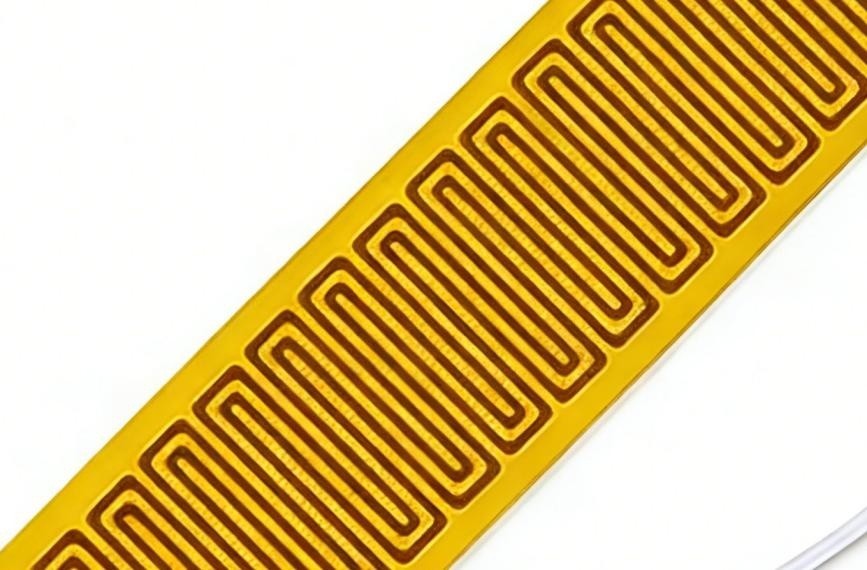
If you have ever ordered a flexible heating element prototype—perhaps from a manufacturer like JLCPCB—and looked closely at the copper traces, you might have noticed something specific. The lines aren’t rigid squares or sharp zig-zags. Instead, the corners are gently rounded, and the connection pads look like liquid droplets (a feature engineers call "teardrops").
You might ask: Is this just an aesthetic choice? Did the designer just want the circuit to look artistic?
The short answer is no. While they do look sleek, these design choices are purely functional. In the world of flexible electronics, 90-degree angles are the enemy. Here is the science behind why rounded corners and teardrops are essential for safety, durability, and performance.
Beyond Aesthetics: The Battle Against Physics
The fundamental challenge of a flexible heater is right there in the name: it must be flexible, and it must get hot.
When a heater operates, it goes through intense "thermal cycling"—heating up and cooling down repeatedly. The problem is that the heating element (usually a metal alloy) and the insulation base (usually Polyimide or PI film) expand and contract at different rates. This mismatch creates mechanical tension.
If we designed these circuits like a standard rigid PCB with sharp corners, they would fail rapidly. The design must account for thermal expansion, electrical consistency, and mechanical durability all at once.
Mitigating Mechanical Stress and Metal Fatigue
Imagine taking a piece of paper and tearing it. It is much easier to start a tear from a sharp notch than from a smooth edge.
In engineering, a 90-degree sharp corner is known as a stress concentration point. As the heater warms up, the metal traces expand. If there is a sharp corner, all the mechanical stress from that expansion focuses on that single distinct point.
Over time, this repeated pulling and pushing causes "metal fatigue." Micro-cracks begin to form at the inner corner of the right angle. Eventually, these cracks widen until the circuit breaks completely (an open circuit), causing the heater to fail. Furthermore, sharp metal corners can act like tiny knives, piercing the thin insulation layer during bending and causing safety hazards.
By using a radius (rounded) corner, that stress is distributed evenly across the curve rather than focusing on a single pixel. It allows the circuit to "breathe" and flex without cracking.
Thermal Management: Preventing the "Hotspot" Effect
A heating element is essentially a resistor; it turns electrical energy 100% into heat. However, we want that heat to be uniform, not patchy.
Electricity flows somewhat like water. If you force a fast-flowing river to take a sharp 90-degree turn, the water crashes against the outer bank and swirls chaotically, but the "pressure" is highest at the inner corner. In electronics, this is related to the Skin Effect. Current tends to crowd into the shortest path—the inside corner of a sharp turn.
This "current crowding" creates a localized hotspot. A sharp corner becomes significantly hotter than the rest of the trace. Paradoxically, the outer corner might be cooler because it has more surface area to dissipate heat. This creates a temperature gradient that stresses the material.
By rounding the inner radius, engineers ensure the current flows smoothly and evenly, maintaining a steady temperature.
Additionally, spacing matters. The uniformity of the heat depends on the gap between traces and the thickness of the copper (usually incredibly thin, between $0.018\text{ mm}$ and $0.06\text{ mm}$). Smooth curves allow for consistent spacing, ensuring the heater warms your device evenly without burning out specific spots.
Chemical Etching: The Fluid Dynamics of Manufacturing
The benefits of curves start even before the heater is turned on—they begin during manufacturing.
Flexible heaters are made using an etching process. A chemical solution washes over a copper sheet to dissolve the unwanted metal, leaving behind the circuit pattern.
If the design has sharp 90-degree angles, the etching fluid flows poorly.
- Stagnation: the fluid can get "stuck" in sharp corners (eddies), causing over-etching. This makes the wire thinner at the corner than intended, increasing resistance and fragility.
- Residue: conversely, flow restriction can lead to under-etching, leaving behind unwanted metal burrs that can cause short circuits.
Rounded corners allow the chemical solution to flow smoothly, ensuring the metal traces are exactly the width they were designed to be.
The "Teardrop": A Tendon for Your Circuit
Finally, let’s look at the connection pads—the spots where wires are soldered to the heater. You will often see a smooth, ramp-like shape connecting the thin trace to the wide pad. This is the teardrop.
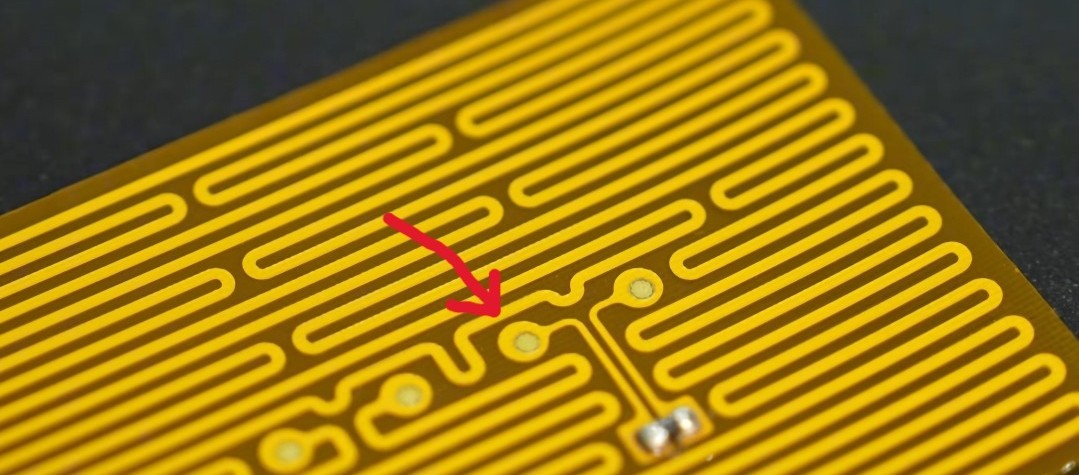
Think of the teardrop as a mechanical tendon.
The junction between a soldering pad and a thin wire is a structural weak point. Without a teardrop, any tug on the wire or thermal expansion applies sheer force right at that "neck," snapping the connection. The teardrop adds material to widen that connection, distributing the stress over a larger area.
It also provides a larger surface area for the solder to anchor to, and electrically, it prevents a "bottleneck" where current transitions from the pad to the trace, further reducing the risk of overheating.
A Note on Interference (EMI)
While heaters aren’t radio antennas, they do involve switching large currents. Rapidly turning a heater on and off (to control temperature) can generate Electromagnetic Interference (EMI).
Sharp corners can act like tiny antennas, radiating this noise outwards. Smooth, rounded transitions significantly reduce this radiation, helping the device meet electromagnetic compatibility (EMC) standards—meaning your heater won’t interfere with other sensitive electronics nearby.
FAQ about Rounded Corners and Teardrops
Q: Why are 90-degree corners a problem on a flexible heater?
A sharp 90-degree corner is a stress concentration point. As the heater goes through thermal cycling, all the mechanical stress from expansion focuses on that single point, causing metal fatigue and micro-cracks that eventually widen into an open circuit. Sharp metal corners can also act like tiny knives, piercing the thin insulation layer during bending.
Q: How do rounded corners improve heat uniformity?
Current tends to crowd into the shortest path — the inside corner of a sharp turn. That current crowding creates a localized hotspot, so the sharp corner runs significantly hotter than the rest of the trace while the outer corner may run cooler, producing a temperature gradient that stresses the material. Rounding the inner radius lets the current flow smoothly and evenly, maintaining a steady temperature.
Q: What is a teardrop and why does it matter?
A teardrop is the smooth, ramp-like shape connecting a thin trace to a wide solder pad. That junction is a structural weak point: without a teardrop, any tug on the wire or thermal expansion applies shear force right at the "neck" and can snap the connection. The teardrop widens the connection, spreads the stress over a larger area, gives the solder more surface to anchor to, and removes the electrical bottleneck where current transitions from pad to trace.
Q: Do sharp corners affect manufacturing quality?
Yes. Flexible heaters are chemically etched, and sharp angles disrupt the flow of the etching solution. Fluid can stagnate in corners and cause over-etching, making the wire thinner than intended and raising its resistance; restricted flow elsewhere causes under-etching, leaving metal burrs that can short. Rounded corners let the solution flow smoothly so traces come out at their designed width.
Q: Can a flexible heater generate EMI?
It can. Heaters switch large currents, and rapidly turning one on and off for temperature control generates electromagnetic interference. Sharp corners act like tiny antennas that radiate this noise, while smooth, rounded transitions significantly reduce the radiation and help the device meet EMC standards.
Conclusion: Why Flexible Heaters Use Rounded Corners and Teardrops
Reliability in engineering often looks like "over-design," but it is actually just good physics. The rounded corners and teardrops on a flexible heater aren’t there for decoration. They are a calculated defense against thermal stress, mechanical cracking, manufacturing errors, and electrical failure.
At JLCPCB, we apply these rigorous design standards to every flexible heater we manufacture. Whether you need high-precision Polyimide (PI) heaters for compact electronics or rugged silicone rubber heaters for industrial applications, our engineering process ensures your designs are optimized for longevity and safety. We are committed to delivering professional-grade thermal solutions with the efficiency and quality you expect.
Keep Learning
How to Design a Custom Flexible Heater with the JLCPCB Calculator
This guide is specifically designed for JLCPCB's flexible heater customization service. We provide a dedicated calculator tool that simplifies the trace design process, allowing you to focus on performance requirements while our engineers handle the technical implementation. Download the Flex Heater Calculator Excel Tool Flexible Heater Design Basics Designing a custom flexible heater requires balancing electrical resistance, material selection, heat distribution, and the conditions in which the heate......
Flexible Heater Design Optimization: Why We Use Rounded Corners and Teardrops
TL;DR Those sleek curves and "teardrops" you see on flexible heater circuits aren’t just for looks. They are critical engineering features that: Prevent Cracking: Rounded corners distribute physical stress during thermal expansion, stopping metal fatigue and micro-cracks. Even Out Heat: Smooth paths prevent electrical "hotspots" that occur at sharp 90-degree angles. Boost Durability: Teardrops act like mechanical tendons, strengthening fragile solder connections against pulling and bending. Improve Ma......
How to Choose Temperature Control for Custom Flexible Heating Films
So, you're designing a custom heating solution—perhaps a heated jacket, a 3D printer bed, or a specialized medical device. You've picked out your heating film material, but now you face a critical question: How do I stop this thing from getting too hot? Selecting the right temperature control is just as important as the heating element itself. It's the difference between a cozy, efficient device and a melted, hazardous mess. But with terms like "NTC," "Bi-metal," and "Hysteresis" thrown around, it can......
Custom Flexible Heater Case Study: From JLC PCB Order to Performance Validation
Introduction Flexible heaters represent a paradigm shift in modern heating technology, redefining our approach to thermal management in electronic systems. The evolution from traditional rigid resistive heating elements to PCB-based flexible heating solutions marks a significant leap toward high-precision, high-reliability manufacturing. This comprehensive guide explores the technical principles, material engineering, design methodologies, and practical applications of flexible heaters, providing engi......
Factors Affecting Heating Film Uniformity: A Guide for Efficient Thermal Management
Resistive heating elements, particularly in thin, flexible forms known as heating films, have become the backbone of modern efficient thermal management. Their ability to deliver controllable, uniform heat within compact devices makes them indispensable in industries ranging from aerospace to medical tech. However, simply applying power to a resistive circuit does not guarantee performance. Achieving consistent temperature distribution in a flexible heater requires a deep understanding of circuit layo......
Choosing the Right Substrate for Flexible Heaters: A Guide to Copper, Stainless Steel, and FeCrAl
Introduction Developing a heating element for a small medical device or a rugged outdoor sensor presents a unique thermal engineering challenge. The solution usually does not lie with the heater, but instead with the substrate. Flexible heaters are an effective modern solution to these complicated thermal challenges. However, the performance of the flexible heater is determined by the substrate material on which it is constructed. Many flexible heaters are constructed on polyimide or silicone, but the......