How to Design a Custom Flexible Heater with the JLCPCB Calculator
17 min
- Flexible Heater Design Basics
- How to Calculate Flexible Heater Resistance
- How to Use the Flexible Heater Calculator
- Flexible Heater Materials: PI, Silicone, and Other Options
- Flexible Heater Power Density and Thermal Management
- Flexible Heater Installation and Temperature Control
- Flexible Heater Testing and Design Validation
- Flexible Heater Manufacturing Considerations
- Flexible Heater Applications
- Flexible Heater Design FAQs
- Summary
This guide is specifically designed for JLCPCB's flexible heater customization service. We provide a dedicated calculator tool that simplifies the trace design process, allowing you to focus on performance requirements while our engineers handle the technical implementation.
Download the Flex Heater Calculator Excel Tool
Flexible Heater Design Basics
Designing a custom flexible heater requires balancing electrical resistance, material selection, heat distribution, and the conditions in which the heater will operate. Whether you are developing a prototype or integrating a heater into a finished product, the design starts with the required heating area, voltage, power, and target resistance.
This flexible heater design guide walks through the main design decisions, from resistance and trace calculations to material selection, thermal management, installation, and design validation. It also explains how to use the JLCPCB flex heater calculator to simplify trace design.
The flexible heaters discussed in this article refer specifically to flexible heating films, including polyimide (PI) and silicone heaters, rather than other flexible heating products such as heated water tubes or cable heaters.
How Flexible Heaters Work
A flexible heater converts electrical energy into heat through a resistive heating element. When voltage is applied, current flows through the resistive trace and generates heat according to Joule's law:
P = V2 / R
Where:
• P = Power (watts)
• V = Supply voltage (volts)
• R = Total resistance of the heating trace (ohms)
Trace width, length, thickness, and material resistivity determine the resistance of the heating circuit. By adjusting these parameters, the heater can be designed to meet a specific voltage and power requirement while fitting the available heating area.
Flexible Heater Construction
A typical flexible heater includes several functional components:
1. Heating element — The resistive conductor that generates heat.
2. Encapsulation material — A flexible insulating material such as polyimide or silicone that protects the heating element.
3. Lead wires — Conductors that connect the heating circuit to the external power supply.
4. Temperature sensor (optional) — A thermistor or RTD used to monitor heater temperature.
5. Adhesive layer (optional) — Used to bond the heater to the target surface.
For a broader introduction to flexible heaters and the differences between polyimide and silicone heaters, see our overview of what flexible heaters are and how polyimide compares with silicone.
How to Calculate Flexible Heater Resistance
The electrical design determines the heater's resistance, power output, trace dimensions, and current requirements. The basic design process starts with the required supply voltage and heating power, then works backward to the target resistance.
Flexible Heater Resistance and Power Calculation
For a resistive flexible heater, the required resistance can be calculated using:
R = V2 / P
For example, if a project uses a 12 V power supply and requires 14.4 W of heating power:
R = 122 / 14.4 = 10 Ω
This target resistance can then be used as an input for the trace design.
Flexible Heater Trace Design
The heating trace must provide the required resistance while fitting within the available heating area. The main parameters include:
• Trace length
• Trace width
• Trace thickness
• Material resistivity
• Number of heating wire groups
• Trace spacing and layout
Traditional manual trace design requires balancing these parameters while also considering heat distribution and manufacturing constraints. The JLCPCB calculator simplifies this process by calculating the required trace dimensions from the selected design parameters.
Heating Wire Groups and Resistance
The number of heating wire groups affects the electrical characteristics and available routing space of the heater. More parallel groups increase the total conductor cross-sectional area and generally reduce resistance, while fewer groups can increase resistance and simplify routing.
If you are unsure where to start, use one heating wire group as the initial configuration and adjust it based on the calculated trace dimensions.
How to Use the Flexible Heater Calculator
The JLCPCB flexible heater calculator is an Excel-based tool for calculating key trace design parameters. It allows you to define the main electrical and geometric requirements without manually designing the complete heating trace.
Flexible Heater Calculator Interface
The spreadsheet is divided into three main areas:
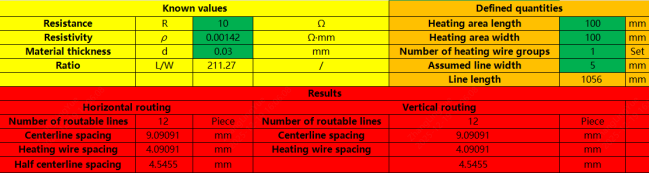
Central calculation area — Green cells require manual input, while the red sections display calculated results.
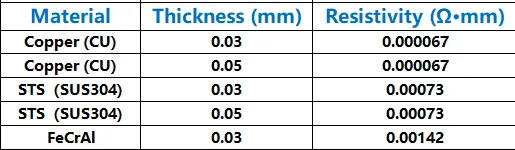
Material parameter area — Contains physical parameters for the available heating materials.

Calculation verification area — Used to cross-check the calculated resistance against the target value.
Enter the Heating Area and Target Resistance
Start by entering three basic parameters in the central calculation area:
1. Heating area length
2. Heating area width
3. Target resistance
Length and width should correspond to the area that needs to be heated. For irregular shapes, a suitable approximation can be used as the starting design area.
The target resistance should be calculated from the project's supply voltage and power requirements. For example, a 12 V supply with a target power of 14.4 W requires a target resistance of 10 Ω.
For this example, assume a heating area of 100 mm × 100 mm and a target resistance of 10 Ω.
Select the Heating Material
Select a heating material from the material parameter area and enter its relevant parameters into the central calculation area, including:
• Material thickness
• Resistivity
In this example, FeCrAl (Iron-Chromium-Aluminum alloy) is selected.
The material should be selected based on the target resistance, available trace dimensions, operating temperature, and application requirements. A material with higher resistivity can achieve a given resistance with a shorter or wider trace than a lower-resistivity material under otherwise comparable conditions.
Set the Number of Heating Wire Groups
Enter the number of heating wire groups used in the design. This parameter represents the parallel heating circuits within the flexible heater.
If you are unsure of the appropriate value, start with one group and use the resulting trace dimensions to determine whether another configuration is more suitable.
Optimize the Flexible Heater Trace Width
Enter an initial value in the Assumed line width field and compare it with the calculated Line width.
1. Enter an initial line-width value, such as 0.5 or 1.0.
2. Press Enter to calculate the result.
3. Check the calculated Line width.
4. Compare it with the Assumed line width.
The goal is to bring the assumed and calculated values as close together as practical. If the values remain significantly different after several iterations, reconsider the selected material or number of heating wire groups.
Verify the Calculated Resistance
After selecting a suitable trace width, use the calculation verification area to cross-check the design.
1. Enter the resistivity of the selected material.
2. Enter the corresponding material thickness.
3. Enter the assumed line width used in the design.
4. Enter the actual line length.
5. Check the calculated resistance against the target resistance.
The actual trace length may differ slightly from the initial calculated length because of pad positions, trace corners, and other layout details. The final design should therefore be verified using the actual trace geometry before production.
Once the electrical parameters have been finalized, you can explore JLCPCB flexible heater manufacturing capabilities for available materials, tolerances, and lead times.
Flexible Heater Materials: PI, Silicone, and Other Options
Material selection affects the heater's temperature capability, flexibility, mechanical durability, electrical performance, and installation requirements. The main material decisions include the encapsulation material, heating element material, and adhesive system.
Polyimide vs. Silicone Flexible Heaters
Polyimide (PI) and silicone are two commonly used encapsulation materials for flexible heaters. PI heaters are typically thinner and better suited to applications where space and flexibility are important, while silicone heaters provide a thicker and more mechanically robust construction.
| Property | PI Flex Heater | Silicone Flex Heater |
|---|---|---|
| Base Material Thickness | 0.09–0.27 mm | 1.0–2.0 mm (including silicone layer) |
| Light Transmittance | 50 μm PI film: 60.2%; 25 μm PI film: 70.6% | 0% |
| Temperature Range | -40~260°C (long-term <150°C) | -40~300°C (long-term <200°C) |
| Voltage Range | 3.7~220 VAC; 2000 VDC 1 min leakage ≤1 mA | 1~380 VAC; 2500 VDC 1 min leakage ≤1 mA |
| Insulation Resistance | ≥100 MΩ @DC 1000 V | ≥500 MΩ @DC 1500 V |
| Maximum Power Density | 1.0 W/cm² | 2.0 W/cm² |
| Thermal Conductivity | 0.2–0.35 W/(m·K) | 1.0–1.5 W/(m·K) |
| Mechanical Compressive Strength | ≤50 KG/cm² | 200–350 KG/cm² |
| Wire Pull Force | ≥100 N | ≥100 N |
| Service Life | 5 years | 5 years |
| Solder Joint Pull Force | ≥40 N | ≥40 N |
PI flexible heaters are useful when a thin profile, flexibility, or compact integration is important. Typical applications include medical equipment, battery thermal management, laboratory instruments, and other devices where the heater is installed inside a protective housing.
Silicone flexible heaters provide a thicker, more robust construction and can support higher power density under suitable conditions. They are commonly considered for industrial equipment, outdoor equipment, pipes, tanks, and other applications where mechanical protection is important.
As a general design consideration:
• Choose PI when thickness, flexibility, or compact integration is a priority.
• Consider silicone when mechanical durability and higher power density are important.
• Always evaluate the actual operating temperature, mounting conditions, and required power density rather than selecting a material based on a single specification.
For a more detailed comparison of insulating materials, read our guide on choosing insulating materials for flexible heaters.
Heating Element Materials
The heating element material affects resistivity, trace dimensions, temperature performance, and electrical stability.
| Material | Thickness (mm) | Resistivity | Key Advantage |
|---|---|---|---|
| Copper (CU) | 0.03 / 0.05 | 0.067 ± 6% Ω·cm² | Low resistivity and high thermal conductivity |
| Stainless Steel (SUS304) | 0.03 / 0.05 | 0.768 ± 6% Ω·cm² | Higher resistivity and corrosion resistance |
| FeCrAl | — | ~1.2–1.4 Ω·mm²/m | Higher resistivity and high-temperature capability |
| Cupronickel | — | ~4.9×10⁻⁷ Ω·m | Resistance stability over temperature |
Copper: Its low resistivity makes it suitable for low-resistance, low-voltage, and higher-current designs where the required trace dimensions can be accommodated.
Stainless Steel: Its higher resistivity than copper provides more flexibility when designing resistance within a limited heating area, while its corrosion resistance can be useful in demanding environments.
FeCrAl: Its relatively high resistivity and high-temperature capability make it suitable for designs requiring higher resistance or elevated operating temperatures.
Cupronickel: Its resistance stability over temperature can be useful where maintaining predictable electrical characteristics across a temperature range is important.
Material selection should be based on the calculated resistance, available trace geometry, operating temperature, electrical requirements, and environmental conditions rather than resistance alone.
Adhesive Selection for Flexible Heaters
The adhesive system affects how effectively the heater transfers heat to the target surface and how reliably it remains attached during operation. The adhesive should be compatible with both the heater material and the operating environment.
| Tape Model | Thickness (mm) | Long-term Temp | Short-term Temp | Low Temp Limit | Features & Applications |
|---|---|---|---|---|---|
| 3M 9448A | 0.15 | 70°C | 150°C | — | General-purpose double-sided tape for medium-low temperature applications |
| 3M 468MP | 0.13 | 149°C | 204°C | -35°C | High-performance acrylic adhesive for higher-temperature bonding |
| 3M 55236 | 0.06 | 70°C | 150°C | — | Ultra-thin double-sided tape for light-duty bonding |
| Crown 513 | 0.16 | 80°C | 110°C | — | Thicker and elastic adhesive for curved or rough surfaces |
When selecting an adhesive:
1. Clean the bonding surface and remove grease, dust, and other contaminants.
2. Apply sufficient pressure after bonding to achieve good surface contact.
3. Allow the adhesive to develop sufficient bond strength before exposing it to high mechanical or thermal stress.
4. Verify that the adhesive's temperature rating is suitable for the actual heater operating temperature.
5. For curved or mechanically demanding applications, consider additional mechanical retention where appropriate.
Flexible Heater Power Density and Thermal Management
Electrical resistance determines how much power the heater generates, but it does not determine the final surface temperature by itself. Mounting conditions, heat dissipation, substrate properties, and the surrounding environment all affect thermal performance.
Power Density and Heater Temperature
Power density, expressed in watts per square centimeter (W/cm²), is an important parameter when evaluating heater output and thermal behavior.
| Input Power | Power Density | Steady-State Surface Temperature | Notes |
|---|---|---|---|
| 0.25 W (1 V on 4 Ω) | 0.35 W/cm² | ~32°C | Warm to touch under the stated test conditions |
| 1 W (2 V on 4 Ω) | 1.4 W/cm² | ~50°C | Higher heating output under the stated test conditions |
| 4 W (4 V on 4 Ω) | 5.6 W/cm² | ~181°C | High power density requiring careful thermal design |
These temperatures were measured in still air on a free-standing heater. Actual temperatures can differ substantially when the heater is bonded to a heat-dissipating surface. Always validate thermal performance under the actual mounting and operating conditions.
Heat Distribution and Hot Spots
Temperature distribution can be affected by several design and environmental factors:
• Trace width and spacing
• Trace density across the heating area
• Edge effects
• Substrate thermal conductivity
• Interface thermal resistance
• Convection and radiation
• Contact with the heated object
Trace layout should therefore be considered together with the intended mounting conditions rather than evaluated as an isolated electrical pattern.
Heat Sinking and Temperature Control
For higher-power applications, bonding the heater to an appropriate heat spreader can help distribute heat and reduce local hot spots. Temperature sensing can also be used to regulate heater output and provide protection against abnormal temperature rise.
Depending on the application, thermal management may include:
• Matching power density to the heater's rated operating conditions
• Using a heat spreader for high-power applications
• Adding a thermistor or other temperature sensor
• Using a thermal fuse or electronic cutoff where appropriate
• Testing the heater under the actual installation conditions
Flexible Heater Installation and Temperature Control
Installation affects both heat transfer and mechanical reliability. The fixing method should match the heater construction, target surface, operating temperature, and expected mechanical loads.
Adhesive Installation
Adhesive backing is a common installation method for flexible heaters. The bonding surface should be clean, dry, and compatible with the selected adhesive. Good surface contact is important because air gaps can increase thermal resistance and create uneven heating.
Mechanical Fixing
Silicone heaters used in industrial applications may also be mechanically retained using methods such as:
• Spring hooks for cylindrical objects
• Bolt fixing holes
• Metal clips
• Removable fastening systems
JLCPCB currently provides backing adhesive installation solutions. Mechanical fixing methods are included here as technical references for applications that require additional mechanical retention.
Temperature Sensors and Thermal Protection
For applications where temperature must remain within a defined range, consider integrating a thermistor, RTD, thermal fuse, or electronic temperature-control system. The sensor location should represent the temperature that matters to the application rather than simply the hottest or easiest-to-access point.
Flexible Heater Testing and Design Validation
A calculated design should be validated under the actual electrical, thermal, and mechanical conditions in which the heater will operate.
Electrical Performance Testing
Verify the finished heater's resistance and electrical insulation against the applicable design and manufacturing requirements. The measured resistance should be compared with the target value used during the design stage.
Thermal Performance Testing
Measure temperature under the intended mounting conditions rather than relying only on free-standing heater data. Check warm-up behavior, steady-state temperature, temperature distribution, and potential hot spots.
Reliability and Environmental Testing
Depending on the application, validation may include thermal cycling, humidity exposure, bending, mechanical stress, or long-duration operation. The appropriate test conditions should be defined according to the heater's intended environment and applicable product requirements.
Flexible Heater Manufacturing Considerations
Designing for manufacturability helps ensure that the calculated electrical parameters can be translated into a consistent production design.
Flexible Heater Manufacturing Process
Flexible heaters can be manufactured using PCB-like processes adapted for resistive heating materials and flexible substrates. Typical stages include substrate preparation, pattern transfer, etching or forming of the heating circuit, post-processing, and assembly of leads, adhesive, and optional sensors.
For a more detailed look at the production process, explore the JLCPCB flexible heater manufacturing process.
Design for Manufacturability
Before production, confirm that the selected trace dimensions, spacing, heating area, lead positions, mounting features, and material combination are compatible with the manufacturing process. Final production parameters should be reviewed with the manufacturer when the design involves unusual geometries or operating conditions.
Flexible Heater Applications
Flexible heaters can be customized for applications where a thin, conformable heating element is required.
Battery Thermal Management
Flexible heaters can be integrated into battery thermal-management systems to provide controlled heating in cold operating conditions.
Medical Devices
PI and silicone heaters can be used in equipment such as blood warmers, respiratory equipment, laboratory instruments, and other temperature-controlled devices, subject to the applicable product requirements.
Wearable Devices
The thin profile and conformability of flexible heaters make them suitable for wearable applications. Designs intended for direct or prolonged skin contact require careful temperature control and validation.
Industrial Equipment
Flexible heaters can be used for applications including pipe freeze protection, tanks, outdoor equipment, instrumentation, and 3D printer components where localized heating is required.
Flexible Heater Design FAQs
How do you calculate the resistance of a flexible heater?
Use R = V2 / P, where R is resistance in ohms, V is supply voltage, and P is desired power. For example, a 12 V heater designed for 14.4 W requires a target resistance of 10 Ω.
How do you calculate flexible heater power?
For a resistive heater, power can be calculated using P = V2 / R. The required power should then be evaluated together with heating area, power density, mounting conditions, and heat dissipation.
What is the difference between a PI heater and a silicone heater?
PI heaters are typically thinner and well suited to compact applications where flexibility and low profile are important. Silicone heaters provide a thicker and more mechanically robust construction and can support higher power density under suitable conditions.
What is the maximum temperature of a flexible heater?
The maximum operating temperature depends on the heater construction, encapsulation material, power density, mounting conditions, and application. The temperature ratings listed by the manufacturer should be used together with testing under the actual operating conditions.
Can flexible heaters be customized to different shapes and sizes?
Yes. Flexible heaters can be designed in different shapes, dimensions, resistance values, power ratings, lead configurations, and material combinations to fit the intended application. Final customization options depend on the manufacturing process and selected materials.
How do you choose a flexible heater material?
Start with the required operating temperature, heating area, power density, target resistance, mechanical environment, and mounting method. PI and silicone should be selected according to the application requirements, while the heating element material should be evaluated based on resistivity and the required trace geometry.
Summary
Designing a flexible heater requires coordinating electrical, material, thermal, mechanical, and manufacturing requirements. A practical design process is:
• Define the electrical requirements: Determine supply voltage, target power, heating area, and target resistance.
• Design the heating trace: Select the heating material and determine suitable trace dimensions and wire groups.
• Use the calculator: Iterate the assumed trace width and verify the calculated resistance.
• Select the construction: Choose PI or silicone and evaluate the heating element and adhesive according to the application.
• Manage heat: Evaluate power density, heat distribution, mounting conditions, and temperature control.
• Validate the design: Test electrical resistance and thermal performance under actual operating conditions before production.
Ready to turn your design into a real product? You can get a flexible heater quote online or learn more about JLCPCB custom flexible heater services and available customization options.
If you encounter challenges during the design process, JLCPCB's technical support team can help review the design requirements and manufacturing considerations.
Keep Learning
How to Design a Custom Flexible Heater with the JLCPCB Calculator
This guide is specifically designed for JLCPCB's flexible heater customization service. We provide a dedicated calculator tool that simplifies the trace design process, allowing you to focus on performance requirements while our engineers handle the technical implementation. Download the Flex Heater Calculator Excel Tool Flexible Heater Design Basics Designing a custom flexible heater requires balancing electrical resistance, material selection, heat distribution, and the conditions in which the heate......
Flexible Heater Design Optimization: Why We Use Rounded Corners and Teardrops
TL;DR Those sleek curves and "teardrops" you see on flexible heater circuits aren’t just for looks. They are critical engineering features that: Prevent Cracking: Rounded corners distribute physical stress during thermal expansion, stopping metal fatigue and micro-cracks. Even Out Heat: Smooth paths prevent electrical "hotspots" that occur at sharp 90-degree angles. Boost Durability: Teardrops act like mechanical tendons, strengthening fragile solder connections against pulling and bending. Improve Ma......
How to Choose Temperature Control for Custom Flexible Heating Films
So, you're designing a custom heating solution—perhaps a heated jacket, a 3D printer bed, or a specialized medical device. You've picked out your heating film material, but now you face a critical question: How do I stop this thing from getting too hot? Selecting the right temperature control is just as important as the heating element itself. It's the difference between a cozy, efficient device and a melted, hazardous mess. But with terms like "NTC," "Bi-metal," and "Hysteresis" thrown around, it can......
Custom Flexible Heater Case Study: From JLC PCB Order to Performance Validation
Introduction Flexible heaters represent a paradigm shift in modern heating technology, redefining our approach to thermal management in electronic systems. The evolution from traditional rigid resistive heating elements to PCB-based flexible heating solutions marks a significant leap toward high-precision, high-reliability manufacturing. This comprehensive guide explores the technical principles, material engineering, design methodologies, and practical applications of flexible heaters, providing engi......
Factors Affecting Heating Film Uniformity: A Guide for Efficient Thermal Management
Resistive heating elements, particularly in thin, flexible forms known as heating films, have become the backbone of modern efficient thermal management. Their ability to deliver controllable, uniform heat within compact devices makes them indispensable in industries ranging from aerospace to medical tech. However, simply applying power to a resistive circuit does not guarantee performance. Achieving consistent temperature distribution in a flexible heater requires a deep understanding of circuit layo......
Choosing the Right Substrate for Flexible Heaters: A Guide to Copper, Stainless Steel, and FeCrAl
Introduction Developing a heating element for a small medical device or a rugged outdoor sensor presents a unique thermal engineering challenge. The solution usually does not lie with the heater, but instead with the substrate. Flexible heaters are an effective modern solution to these complicated thermal challenges. However, the performance of the flexible heater is determined by the substrate material on which it is constructed. Many flexible heaters are constructed on polyimide or silicone, but the......