EMI Shielding for PCBs : Advanced Techniques and Materials for Superior Electromagnetic Compatibility in Professional Fabrication
11 min
- How EMI Shielding Works on PCBs
- Key EMI Shielding Materials and Their Applications
- Implementing Effective EMI Shielding in PCB Design
- Professional Manufacturing Techniques for Robust EMI Shielding
- Frequently Asked Questions (FAQ)
In essence, EMI shielding is simply the act of enclosing any conductive or magnetic material to ensure the electrical and magnetic fields do not creep in or out of a particular zone on your PCB. Imagine that you had a Faraday cage around your delicate circuits, except that you have to shield not yourself, but your neighbor, against your noisy switching regulator (and the other way around). Modern electronics have become a massive nightmare due to EMI. With clock speeds in the GHz and switching regulators in the megahertz, and wireless radios appearing everywhere on a PCB, the electromagnetic resonance within and around a PCB is extremely cluttered.
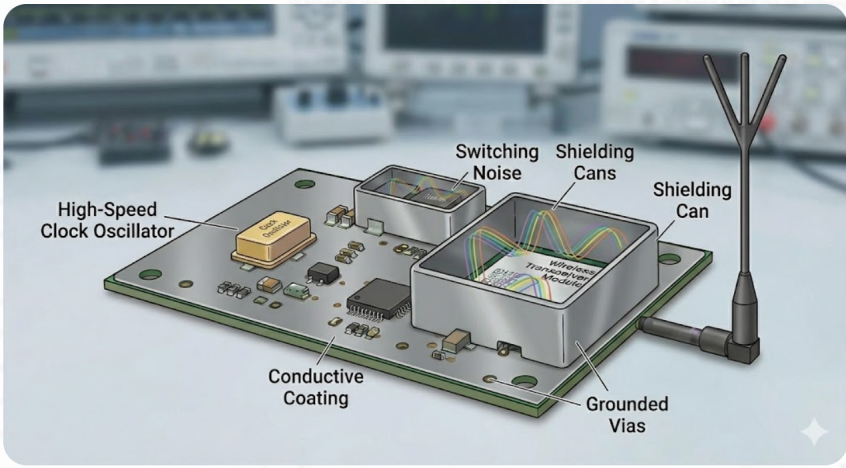
Unless you shield your design with EMI, your device may fail regulatory tests (FCC, CE, CISPR), experience self-interference, or even cause interference with surrounding equipment. The stakes are high. A lack of an EMC test may delay a launch by weeks or months, as you hastily apply shielding and filters as a last-minute palliative to an otherwise beautiful product, which is always more costly and finer than doing it right the first time
Common Sources of Electromagnetic Interference in PCBs
To begin with, it will be important to determine the actual source of EMI in order to tame it. High-speed clock signals and harmonics, the inductors and transformers of switching supplies, dumping out both conducted and radiated noise, data links such as USB 3.0, PCIe, HDMI throwing up broadband hiss, RF transmitters and oscillators intentionally beaming, and any fast edge-rate objects that cause little EM fields to ride along with the neighboring traces and cables are the typical suspects on a PCB.
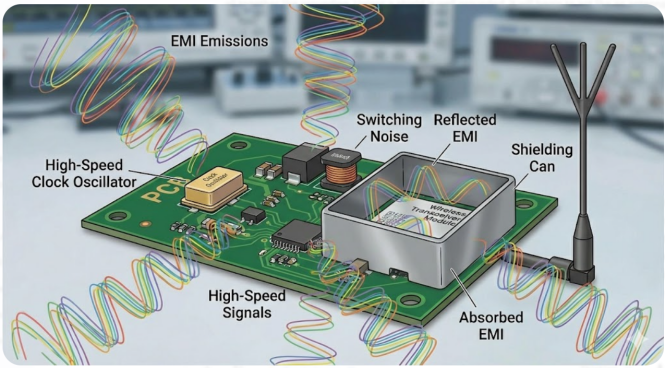
Bad parts may be the only trouble-makers, but even the most ordinary parts may become EMI suspects when the layout is loose. Consider a simple LED driver: when it changes too rapidly, and the current loop area is a mess, it can radiate enough to put you out of a Class B emissions test.
How EMI Shielding Works on PCBs
Principles of Reflection, Absorption, and Grounding
The question is, what is the mechanism of an EMI shield? It is simply dependent on three factors that interact synergistically. At low frequencies, it is primarily reflection. As a wave impinges on a conductive surface, the impedance difference between the free space and the metal causes a large portion of the energy to be reflected. Actually, conductive materials, such as copper or aluminum, are excellent reflectors.
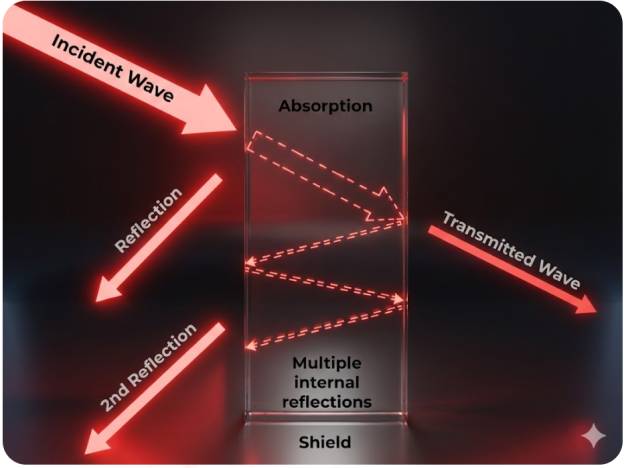
The higher the frequency, the higher the absorption kicks in. The wave enters the shield, and its energy is converted into heat due to resistive losses. Its absorption is determined by the permeability of the material, its conductivity, and its thickness. Inferior shields, shields that are thicker, or have high magnetic permeability- think mu-metal, perform better. Nothing brings it all together like grounding. Unless a shield is well grounded, it will begin to act like an antenna rather than a barrier. Good shielding requires lots of vias to the ground planes, wide stitching patterns, and good solder joints.
Role of Shielding Layers, Cans, and Conductive Coatings
At the board level, one can shield in a few ways, depending on what you are doing. A solid isolation is provided by shielding cans, metal enclosures soldered onto the PCB over sensitive components, and used in RF modules, wireless equipment, and sensitive analog circuits. They are typically composed of tin-plated steel or nickel silver and are able to block up to 40 -80 dB of EMI depending on construction. Lightweight and flexible conductive coatings and paints are also available in cases where weight or height may be a concern. They are applied with metallic particles (silver, copper, or nickel) incorporated into a polymer and sprayed or painted only on the areas of a car that require it.
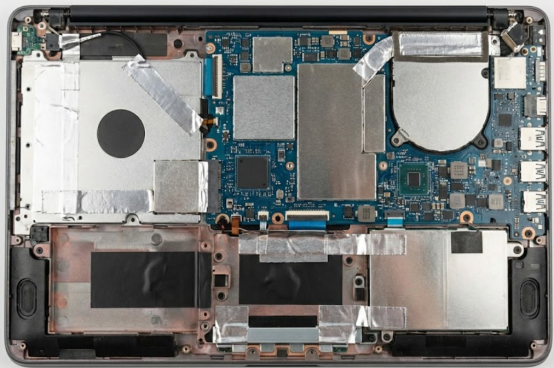
On the PCB, special ground copper planes serve the purpose of in-built shield planes. A continuous, uninterrupted ground plane between a noisy layer and a sensitive component reduces coupled noise significantly, which is one of the easiest and least expensive methods of shielding in PCB design.
Key EMI Shielding Materials and Their Applications
Conductive Fabrics, Foils, and Polymer Composites
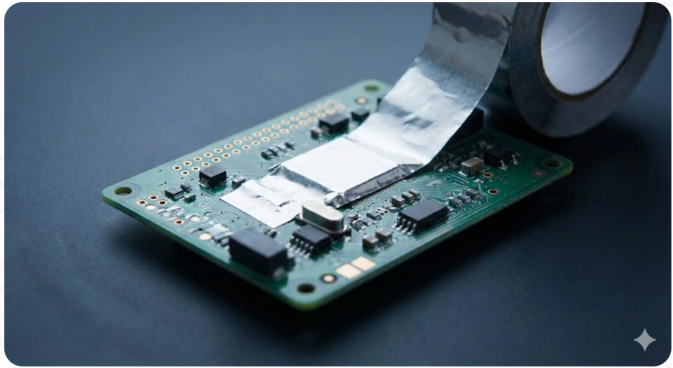
The EMI shielding world is a toolbox to designers, Yo. When you are prototyping or even simply fixing something, copper foil tape remains a mainstay, as it is extremely conductive and simple to apply. Assuming mass production, then you would likely consider conductive fabrics woven out of metallized yarns, which are stretchy and can fit around odd objects in a very smooth manner.
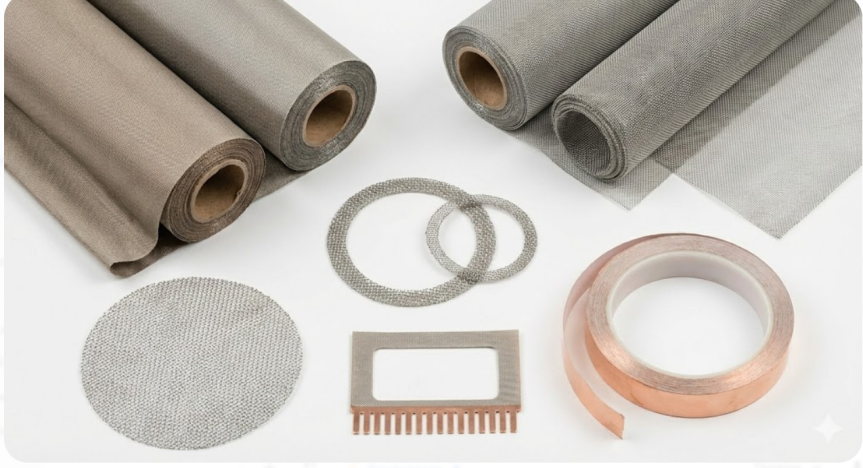
Conductive fillers in polymer composites, such as carbon fiber, nickel-coated particles, and silver flakes, combine to provide you with a sweet mix of mechanical strength and good shielding. You can shape them into any form that you require, hence they are handy in shielding at the enclosure level in consumer devices.
Copper Pours, Ground Planes, and Specialized Coatings
Copper pours and ground planes are considered the main tricks of shielding that can be found inside the PCB. On a 4-layer board, a good ground plane on Layer 2 prevents a significant amount of the top-layer chip from interfering with the inner-layer signal or power interference. The trick is to maintain that plane, to fill in any gaps, splits, or holes that allow EM energy to escape.
The outer layers (aka copper floods) are grounded twice: to provide increased EMC by adding more return paths and shielding, and to assist the fab guys by providing a uniform copper spread to plate. All you need to do is ensure that the ground pours are cleanly attached to the main ground net and are properly via-filled.
Material Selection for Different Frequency Ranges
Various frequencies require various shielding strategies. To keep down very low frequencies (less than 1 MHz), you are concerned about magnetic fields, and in this case, high-permeability alloys such as mu-metal or ferrite are desired. At the MHz up to the low-GHz orbit, plain copper or aluminum shields are effective in reflection and absorption. At frequencies above 10GHz, the quality of the construction is of great concern - a single hole in the resonant structure can cause resonant cavities, which cause problems with the performance. In the 100MHz to 6GHz range, normal copper ground planes and shielding cans designed well suffice in most PCB-scale work. It is not about fancy stuff; it is all about hustling to seal gaps, grind grounding, and control apertures.
Pro-Tip: The highest-frequency signal on your board determines your EMI shielding requirements. Remember that a 100 MHz square wave contains significant energy at its 5th, 7th, and 9th harmonics (500 MHz, 700 MHz, 900 MHz), so shield for the harmonic content, not just the fundamental.
Implementing Effective EMI Shielding in PCB Design
Partitioning, Via Fencing, and Grounding Strategies
Controlling emissions begins at the board layout phase. I would divide the board into areas such as digital, analog, RF, and power, and place them physically separated so that the noisy stuff does not strike the sensitive areas. The zoning is a slicing of the coupling before you even consider shielding. Via fencing (or stitching) is such as constructing walls with ground vias around the border of the significant areas. Provided you maintain the separation at a tenth of the wavelength of the highest frequency you are observing, you have a solid barrier to electromagnetism on a board level.
This is very critical in RF regions and between digital and analogue areas. Ground strategy is equally important. Adopt a star-ground or split-ground scheme with each section having its own return path, which converges in one node. That prevents the drag of one area by the noisy return currents of another area.
Integration with Multi-Layer Stackups and Component Placement
Your stackup is actually your initial line of protection against EMI. Each signal layer in a properly planned multi-layer PCB is immediately adjacent to a ground or power plane, thus making the loop area of any layer small and providing you with inherent layer-to-layer shielding. An example of a six-layer EMC-optimized stackup may appear as Signal-Ground-Signal-Power-Ground-Signal, thus each high-speed trace has a prepared reference plane. Placement of the components is to be done in line with that zoning strategy. Store clock oscillators, switching regulators, and high-speed processors in the digital zone with short and direct traces. Move RF and sensitive analog components and route their power supplies as far as possible, and filter at the end of the zone.
Professional Manufacturing Techniques for Robust EMI Shielding
Precision Application of Shielding Layers and Coatings
Yo, in case you want to be legit in EMI shielding, then you have to be incredibly precise with manufacturing. The board-level shielding cans should be soldered, with solid and void-free joints, to maintain the ground everywhere. The slightest crack causes the joint to become a slot antenna, and this may leak or intercept noise, and no one wants that.
When you are applying conductive coatings, you need to check the thickness, which is normally between 5 and 75 micrometers, and apply it evenly all over the target area. When it is too thin, the shielding will not shield against enough; when it is too thick, the coating will begin cracking or delaminating as the board experiences temperature variations. A spray-app that is used professionally with masking is used to ensure the edges are clean and that the coverage is even.
Advanced Testing for Compliance and Performance Verification
In the case of EMC compliance testing, you will see things such as radiated (or emitted) testing (typically per CISPR 32 or FCC Part 15), conducted testing, and radiated immunity testing. Performing pre-compliance testing with near-field probes and spectrum analyzers during dev is the most important: it allows you to detect EMI problems early, rather than spend a fortune later having a complete certification run.
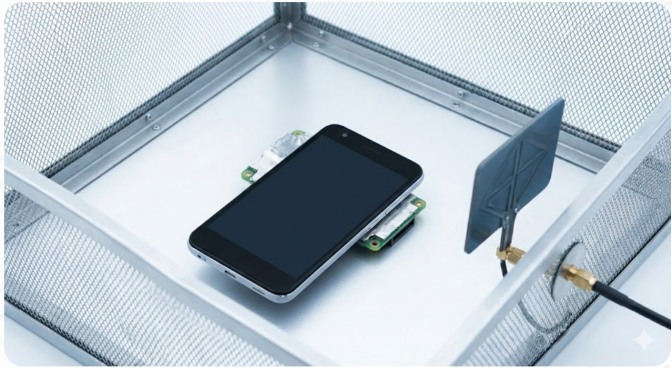
To actually measure board-level shielding performance you can perform transfer-impedance measurements, test in a shielded room or perform near-field scanning. These techniques enable the engineers to narrow down on the amount of attenuation that the shielding is actually providing and to identify any weak points that require correction.
How JLCPCB Delivers Reliable EMI-Shielded PCBs at Scale

The multi-layer fabrication game by JLCPCB is a solid one, and it provides a good base to PCB-level EMI shielding. Accurate layer registration ensures that ground planes are continuous and aligned. The trace geometries of their controlled-impedance fab are consistent, thus you have predictable EMC behaviour. In addition, they do comprehensive DFM inspections to ensure that your ground plane integrity, via-fencing patterns, and copper pours are all as per the design intent before you go to production.
In assembly, the SMT lines nail shielding at JLCPCB can be placed and then soldered with the accuracy required to achieve solid ground contact everywhere on the board. Their combination of fab perfection and assembly expertise translates to having boards that are already ready to pass EMC tests immediately after coming out of the production line.

Frequently Asked Questions (FAQ)
Q. What is EMI shielding, and do all PCBs need it?
EMI shielding uses conductive materials to block electromagnetic interference from entering or leaving circuit sections. Every PCB needs dedicated shielding cans or coatings. Every PCB benefits from basic EMI design practices like continuous ground planes, proper decoupling, and controlled impedance routing.
Q. How does EMI shielding work at the board level?
Board-level EMI shielding works through three mechanisms: reflection, absorption, and proper grounding (providing low-impedance paths for shield currents). Effective shielding combines all three through ground planes, via fencing, and physical shields.
Q. What are the most common EMI shielding materials for PCBs?
The most common materials include copper, tin-plated steel or nickel silver (shielding cans), and conductive polymer coatings. For board-level shielding, the copper already present in your PCB stackup is your most cost-effective shielding material when used properly.
Q. Can via fencing replace physical shielding cans?
Via fencing provides moderate shielding effectiveness (typically 15-30 dB) and is excellent for reducing coupling between board sections. However, for high-isolation requirements (40+ dB), physical shielding cans are still necessary.
Popular Articles
Keep Learning
Navigating the Impedance Landscape: Selecting the Right Impedance for USB, Ethernet, HDMI, and SD Card Interfaces
Introduction In the realm of high-speed digital communication, choosing the right impedance is a critical aspect of successful PCB design. Impedance matching ensures optimal signal integrity, minimizes reflections, and enhances the overall performance of interfaces such as USB, Ethernet, HDMI, and SD Card. In this blog post, we'll explore the importance of impedance, the factors influencing impedance selection, and best practices for ensuring reliable data transmission in these widely used interfaces.......
A Beginners Guide to Impedance Control in PCBs
When a digital signal is transmitted from one point to another, it causes a change in the state of the signal line. This change can be understood as an electromagnetic wave moving through the circuit. Reflection occurs when this wave encounters a boundary between different mediums. At this boundary, some of the wave's energy continues as a signal, while the rest is reflected. This process repeats until the energy is either absorbed by the circuit or dissipated into the environment. For electrical engi......
What is PCB Signal Attenuation: How Signals Weaken Over Distance and How to Mitigate It
Key Takeaways Primary Causes: Signal attenuation is mainly caused by skin effect (conductor loss) and substrate energy absorption (dielectric loss). How to Mitigate: Reduce loss by using wider traces, low-loss materials, controlled impedance, and removing via stubs. JLCPCB Solutions: JLCPCB offers Rogers high-frequency laminates, High-TG FR4, precision impedance control, and backdrilling to protect signal integrity. As a signal travels from the source to the load through PCB conductors, the signal is ......
Understanding Analog and Digital Ground in PCB Design
When working on printed circuit board (PCB) design, proper grounding is crucial for ensuring signal integrity, minimizing noise, and maintaining reliable performance. Two common types of ground planes used in PCB layouts are Analog and Digital ground. In this article, we will explore the differences between analog and digital ground, their significance in PCB design, and best practices for their implementation. Analog Ground vs. Digital Ground Analog ground and digital ground have separate purposes in......
Design Guide for USB-3.0 Differential Signaling
In the world of data transfer, USB 3.0 is the Usain Bolt to USB 2.0’s friendly jogger. USB 2.0 is called “High Speed” and limped along at 480 Mb/s, whereas USB 3.0 SuperSpeed rockets up to 5 Gb/s (over ten times faster). But this speed jump brings full‑duplex operation and new differential transmit (SSTX) and receive (SSRX) pairs on dedicated pins. USB 2.0 D+/D– lines handle enumeration and legacy data, while two new 5 Gb/s high‑speed differential pairs carry SuperSpeed data in each direction. While m......
Understanding Impedance Matching for High-Speed PCB Designs
With the advancement of technology and the ever wider application of integrated circuits, the frequency and speed of electronic signal transmission have been increasing, making it essential for PCB conductors to provide high-performance transmission lines. These transmission lines are responsible for delivering signals from a source to the input of a receiver accurately and completely. This requirement emphasizes the need for impedance matching. Electrical impedance, commonly represented as Z and meas......