Differential Pairs on PCBs: Best Practices for Routing, Impedance Control, and Signal Integrity
7 min
- Introduction: The Importance of Differential Pairs in High-Speed PCBs
- Key Advantages and Common Standards for Differential Pairs
- Essential Design Rules for Reliable Differential Pairs
- Advanced Routing Techniques and Signal Integrity Practices
- Common Challenges in Differential Pair Design and How to Overcome Them
- Conclusion
- FAQ: Common Questions About Differential Pairs
High-speed digital designs increasingly rely on differential pairs to transmit data reliably at rates from several Gbps to tens of Gbps. These paired traces carry signals of equal magnitude but opposite polarity, allowing receivers to reject common-mode noise while preserving the differential signal. Engineers use differential pairs for interfaces like USB, HDMI, PCIe, and Ethernet because they provide superior noise immunity and reduced EMI compared to single-ended traces.
Introduction: The Importance of Differential Pairs in High-Speed PCBs
Fundamentals of Differential Signaling
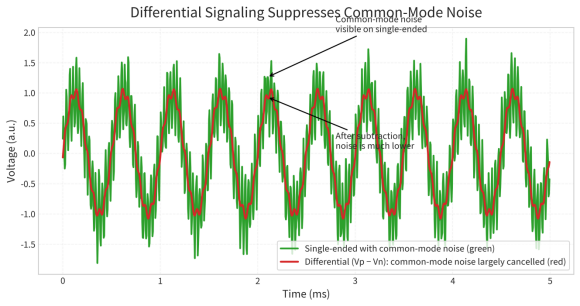
Differential pairs consist of two complementary traces (positive and negative) that propagate signals with opposite polarities. The receiver subtracts the negative from the positive to recover the original data. This subtraction cancels out noise picked up equally on both traces, such as from power supply fluctuations or external interference. In PCB terms, the key parameter is differential impedance—typically 90–100 ohms depending on the standard—which must remain consistent along the entire path to avoid reflections.
Why Differential Pairs Are Essential Today
Data rates have risen dramatically in modern devices, from 480 Mbps in USB 2.0 to 20 Gbps per lane in PCIe 5.0. Single-ended signaling struggles with noise and skew at these speeds, leading to bit errors. Differential pairs tolerate longer trace lengths and harsher environments while emitting less EMI. They have become standard in consumer electronics, automotive infotainment, and data centers where signal integrity directly impacts performance.
Key Advantages and Common Standards for Differential Pairs
Benefits Over Single-Ended Signaling
Differential pairs offer several practical advantages. They provide excellent common-mode rejection, often 20–40 dB better than single-ended lines, which reduces susceptibility to ground bounce and crosstalk. EMI emissions drop because the opposite currents cancel magnetic fields. Return currents stay confined between the pair and its reference plane, minimizing loop area. In noisy environments like automotive or industrial systems, these benefits translate to lower bit error rates and more robust links.
Popular Standards and Typical Impedance Requirements
Most high-speed interfaces specify differential pairs with tight impedance tolerances. Common examples include:
| Standard | Typical Differential Impedance | Data Rate Example | Notes |
| USB 2.0/3.0 | 90 Ω ±15% | 480 Mbps / 5 Gbps | Full-speed and SuperSpeed |
| HDMI 1.4/2.0 | 100 Ω ±10% | Up to 18 Gbps | TMDS pairs |
| PCIe 3.0/4.0 | 100 Ω ±10% | 8–16 GT/s per lane | High tolerance for reflections |
| 1000BASE-T Ethernet | 100 Ω ±10% | 1 Gbps | Twisted pair emulation on PCB |
Table 1: Common differential pair standards and impedance targets.
These values come from interface specifications and require controlled dielectric materials and trace geometry during fabrication.
Essential Design Rules for Reliable Differential Pairs
Impedance Control, Width, Spacing, and Length Matching
Differential impedance is calculated using trace width (W), spacing (S), height to reference plane (H), and dielectric constant (Er). For a typical 100 Ω pair on FR-4, widths of 4–6 mil with spacing 5–8 mil and prepreg thickness 4–6 mil work well. Field solvers like Saturn PCB Toolkit or built-in calculators in Altium/KiCad provide precise values based on stackup. Variations in etching or dielectric can shift impedance 5–10%, so specify tolerances in fabrication notes. Length matching limits intra-pair skew to 5–15 ps (depending on rise time)—use accordion or sawtooth patterns on the longer trace, keeping amplitude low (<3x width) to avoid added inductance or capacitance.
Reference Planes, Return Paths, and Layer Selection
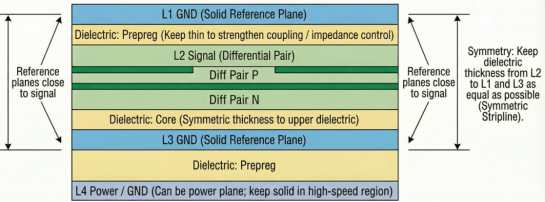
A continuous reference plane (preferably ground) immediately adjacent to the pair is essential for stable impedance and low inductance return. Splitting planes forces return currents to detour, creating common-mode noise. In multilayer designs, prefer inner layers for shielding from external interference, but ensure the stackup is symmetric to control warpage during lamination. For high-layer-count boards, alternate signal and plane layers to provide multiple references. Stitching vias every 5–10 mm around the pair perimeter tie planes together across layers.
Advanced Routing Techniques and Signal Integrity Practices
Coupling Strategies, Via Handling, and Crosstalk Reduction
Tight coupling (S ≈ W) maximizes common-mode rejection but lowers impedance; loose coupling raises impedance for easier matching. Route pairs with constant spacing and avoid sharp bends—use 45-degree angles or arcs with radius >3x width. For vias, minimize stubs by back-drilling or using blind/buried vias; place pair vias symmetrically and surround with ground vias (4–6 per pair) to maintain shielding. Keep pairs at least 5H (height to plane) away from aggressors to limit far-end crosstalk below -40 dB
Simulation Tools and Manufacturing Considerations
HyperLynx or SIwave for pre- and post-layout simulation reveal eye closure or reflections early. TDR testing verifies impedance continuity. Manufacturing factors like copper roughness (low-profile foil preferred), solder mask thickness, and etch uniformity affect loss and skew. Controlled processes achieve ±8–10% impedance accuracy, with test coupons on panels for verification. DFM rules include avoiding acid traps in tight spacing and ensuring minimum drill-to-copper clearance for reliable plating.
Common Challenges in Differential Pair Design and How to Overcome Them
Impedance Discontinuities, Skew, and EMI Issues
Bends, connectors, or layer changes create impedance drops, causing reflections that degrade eye openings. Excessive intra-pair skew converts differential to common-mode, increasing EMI. Solutions include gradual tapers at transitions, tight length tolerance (<0.1 mm for >5 Gbps), and shielding with ground pours or vias.
Role of Professional Fabrication in Resolving Tolerances
Etch variation and dielectric inconsistency can shift impedance 10–15%. Professional fabricators use laser direct imaging for precise patterning, controlled prepreg flow, and impedance coupon testing to hold ±5–10% accuracy. They also optimize stackup for low-loss materials and provide early DFM feedback on via structures or spacing feasibility.

Conclusion
Differential pairs are critical when data rates exceed 1 Gbps, noise margins tighten, or EMI compliance is required—common in modern interfaces like USB-C, PCIe, and high-resolution video. Proper implementation ensures open eyes, low BER, and certification passage.
For reliable results, partner with a fabricator experienced in high-speed boards. JLCPCB offers precise impedance control (±10% standard, tighter on request), multilayer and HDI support for dense routing, and quick-turn prototyping to validate signal integrity early. Their online calculator and DFM checks help refine differential pair parameters before production. Upload your design at jlcpcb.com for instant quoting and fabrication that meets demanding high-speed requirements.

FAQ: Common Questions About Differential Pairs
Q1: What is the main difference between differential and single-ended signaling?
A: Differential uses two complementary traces to cancel common-mode noise, offering better immunity (20–40 dB) and lower EMI than single-ended, which relies on a single trace and ground reference.
Q2: How tight should length matching be for differential pairs?
A: Keep intra-pair skew under 5–15 ps (or <0.1 mm for >5 Gbps signals) to prevent timing errors and mode conversion—use serpentine routing on the longer trace.
Q3: Why is a solid reference plane critical for differential pairs?
A: It ensures consistent impedance, low-inductance return paths, and shielding; plane splits force current detours, creating noise and discontinuities.
Q4: Can I route differential pairs on outer layers?
A: Possible but not ideal—inner layers provide better shielding and impedance stability; outer layers increase susceptibility to external noise and require extra guarding.
Popular Articles
Keep Learning
Stop PCB Crosstalk Before It Becomes a Signal Integrity Problem
Key Takeaways NEXT vs FEXT: NEXT saturates with trace length, while FEXT grows linearly with distance. Spacing & Stackup: Apply the 3W rule and keep traces close to reference planes. Edge Rates: Fast rise times drive crosstalk more than clock frequency. Fab Margins: Etching variations reduce gaps, requiring extra layout clearance. Verification: Use DFM checks and TDR coupons instead of basic continuity tests. PCB crosstalk is the noise one trace pushes into its neighbor, even though the two nets are e......
Navigating the Impedance Landscape: Selecting the Right Impedance for USB, Ethernet, HDMI, and SD Card Interfaces
Introduction In the realm of high-speed digital communication, choosing the right impedance is a critical aspect of successful PCB design. Impedance matching ensures optimal signal integrity, minimizes reflections, and enhances the overall performance of interfaces such as USB, Ethernet, HDMI, and SD Card. In this blog post, we'll explore the importance of impedance, the factors influencing impedance selection, and best practices for ensuring reliable data transmission in these widely used interfaces.......
A Beginners Guide to Impedance Control in PCBs
When a digital signal is transmitted from one point to another, it causes a change in the state of the signal line. This change can be understood as an electromagnetic wave moving through the circuit. Reflection occurs when this wave encounters a boundary between different mediums. At this boundary, some of the wave's energy continues as a signal, while the rest is reflected. This process repeats until the energy is either absorbed by the circuit or dissipated into the environment. For electrical engi......
What is PCB Signal Attenuation: How Signals Weaken Over Distance and How to Mitigate It
Key Takeaways Primary Causes: Signal attenuation is mainly caused by skin effect (conductor loss) and substrate energy absorption (dielectric loss). How to Mitigate: Reduce loss by using wider traces, low-loss materials, controlled impedance, and removing via stubs. JLCPCB Solutions: JLCPCB offers Rogers high-frequency laminates, High-TG FR4, precision impedance control, and backdrilling to protect signal integrity. As a signal travels from the source to the load through PCB conductors, the signal is ......
Understanding Analog and Digital Ground in PCB Design
When working on printed circuit board (PCB) design, proper grounding is crucial for ensuring signal integrity, minimizing noise, and maintaining reliable performance. Two common types of ground planes used in PCB layouts are Analog and Digital ground. In this article, we will explore the differences between analog and digital ground, their significance in PCB design, and best practices for their implementation. Analog Ground vs. Digital Ground Analog ground and digital ground have separate purposes in......
Design Guide for USB-3.0 Differential Signaling
In the world of data transfer, USB 3.0 is the Usain Bolt to USB 2.0’s friendly jogger. USB 2.0 is called “High Speed” and limped along at 480 Mb/s, whereas USB 3.0 SuperSpeed rockets up to 5 Gb/s (over ten times faster). But this speed jump brings full‑duplex operation and new differential transmit (SSTX) and receive (SSRX) pairs on dedicated pins. USB 2.0 D+/D– lines handle enumeration and legacy data, while two new 5 Gb/s high‑speed differential pairs carry SuperSpeed data in each direction. While m......