High Speed PCB Layout Guide for Reliable Signal Control
10 min
- Key Takeaways
- Defining High-Speed Constraints in PCB Design
- Component Placement Strategies in High Speed PCB Layout
- Power Integrity Considerations in High Speed PCB Design Guidelines
- Parasitic Effects in High Speed PCB Layout
- Grounding and Return Path in High Speed PCB Layout Guidelines
- High Speed Layout Routing Techniques
- From Layout to Manufacturable PCB
- Frequently Asked Questions (FAQs)
- Conclusion
Key Takeaways
1. High-speed ≠ high frequency alone — it's defined by signal edge rates and trace electrical length. Treat traces as transmission lines with controlled impedance, not simple wires.
2. Placement is an electrical decision — clustering drivers/receivers, matching differential pairs symmetrically, and keeping decoupling capacitors tight to power pins directly govern signal integrity.
3. Continuous ground planes are non-negotiable — never route high-speed traces across split planes; use stitching vias to maintain return path continuity and minimize loop area.
4. Parasitics are inevitable, manage them early — parasitic capacitance and inductance from trace geometry and vias degrade edges and cause ringing; define constraints and stackup at the start, not after layout.
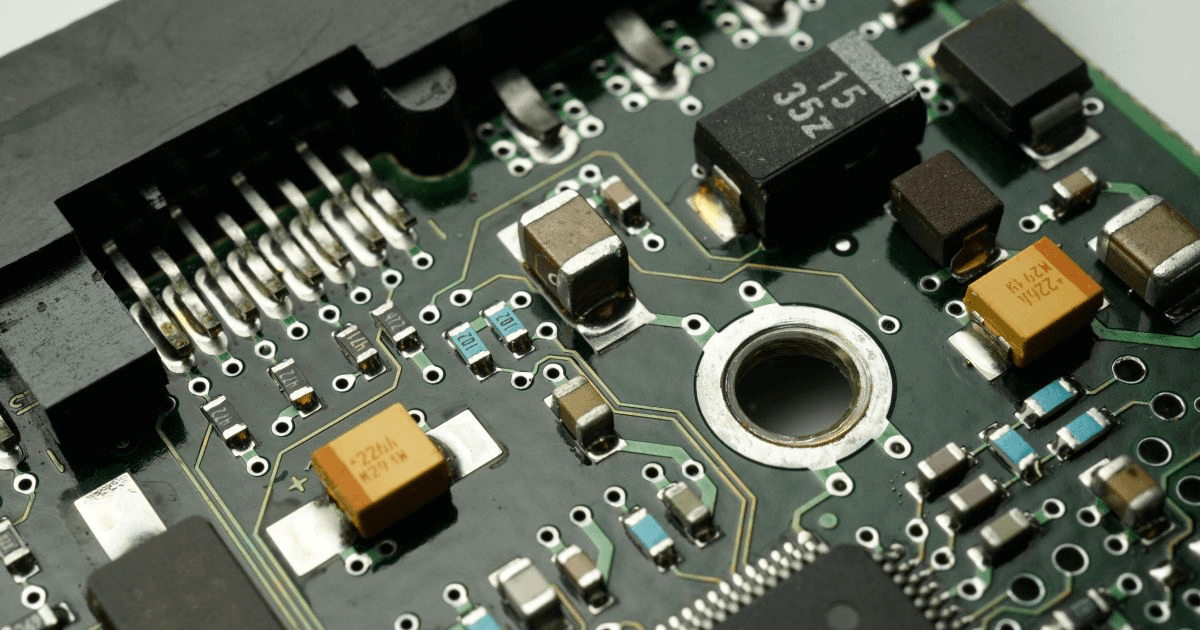
Figure1.Macro view of a populated PCB showing SMD capacitors and resistors in a high-speed layout.
High speed PCB routing refers to a layout design where signal behavior follows transmission line theory. High-speed PCB layout treats traces as controlled impedance paths rather than simple conductors. Signal integrity, power integrity, and electromagnetic effects guide routing decisions in high-speed PCB design.
Traditional PCB routing focuses on electrical connectivity between components. High-speed PCB layout focuses on waveform preservation, timing accuracy, and noise control. Signal edges propagate as electromagnetic waves across traces, which creates reflections and crosstalk. Layout decisions determine impedance continuity, return path stability, and electromagnetic behavior across multilayer stackups and complex routing environments.
Defining High-Speed Constraints in PCB Design
High-speed PCB constraints get defined at the initial design stage. Signal flow mapping identifies critical nets before layout begins. Early planning establishes control over signal integrity and timing behavior.
Signal flow analysis organizes data paths and timing relationships. Critical nets include clock lines, differential pairs, and high-frequency interfaces. Constraint assignment defines impedance targets, trace length limits, and spacing rules. Routing decisions follow these constraints and reduce signal distortion.
Constraint definition embeds layout intent into the design stage. Layer stackup, reference planes, and return path continuity define the electrical structure of the board. Controlled impedance depends on dielectric thickness and trace geometry. Early constraint planning reduces redesign cycles and improves layout accuracy.
Component Placement Strategies in High Speed PCB Layout
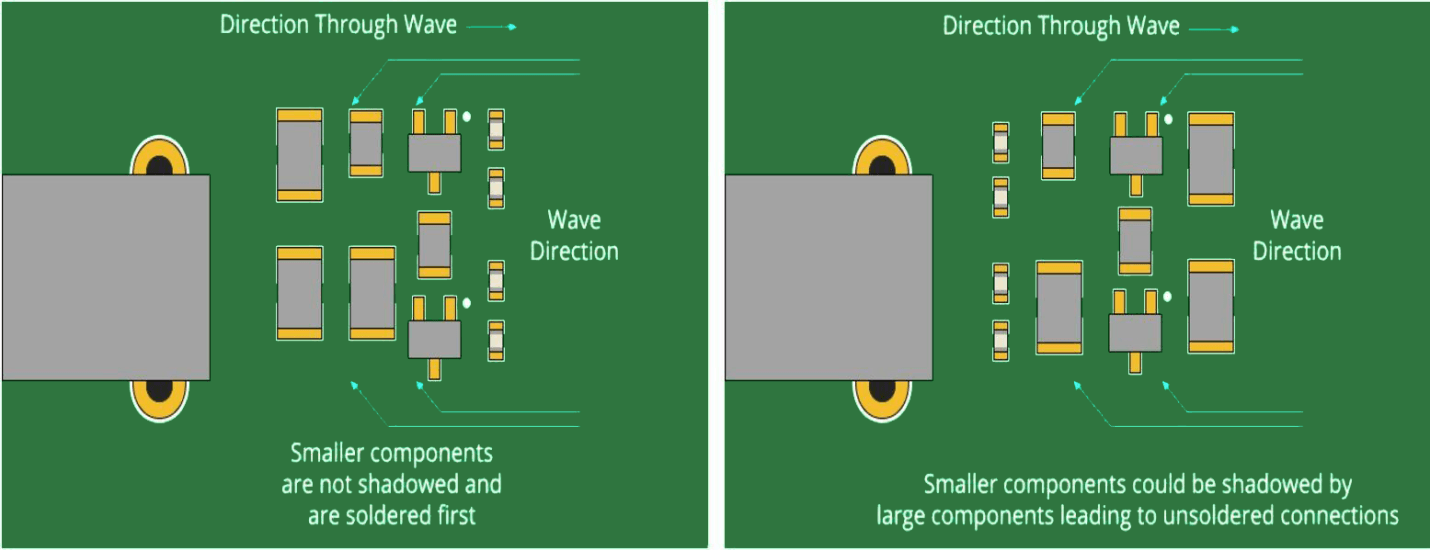
Figure2. Diagram illustrating component shadowing effects during wave soldering on a PCB.
Why Placement Directly Affects High-Speed Performance?
Component placement functions as an electrical design step in high-speed PCB layout. Placement defines signal path length, return path continuity, and impedance stability. Poor placement increases reflections, delay, crosstalk, and waveform distortion.
High-speed PCB layout requires minimal distance between drivers and receivers within critical signal paths. Shorter paths reduce propagation delay and limit signal attenuation across traces. Placement errors introduce impedance discontinuities that distort edges and degrade timing margins. Improper placement near plane splits disrupts return paths and increases loop inductance.
Component arrangement influences electromagnetic coupling across the entire board structure. Closely spaced high-speed nets increase capacitive and inductive coupling between traces. Parallel routing sections amplify crosstalk and noise transfer between signals. Spacing, orientation, and layer assignment control interference in high-speed PCB design. These parameters preserve signal integrity across dense routing regions.
Optimizing Placement for Critical Signals and Paths
Placement prioritization surrounds critical high-speed signals in PCB design. Clock sources, processors, and memory devices form tight clusters. This arrangement reduces latency and preserves timing relationships.
Differential signal components require symmetrical placement. Equal path geometry preserves signal balance and reduces noise sensitivity. Misalignment creates skew and signal degradation.
Power components require placement close to load devices. Decoupling capacitors sit near power pins to stabilize voltage. This arrangement reduces supply noise and improves high-speed PCB performance.
Power Integrity Considerations in High Speed PCB Design Guidelines
Power integrity acts as a core requirement in high-speed PCB design. Power distribution networks influence voltage stability across high-frequency circuits. Poor power integrity introduces noise that degrades signal performance.
Decoupling Strategies for High-Speed Circuits
Decoupling capacitors sit close to integrated circuit power pins. Short connections reduce parasitic inductance within the current path. Each capacitor targets specific frequency ranges within the power spectrum.
High-speed PCB layouts use multiple capacitor values for broadband decoupling. Small capacitors filter high-frequency noise near the device. Larger capacitors stabilize lower-frequency variations within the power network.
Reducing Power Noise Through Layout Optimization
Layout structure controls current flow within the power distribution network. Solid power and ground planes reduce impedance and voltage fluctuation. Continuous planes maintain stable reference conditions for high-speed signals.
Designers minimize loop area between power and ground paths. Smaller loops reduce electromagnetic radiation and switching noise. Proper placement of vias and planes improves current return efficiency and power stability.
Parasitic Effects in High Speed PCB Layout
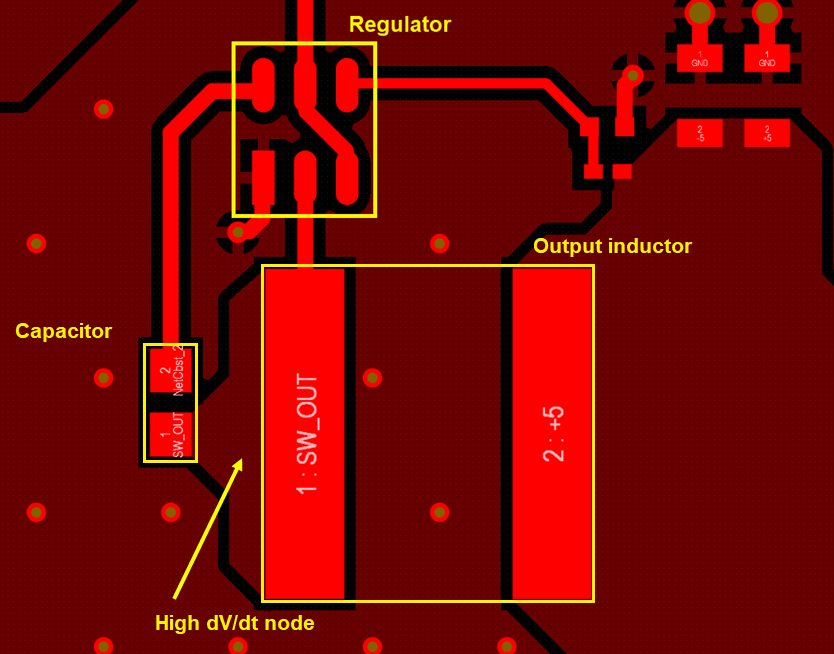
Figure3. Voltage regulator PCB layout highlighting high dV/dT nodes and decoupling placement.
Every high-speed PCB layout contains inherent parasitic effects. Parasitic capacitance and parasitic inductance appear within traces, pads, and vias. These unintended electrical properties arise from physical geometry and material structure.
Sources of Parasitic Capacitance and Inductance
Parasitic capacitance forms between adjacent conductors and reference planes. Trace width, spacing, and dielectric thickness influence this capacitance. Closely spaced traces increase electric field coupling between signals.
Parasitic inductance develops along current paths and via structures. Longer traces and narrow conductors increase inductive behavior. Vias introduce additional inductance due to vertical current transitions.
Impact of Parasitics on Signal Integrity
Parasitic capacitance slows signal edges and increases propagation delay. Excess capacitance distorts waveform shape and reduces timing accuracy. High-speed signals lose edge definition under capacitive loading.
Parasitic inductance causes voltage spikes and ringing within signal paths. Inductive effects increase impedance variation and reflection. Combined parasitic effects degrade signal integrity and increase electromagnetic interference.
Grounding and Return Path in High Speed PCB Layout Guidelines
Grounding acts as a reference system for high-speed PCB signals. Ground planes define return paths for signal currents. Stable return paths maintain signal integrity and reduce electromagnetic noise.
Importance of Continuous Ground Planes
Continuous ground planes create low impedance return paths beneath signal traces. High-speed PCB layout relies on uninterrupted reference planes for stable transmission. Solid planes reduce voltage fluctuation and maintain consistent impedance.
Ground continuity supports predictable current flow across the board. Signal currents follow the path of least impedance under traces. Continuous planes minimize loop area and reduce radiation.
High Speed Layout Routing Techniques
Engineers apply routing discipline in high-speed PCB layout based on high-speed layout guidelines to control signal behavior. Routing decisions affect reflections, crosstalk, and electromagnetic emission. Proper trace geometry maintains waveform integrity across the board.For a deeper dive into routing techniques with practical examples, see our High-Speed PCB Routing Guidelines .
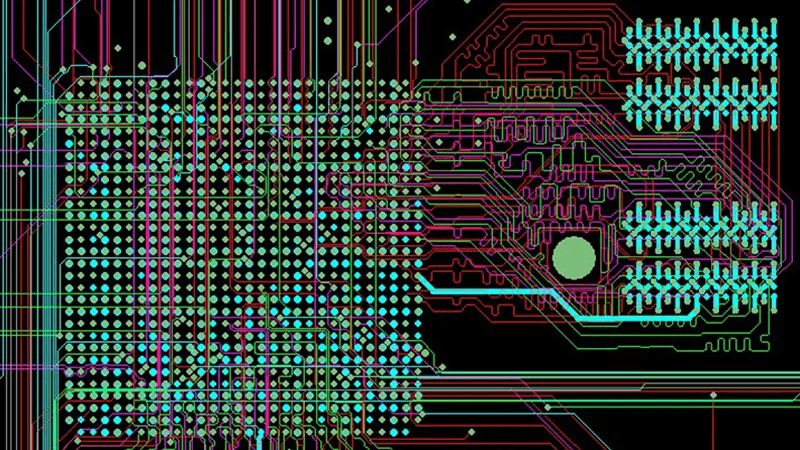
Figure4. High-density BGA escape routing with via fanout and controlled-impedance trace design.
Trace Length Control and Loop Area Reduction
Trace length matching maintains timing alignment across related signals. Unequal lengths introduce skew and timing errors in high-speed PCB signals. Matched routing preserves synchronous data transfer between components.
Loop area reduction limits electromagnetic radiation from signal paths. Smaller loops reduce inductive coupling between adjacent nets. Tight routing around reference planes stabilizes current return paths.
Controlled Impedance and Differential Routing
Controlled impedance routing maintains consistent electrical characteristics along traces. Designers adjust trace width, spacing, and dielectric stackup for impedance targets. Stable impedance reduces reflections and signal distortion.
Differential routing uses paired traces for balanced signal transmission. Equal length and spacing maintain signal symmetry across pairs. Balanced geometry reduces noise sensitivity and improves high-speed PCB signal integrity.
Avoiding Return Path Disruptions
Return path disruptions occur due to plane splits, gaps, or routing across voids. These interruptions force the current to detour, which increases the loop area. Larger loops increase electromagnetic interference and signal distortion.
High-speed traces avoid routing across split planes in PCB layout. Split planes interrupt return current paths and increase loop area. These interruptions degrade signal integrity and increase electromagnetic emission.
Stitching vias reconnects ground regions across separated planes. Via placement restores the return current continuity under the signal paths. Grounding strategy maintains stable current flow across high-speed PCB structures.
From Layout to Manufacturable PCB
Manufacturing rules convert high-speed PCB layout into fabrication-ready data. Design transfer defines layer stack, drill files, and impedance targets. Fabrication constraints validate final geometry and output quality.
Differences Between Conventional and High-Speed PCB Design
Conventional PCB design focuses on connectivity and component placement. High-speed PCB design focuses on signal integrity and controlled electrical behavior. Routing decisions affect timing, impedance, and electromagnetic performance.
High-speed PCB layouts require tighter tolerances for trace geometry and spacing. Fabrication processes enforce limits on copper thickness and dielectric consistency. Conventional designs tolerate wider variation in electrical parameters.
Balancing Design Rules with Real-World Constraints
Electrical requirements align with manufacturing capabilities in high-speed PCB design. Stackup selection defines impedance targets and layer distribution. Fabrication limits shape trace width and via structures.
Manufacturing review checks drill sizes, copper balance, and clearance rules. Layout adjustments match process constraints without degrading signal behavior. Final validation confirms reliable high-speed PCB production output.
High-speed PCB layout design requires careful control of constraints, power integrity, parasitics, grounding, and routing strategies. JLCPCB provides end-to-end PCB layout support that aligns signal integrity with manufacturable output.
Frequently Asked Questions (FAQs)
Q: What is the best trace width for high-speed PCB signals?
Trace width depends on target impedance and stackup geometry. Trace width depends on dielectric height and copper thickness in PCB design. Controlled impedance defines routing dimensions for stable signal behavior.
Q: How do vias affect signal integrity in high-speed PCB design?
Vias introduce inductance and disrupt signal continuity. Long via barrels increases delay and reflection risk. Via count decreases across critical nets in PCB design. Back drilling removes unused via stubs for improved signal integrity.
Q: What is the best PCB stackup for high-speed signals?
A symmetrical stackup with solid ground planes improves return path stability. Signal layers sit adjacent to reference planes in PCB design. This structure reduces impedance variation and electromagnetic interference across routing layers.
Q: How to reduce crosstalk in high-speed PCB routing?
Crosstalk forms from electromagnetic coupling between adjacent traces. Close spacing and parallel routing increase interference levels. Spacing increases between traces, and parallel routing length reduces coupling effects in PCB design.
Q: What is the best dielectric material for high-speed PCB design?
Dielectric constant affects signal velocity and impedance control. Material variation changes propagation delay across traces. Stable dielectric properties maintain consistent high-frequency performance across the PCB.
Conclusion
High-speed PCB layout demands treating every trace as a controlled-impedance path, every plane as a return current reference, and every placement decision as an electrical one. From constraint definition through routing discipline to manufacturing handoff, signal integrity, power integrity, and EMI control must drive the process—not just connectivity. Ready to start your next project? Get professional high speed PCB layout support from JLCPCB to turn your design into a manufacturable, signal-clean board.
Keep Learning
HDMI PCB Layout Guidelines:Impedance & Length Matching
Key Takeaways Route the four TMDS pairs as 100 Ω differential pairs, and hold that value through vias, pads, and the connector. Match the P and N traces in each pair first, then match the pairs to each other within your silicon vendor's limits. Keep a solid reference plane under the whole route. Never cross a split. Put ESD protection as close to the connector as practical, so surge current is diverted early. Check the signaling type first. TMDS matching rules do not apply to HDMI 2.1 FRL. Introductio......
RGMII Routing Guidelines for Reliable Gigabit PCB Design
Key Takeaways RGMII is a 12-signal, single-ended, source-synchronous parallel interface; its TX and RX paths are separate timing groups. Match TXD[3:0] and TX_CTL to TXC. Match RXD[3:0] and RX_CTL to RXC. Do not match TX against RX. Budget the aggregate clock-to-data skew separately in each direction, and avoid unintentionally stacking a full PCB delay with an enabled silicon delay. Treat 50 Ω ±10%, 20 mil matching and a 6 inch route limit as TI layout guidance, not universal clauses of the RGMII spec......
Ethernet PCB Routing: Guidelines for MAC, PHY, and RJ45
Key Takeaways Route every MDI pair as a 100 Ω differential transmission line with ±10% control, unless the selected PHY or cable specification requires a different target. TI recommends keeping each MDI route below 2 in and matching P to N within 20 mil for 1 Gb/s or 50 mil for 10/100 Mb/s. Keep metal out from under discrete magnetics, separate chassis ground from board ground, and preserve a continuous reference beneath the routed pairs. TI’s Ethernet-specific guidance places suitable ESD protection ......
SFP Pinout Explained: PCB Layout & Design Guide
Key Takeaways The SFP pinout follows a standard 20-pin edge connector, with dedicated pins for power, ground, differential data pairs, and I2C control signals. The Tx and Rx differential pairs carry the high-speed optical or copper signal and need controlled 100 ohm differential impedance through the entire routing path. Low-speed control pins (TX_FAULT, TX_DISABLE, MOD_ABS, LOS, Rate Select/RS1) use standard single-ended routing and don't need impedance matching. Placing the SFP cage near the board e......
DDR5 PCB Layout Guidelines: Design Rules and Best Practices
Key Takeaways DDR5 raises the stakes on layout: 1.1V rails and data rates up to 8800 MT/s leave far less margin for error than DDR4 did. Target around 40–45 Ω single-ended for DQ/CA and 80 Ω differential for CLK/DQS — exact values come from vendor guidelines — and hold them through every via and connector. Keep DQ and DQS length matching within about 5 mil per byte lane, and never route a DDR5 signal over a gap in its reference plane. Plan for 8 to 12 layers with dedicated ground references next to ev......
Via Stitching in PCB Design: A Complete Guide
Key Takeaways Via stitching bonds same-net copper across layers with repeated plated vias, most often ground, to cut high-frequency impedance between regions. A grounded via next to a signal layer transition gives return current a short local path and helps confine the field around the via. Via fences along board edges and RF cavities suppress edge radiation, but their isolation is geometry- and frequency-dependent, with no universal dB value. Keep stitching pitch at or below one-twentieth of the in-b......